

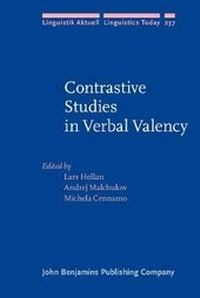
Contrastive Studies in Verbal Valency
Published on 30. April 2017
Book
Hardback
476 pages
978-90-272-5720-8 (ISBN)
Description
In recent years, issues of verbal valency, valency alternations and verb classes have seen a new upsurge of interest from a variety of perspectives. This book comprises articles investigating valency phenomena on a contrastive basis within Romance, Germanic and Slavic, and also in Basque and in the West-African language Ga, as well as classical Greek and Sanskrit. Phenomena include transitive and ditransitive constructions and alternations, involving reflexives, cognate objects, 'null' objects, case (in its syntagmatic and paradigmatic aspects), and infinitives, mostly in a synchronic perspective. Aiming at a closer understanding of the range of regularities falling within the concept of valency frames, the book offers a representative array of current assumptions, hypotheses, methodologies and new findings within the overall field. The volume will provide a valuable resource for researchers and students both in general linguistics and in the relevant language particular disciplines.
More details
Series
Language
English
Place of publication
Amsterdam
Netherlands
Target group
Professional and scholarly
Weight
990 gr
ISBN-13
978-90-272-5720-8 (9789027257208)
Copyright in bibliographic data and cover images is held by Nielsen Book Services Limited or by the publishers or by their respective licensors: all rights reserved.
Schweitzer Classification
Other editions
Additional editions

Lars Hellan
Contrastive Studies in Verbal Valency
E-Book
04/2017
1st Edition
John Benjamins Publishing Company
€123.99
Available for download
Persons
Content
1. Mary Esther Kropp Dakubu In Memoriam; 2. Introduction. Issues in contrastive valency studies (by Hellan, Lars); 3. Part I. Argument coding: Case theory and case/valency frames; 4. Multiple case binding - The principled underspecification of case exponency (by Abraham, Werner); 5. Infinitives: A comparative German-Norwegian study (by Beermann, Dorothee); 6. A labeling system for valency: Linguistic coverage and applications (by Kropp Dakubu, Mary Esther); 7. Non-canonical valency patterns in Basque, variation and evolution (by Creissels, Denis); 8. Part II. Valency rearranging alternations; 9. Exploring the domain of ditransitive constructions: Ditransitive splits and ditransitive alternations across languages (by Malchukov, Andrej); 10. Cognate constructions in Italian and beyond: A lexical semantic approach (by Melloni, Chiara); 11. Object omission and the semantics of predicates in Italian in a comparative perspective (by Cennamo, Michela); 12. On animacy restrictions for the null object in Brazilian Portuguese (by Cyrino, Sonia Maria Lazzarino); 13. Part III. Voice and valency changing (uncoded/coded) alternations and markers; 14. Between Passive and Middle: Evidence from Greek and beyond (by Kulikov, Leonid); 15. Valency alternations between inflection and derivation: A contrastive analysis of Italian and German (by Gaeta, Livio); 16. Pronominal verbs across European languages: What Spanish alternating pronominal verbs reveal (by Teomiro Garcia, Ismael Ivan); 17. Semantic constraints on the reflexive/non-reflexive alternation of Romanian unaccusatives (by Dragomirescu, Adina); 18. Circumfixed causatives in Polish against a panorama of active and non-active voice morphology (by Malicka-Kleparska, Anna); 19. Language index; 20. Subject index