

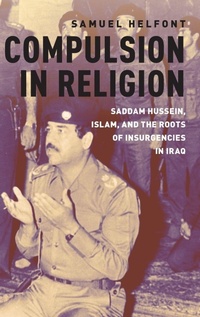
Compulsion in Religion
Saddam Hussein, Islam, and the Roots of Insurgencies in Iraq
Published on 17. May 2018
Book
Hardback
304 pages
978-0-19-084331-1 (ISBN)
Description
Samuel Helfont draws on extensive research with Ba'thist archives to investigate the roots of the religious insurgencies that erupted in Iraq following the American-led invasion in 2003. In looking at Saddam Hussein's policies in the 1990s, many have interpreted his support for state-sponsored religion as evidence of a dramatic shift away from Arab nationalism toward political Islam. While Islam did play a greater role in the regime's symbols and Saddam's statements in the 1990s than it had in earlier decades, the regime's internal documents challenge this theory.
The "Faith Campaign" Saddam launched during this period was the culmination of a plan to use religion for political ends, begun upon his assumption of the Iraqi presidency in 1979. At this time, Saddam began constructing the institutional capacity to control and monitor Iraqi religious institutions. The resulting authoritarian structures allowed him to employ Islamic symbols and rhetoric in public policy, but in a controlled manner. Saddam ultimately promoted a Ba'thist interpretation of religion that subordinated it to Arab nationalism, rather than depicting it as an independent or primary political identity.
The point of this examination of Iraqi history, other than to correct the current understanding of Saddam Hussein's political use of religion throughout his presidency, is to examine how Saddam's controlled use of religion was dismantled during the US-Iraq war, and consequently set free extremists that were suppressed under his regime. When the American-led invasion destroyed the regime's authoritarian structures, it unwittingly unhinged the forces that these structures were designed to contain, creating an atmosphere infused with religion, but lacking the checks provided by the former regime. Groups such as the Sadrists, al-Qaida, and eventually the Islamic State emerged out of this context to unleash the insurgencies that have plagued post-2003 Iraq.
The "Faith Campaign" Saddam launched during this period was the culmination of a plan to use religion for political ends, begun upon his assumption of the Iraqi presidency in 1979. At this time, Saddam began constructing the institutional capacity to control and monitor Iraqi religious institutions. The resulting authoritarian structures allowed him to employ Islamic symbols and rhetoric in public policy, but in a controlled manner. Saddam ultimately promoted a Ba'thist interpretation of religion that subordinated it to Arab nationalism, rather than depicting it as an independent or primary political identity.
The point of this examination of Iraqi history, other than to correct the current understanding of Saddam Hussein's political use of religion throughout his presidency, is to examine how Saddam's controlled use of religion was dismantled during the US-Iraq war, and consequently set free extremists that were suppressed under his regime. When the American-led invasion destroyed the regime's authoritarian structures, it unwittingly unhinged the forces that these structures were designed to contain, creating an atmosphere infused with religion, but lacking the checks provided by the former regime. Groups such as the Sadrists, al-Qaida, and eventually the Islamic State emerged out of this context to unleash the insurgencies that have plagued post-2003 Iraq.
Reviews / Votes
Compulsion in Religion is the definitive account of the religious policies of Saddam's regime and mosque-state relations in Ba?thist Iraq. The work will be of interest to scholars of Iraq, religion and comparative politics, but it is also accessible to general readers. It stands as a corrective to several variants of the narrative positing that the religious policies of Saddam's regime were responsible for the eventual rise of ISIS a decade after the former's toppling. * Journal of Contemporary Iraq and the Arab World * Samuel Helfont has convincingly clarified a number of key factors that eluded most Americans two decades ago. That alone makes Compulsion in Religion essential reading for anyone wishing to understand recent Iraqi and American history * Jonathan M. House, Michigan War Studies Review * Compulsion in Religion was a timely contribution. It provides a nuanced understanding of Saddam's religious policies, based on the regime's internal documents, and sheds light on some of the unintended consequences of the 2003 war. * Michael Brill, Princeton University, The Middle East Journal * Helfont gives us a compelling picture of religious life under Saddam. This book can serve as an invaluable resource for anyone who wants to understand Iraq and its sectarian conflicts better. The Western media and politicians love to paint Iraq in single colors, focusing on corruption or the constant violence. Helfont gives us a nuanced and rich view of the Iraqi religious landscape. * Joshua Karnes, H-Net * Compulsion in Religion is the definitive account of the religious policies of Saddam's regime and mosque-state relations in Ba'thist Iraq. It will be of interest to scholars of Iraq, religion, comparative politics, and general readers searching for an antidote to inaccurate information on the subject. * Middle East Journal * This work is indispensable for scholars of religion and authoritarianism as a hypothesis-generating case study and is a welcome contribution to the field of religion and politics in particular. * Ann Wainscott, Perspectives in Politics * [S]cholars have been hard at work refining and challenging conventional narratives regarding Ba'thist Iraq. Compulsion in Religion forms a significant contribution to this more general effort. ... [It] will be of great interest to students of Iraqi history and modern Iraqi politics alike. * Cole Bunzel, Yale Law School, Orbis * [A] fascinating new book. * Gareth Smyth, The Arab *More details
Language
English
Place of publication
New York
United States
Target group
Professional and scholarly
Dimensions
Height: 240 mm
Width: 161 mm
Thickness: 21 mm
Weight
625 gr
ISBN-13
978-0-19-084331-1 (9780190843311)
Copyright in bibliographic data and cover images is held by Nielsen Book Services Limited or by the publishers or by their respective licensors: all rights reserved.
Schweitzer Classification
Other editions
Additional editions
E-Book
03/2018
1st Edition
OUP eBook
€9.99
Available for download
E-Book
03/2018
1st Edition
OUP eBook
€9.99
Available for download
Person
Samuel Helfont is Lecturer in International Relations at the University of Pennsylvania and Senior Fellow at the Foreign Policy Research Institute in Philadelphia.
Content
Preface and Acknowledgements
Introduction: Religion and Authoritarianism in Saddam's Iraq
Part I: The Penetration of Iraq's Religious Landscape 1979-1989
Chapter 1: Saddam Takes Control
Chapter 2: Co-opting and Coercing Religion in Saddam's Iraq
Chapter 3: Co-opting and Coercing Shi'ism
Chapter 4: Suppressing the Islamist Opposition
Chapter 5: Addressing the Limits of Coercion and Co-optation
Part II: The Gulf War and its Aftermath 1990-1993
Chapter 6: Continuity and Change in the Gulf War
Chapter 7: Iraq's Religious Landscape in the Wake of the Gulf War
Part III: The Faith Campaign 1993-2003
Chapter 8: A Transformed Religious Landscape
Chapter 9: The Regime and the Shi'is in the 1990s
Chapter 10: Mechanisms of Control
Chapter 11: Putting the System to Work
Part IV: The Invasion of Iraq War and the Emergence of Religious Insurgencies
Chapter 12: American Misconceptions about Iraq and the 2003 Invasion
Chapter 13: Emergence of Religious Insurgencies in Iraq
Conclusion: Saddam the Counter-Insurgent and other Reflections on Ruling Iraq
Notes
Bibliography
Index
Introduction: Religion and Authoritarianism in Saddam's Iraq
Part I: The Penetration of Iraq's Religious Landscape 1979-1989
Chapter 1: Saddam Takes Control
Chapter 2: Co-opting and Coercing Religion in Saddam's Iraq
Chapter 3: Co-opting and Coercing Shi'ism
Chapter 4: Suppressing the Islamist Opposition
Chapter 5: Addressing the Limits of Coercion and Co-optation
Part II: The Gulf War and its Aftermath 1990-1993
Chapter 6: Continuity and Change in the Gulf War
Chapter 7: Iraq's Religious Landscape in the Wake of the Gulf War
Part III: The Faith Campaign 1993-2003
Chapter 8: A Transformed Religious Landscape
Chapter 9: The Regime and the Shi'is in the 1990s
Chapter 10: Mechanisms of Control
Chapter 11: Putting the System to Work
Part IV: The Invasion of Iraq War and the Emergence of Religious Insurgencies
Chapter 12: American Misconceptions about Iraq and the 2003 Invasion
Chapter 13: Emergence of Religious Insurgencies in Iraq
Conclusion: Saddam the Counter-Insurgent and other Reflections on Ruling Iraq
Notes
Bibliography
Index