

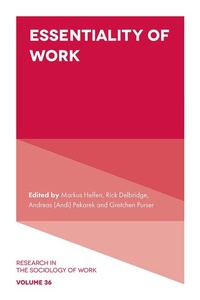
Essentiality of Work
Published on 3. October 2024
Book
Hardback
208 pages
978-1-83608-149-4 (ISBN)
Description
The Covid-19 pandemic both popularized and politicized the designation of essential work. Interrogating the dialectics of essential work, this volume of Research in the Sociology of Work presents original research that explores the essentiality of work and highlights the experiences of essential workers during the pandemic, drawing on empirical studies in Canada, Germany, the United Kingdom and the United States. Demonstrating an enduring struggle for recognition and dignity, as well as for revaluing and materially rewarding essential work, contributors examine the emotional labour involved in gendered care work, the impact of COVID-19 on residential care work, the politics of essentiality and the diversity and intersectional inequality of essential workforces. The final chapters are the first of a new recurring section spotlighting ethnography by presenting both new empirical research and in-depth reviews of extant contributions. Raising pressing questions about the essence of work and its place in contemporary society, Essentiality of Work inspires new debates about the centrality of the work experience and how labour is understood in modern life both for those undertaking work as well as those who benefit.
More details
Series
Language
English
Place of publication
Bingley
United Kingdom
Target group
Professional and scholarly
Product notice
sewn/stitched
Cloth over boards
Dimensions
Height: 232 mm
Width: 160 mm
Thickness: 17 mm
Weight
430 gr
ISBN-13
978-1-83608-149-4 (9781836081494)
Copyright in bibliographic data and cover images is held by Nielsen Book Services Limited or by the publishers or by their respective licensors: all rights reserved.
Schweitzer Classification
Other editions
Additional editions
Markus Helfen | Rick Delbridge | Andreas Pekarek
Essentiality of Work
E-Book
10/2024
1st Edition
Emerald Publishing Limited
€189.99
Available for download
Persons
Markus Helfen is Senior Research Fellow in the Hertie School as well as a Private Lecturer at Freie Universitaet, Germany.
Rick Delbridge is Professor of Organizational Analysis at Cardiff Business School and Co-Convenor of the Centre for Innovation Policy Research, Cardiff University, UK.
Andreas (Andi) Pekarek is Senior Lecturer in the Department of Management and Marketing at the University of Melbourne, Australia.
Gretchen Purser is Associate Professor of Sociology at the Maxwell School of Citizenship and Public Affairs at Syracuse University, USA.
Rick Delbridge is Professor of Organizational Analysis at Cardiff Business School and Co-Convenor of the Centre for Innovation Policy Research, Cardiff University, UK.
Andreas (Andi) Pekarek is Senior Lecturer in the Department of Management and Marketing at the University of Melbourne, Australia.
Gretchen Purser is Associate Professor of Sociology at the Maxwell School of Citizenship and Public Affairs at Syracuse University, USA.
Content
Chapter 1. Essential Work, Inessential Workers?; Markus Helfen, Rick Delbridge, Andreas (Andi) Pekarek, and Gretchen Purser
Chapter 2. Doing Essential 'Dirty Work': Making Visible the Emotion Management Skills in Gendered Care Work; Anna Milena Galazka and Sarah Jenkins
Chapter 3. Defining Essential: How Custodial Labor Became Synonymous With Safety During the COVID-19 Pandemic; Annie J. Murphy
Chapter 4. Fear and Professionalism on the Front Line: Emotion Management of Residential Care Workers Through the Lens of COVID-19 as a 'Breaching Experiment'; Valeria Pulignano, Me-Linh Riemann, Carol Stephenson, and Markieta Domecka
Chapter 5. The Politics of Essentiality: Praise for Dirty Work During the COVID-19 Pandemic; Nancy Cote, Jean-Louis Denis, Steven Therrien, and Flavia Sofia Ciafre
Chapter 6. Essential Workers in the United States: An Intersectional Perspective; Caroline Hanley and Enobong Hannah Branch
A Note From the Editors: Introducing the "Spotlight on Ethnography"
Chapter 7. Floral Ethics and Aesthetics: Understanding Professional Expertise at Work; Isabelle Zinn
Chapter 8. Ethnographic Studies of Essential Work: Jana Costas' 'Dramas of Dignity' and Peter Birke's 'Grenzen Aus Glas' as Two German Exemplars; Markus Helfen
Chapter 9. "More Than a Slight Ache:" On the Ethnographic Sensibility and Enduring Relevance of Studs Terkel's Working; Gretchen Purser
Chapter 2. Doing Essential 'Dirty Work': Making Visible the Emotion Management Skills in Gendered Care Work; Anna Milena Galazka and Sarah Jenkins
Chapter 3. Defining Essential: How Custodial Labor Became Synonymous With Safety During the COVID-19 Pandemic; Annie J. Murphy
Chapter 4. Fear and Professionalism on the Front Line: Emotion Management of Residential Care Workers Through the Lens of COVID-19 as a 'Breaching Experiment'; Valeria Pulignano, Me-Linh Riemann, Carol Stephenson, and Markieta Domecka
Chapter 5. The Politics of Essentiality: Praise for Dirty Work During the COVID-19 Pandemic; Nancy Cote, Jean-Louis Denis, Steven Therrien, and Flavia Sofia Ciafre
Chapter 6. Essential Workers in the United States: An Intersectional Perspective; Caroline Hanley and Enobong Hannah Branch
A Note From the Editors: Introducing the "Spotlight on Ethnography"
Chapter 7. Floral Ethics and Aesthetics: Understanding Professional Expertise at Work; Isabelle Zinn
Chapter 8. Ethnographic Studies of Essential Work: Jana Costas' 'Dramas of Dignity' and Peter Birke's 'Grenzen Aus Glas' as Two German Exemplars; Markus Helfen
Chapter 9. "More Than a Slight Ache:" On the Ethnographic Sensibility and Enduring Relevance of Studs Terkel's Working; Gretchen Purser