

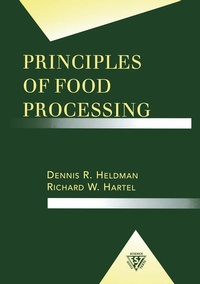
Principles of Food Processing
Published on 15. April 2013
Book
Paperback/Softback
XV, 288 pages
978-1-4613-5870-1 (ISBN)
Description
The approach to teaching the concepts offood processing to the undergrad uate food science major has evolved over the past 40 years. In most under graduate food science curricula, food processing has been taught on a commodity basis. In many programs, several courses dealt with processing with emphasis on a different commodity, such as fruits and vegetables, dairy products, meat products, and eggs. In most situations, the emphasis was on the unique characteristics of the commodity and very little empha sis on the common elements associated with processing of the different commodities. Quite often the undergraduate student was allowed to select one or two courses from those offered in order to satisfy the minimum standards suggested by the Institute of Food Technologists. The current 1FT minimum standards suggest that the undergradu ate food science major be required to complete at least one food processing course. The description of this course is as follows: One course with lecture and laboratory which covers general characteristics of raw food materials, principles offood preserva tion, processing factors that influence quality, packaging, water and waste management, and sanitation. Prerequisites: general chemistry, physics, and general microbiology.
More details
Series
Edition
Softcover reprint of the original 1st ed. 1997
Language
English
Place of publication
New York
United States
Target group
Professional and scholarly
Research
Illustrations
XV, 288 p.
Dimensions
Height: 254 mm
Width: 178 mm
Thickness: 17 mm
Weight
583 gr
ISBN-13
978-1-4613-5870-1 (9781461358701)
DOI
10.1007/978-1-4615-2091-7
Schweitzer Classification
Other editions
Additional editions

Dennis R. Heldman | Richard W. Hartel
Principles of Food Processing
Book
09/1997
Chapman and Hall
€55.71
Article exhausted; check different version
Content
1 Introduction.- 2 Thermal Processing Principles.- 3 Pasteurization and Blanching.- 4 Commercial Sterilization.- 5 Refrigerated Storage.- 6 Freezing and Frozen-Food Storage.- 7 Liquid Concentration.- 8 Dehydration.- 9 Other Separation Processes.- 10 Food Extrusion.