

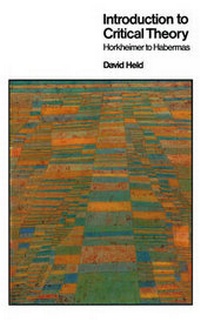
Introduction to Critical Theory
Horkheimer to Habermas
1st Edition
Will be published approx. on 21. September 1989
Book
Paperback/Softback
520 pages
978-0-7456-0769-6 (ISBN)
Description
The writings of the Frankfurt school, in particular of Horkheimer, Adorno, Marcuse, and Jurgen Habermas, caught the imagination of the radical movements of the 1960s and 1970s and became a key element in the Marxism of the New Left. Partly due to their rise to prominence during the political turmoil of the 1960s, the work of these critical theorists has been the subject of continuing controversy in both political and academic circles. However, their ideas are frequently misunderstood.
In this major work, now available from Polity Press, David Held presents a much-needed introduction to, and evaluation of, critical theory. Some of the major themes he considers are critical theory's relation to Marx's critique of political economy, Freudian psychoanalysis, aesthetics and the philosophy of history. There is also an extended discussion of critical theory's substantive contribution to the analysis of capitalism, culture, the family, the individual, as well as its contribution to epistemology and methodology.
In this major work, now available from Polity Press, David Held presents a much-needed introduction to, and evaluation of, critical theory. Some of the major themes he considers are critical theory's relation to Marx's critique of political economy, Freudian psychoanalysis, aesthetics and the philosophy of history. There is also an extended discussion of critical theory's substantive contribution to the analysis of capitalism, culture, the family, the individual, as well as its contribution to epistemology and methodology.
Reviews / Votes
'The best introduction to, and analysis of the work of the leading figures in the 'Frankfurt School' that has yet appeared. It should become the standard work in the field.' Political Studies 'An important and usefu book.' Journal of the History of Sociology'The book is clearly written, packed with information and biographical references, and most of all, well-organized.' Contemporary Sociology
'David Held's book presents the major strands of critical theory in an accessible and comprehensive form ... a valuable presentation and evaluation of the thought of the Frankfurt School and some of its critics.' Political Studies
More details
Language
English
Place of publication
Oxford
United Kingdom
Publishing group
John Wiley and Sons Ltd
Target group
College/higher education
Professional and scholarly
Dimensions
Height: 213 mm
Width: 139 mm
Thickness: 39 mm
Weight
624 gr
ISBN-13
978-0-7456-0769-6 (9780745607696)
Copyright in bibliographic data and cover images is held by Nielsen Book Services Limited or by the publishers or by their respective licensors: all rights reserved.
Schweitzer Classification
Other editions
Additional editions
E-Book
06/2013
Polity Press
€32.99
Available for download
E-Book
05/2013
Polity Press
€32.99
Available for download
Person
David Held is Graham Wallas Professor of Political Science at the London School of Economics and Political Science.
Content
Acknowledgements. Introduction.
Part I: Critical Theory: The Frankfurt School:.
1. The formation of the Institute of Social Research.
2. Class, Class Conflict and the Development of Capitalism:.
Critical theory and political economy.
3. The Culture Industry:.
Critical theory and aesthetics.
4. The Changing Structure of the Family and the Individual:.
Critical theory and psychoanalysis.
5. The Critique of Instrumental Reason:.
Critical theory and philosophy of history.
6. Horkheimer's Formulation of Critical Theory:.
Epistemology and method 1.
7. Adorno's Conception of Negative Dialectics:.
Epistemology and method 2.
8. Marcuse's Notions of Theory and Practice:.
Epistemology and method 3.
Part II: Critical Theory: Habermas:.
9. Introduction to Habermas.
10. Discourse, Science and Society.
11. Interests, Knowledge and Action.
12. The Reformulation of the Foundations of Critical Theory.
Part III: The Importance and Limitations of Critical Theory:.
13. An Assessment of the Frankfurt School and Habermas.
14. The concept of critical theory.
Part I: Critical Theory: The Frankfurt School:.
1. The formation of the Institute of Social Research.
2. Class, Class Conflict and the Development of Capitalism:.
Critical theory and political economy.
3. The Culture Industry:.
Critical theory and aesthetics.
4. The Changing Structure of the Family and the Individual:.
Critical theory and psychoanalysis.
5. The Critique of Instrumental Reason:.
Critical theory and philosophy of history.
6. Horkheimer's Formulation of Critical Theory:.
Epistemology and method 1.
7. Adorno's Conception of Negative Dialectics:.
Epistemology and method 2.
8. Marcuse's Notions of Theory and Practice:.
Epistemology and method 3.
Part II: Critical Theory: Habermas:.
9. Introduction to Habermas.
10. Discourse, Science and Society.
11. Interests, Knowledge and Action.
12. The Reformulation of the Foundations of Critical Theory.
Part III: The Importance and Limitations of Critical Theory:.
13. An Assessment of the Frankfurt School and Habermas.
14. The concept of critical theory.