

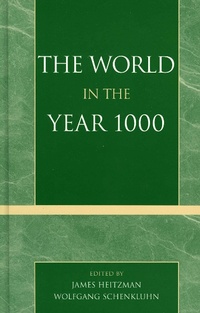
The World in the Year 1000
Published on 9. April 2004
Book
Hardback
338 pages
978-0-7618-2561-6 (ISBN)
Description
This volume is a collection of papers originally delivered by an international group of researchers at a conference organized in April 2000 by Dr. F. J. Brueggemeier and Dr. Wolfgang Schenkluhn. The World in the Year 1000 is organized in four thematic sections covering five world regions: Europe, the Islamic world, India, China, and Mesoamerica. All contributions in this volume are original works by many of today's leading scholars. Unlike most works on pre-modern world history, which follow a thesis over time, this approach suggests that fruitful avenues for comparative work become possible by focusing on a single point in time.
More details
Language
English
Place of publication
Lanham, MD
United States
Product notice
Laminated cover
Dimensions
Height: 221 mm
Width: 160 mm
Thickness: 18 mm
Weight
485 gr
ISBN-13
978-0-7618-2561-6 (9780761825616)
Copyright in bibliographic data and cover images is held by Nielsen Book Services Limited or by the publishers or by their respective licensors: all rights reserved.
Schweitzer Classification
Other editions
Additional editions
E-Book
04/2004
1st Edition
University Press of America
€101.99
Available for download
E-Book
04/2004
1st Edition
University Press of America
€101.99
Available for download
Persons
James Heitzman holds a Ph.D. in History from the University of Pennsylvania. He is Associate Professor in the Department of History, Georgia State University, Atlanta. His fields of interest include the history of South Asia, urbanization, science and technology. Wolfgang Schenkluhn is Professor of Medieval Art History at the Martin-Luther-University Halle-Wittenberg, Germany. His fields of research include medieval art and architecture.
Content
Chapter 1 Regional Maps Chapter 2 Introduction: World History and the Year 1000 Chapter 3 Natural Orders, Social Orders: Nature and Environment in Europe: Perceiving, Taming, Harnessing; The Use of Natural Resources in the Islamic World; Natural Resources and Human Settlements: Perceiving the Environment in India; Different Transitions: Chapter 4 Regimes of Production and Exchange: Minting, Silver Routes and Mining in Europe: Economic Expansion and Technical Innovation; Interdependencies Between the Military and the Economy in the Near East and Egypt; Temple Economy in South Asia; Trade Unde Chapter 5 Ritual Centers: Temple Networks and Royal Power in Southeast Asia; The Ballgame at the Climax of the Feathered Serpent: A Religious Focus in Mesoamerica; Gods and Worshippers on South India Sacred Ground Chapter 6 The Perception of Self and Others: Byzantium and its Neighbors; Islam: Self and Neighbors; Chinese Perceptions of Southeast Asia; Other, or the Others? Varieties of Difference in Indian Society at the Turn of the First Millennium and their Historiog Chapter 7 About the Contributors