

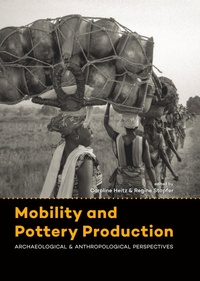
Mobility and Pottery Production
Archaeological and Anthropological Perspectives
1st Edition
Published on 15. February 2017
Book
Hardback
270 pages
978-90-8890-461-5 (ISBN)
Description
For many past and present societies, pottery forms an integral part of material culture and everyday practice. This makes it a promising case example to address human-thing-relations on a more general level, as well as social life itself. Humans organise their lives not only by engaging with materials and things but also by oscillating between movement and stasis. In these various rhythms of mobility - from daily subsistence-based movements to long-term migrations - things like ceramic vessels are crafted, but also act as consumer goods. From their production until their deposition as waste, grave-goods, collectibles etc. pottery vessels can move with their owners or be passed on and may thus shift between spatial, temporal, social, economic and cultural contexts.
This volume unites contributions addressing such phenomena from archaeological and anthropological perspectives. Evolved from an interdisciplinary workshop held at the Institute of Archaeological Sciences (University of Bern) in 2015, the aim is not to promote one single epistemic approach or any elaborated empirical findings but to trigger thoughts and foster discussions.
While the first part of the book contains introductory texts, the second part includes archaeological contributions that address mobility and social ties by focussing on variability in pottery production within, as well as between, settlements and regions. Taking a more object-centred perspective, they comprise attempts to think beyond established concepts of 'archaeological cultures' and chronological issues. The third part unites anthropological and archaeological texts that take more actor-centred perspectives of making, distributing and using pottery. These texts examine how humans and things are intertwined though practices and various rhythms of movement and mobility. Thereby it can be shown how cultural forms are reproduced but also transformed by humans and things, like pots, potters, pottery mongers and pottery users that are intermittently on the move.
This volume unites contributions addressing such phenomena from archaeological and anthropological perspectives. Evolved from an interdisciplinary workshop held at the Institute of Archaeological Sciences (University of Bern) in 2015, the aim is not to promote one single epistemic approach or any elaborated empirical findings but to trigger thoughts and foster discussions.
While the first part of the book contains introductory texts, the second part includes archaeological contributions that address mobility and social ties by focussing on variability in pottery production within, as well as between, settlements and regions. Taking a more object-centred perspective, they comprise attempts to think beyond established concepts of 'archaeological cultures' and chronological issues. The third part unites anthropological and archaeological texts that take more actor-centred perspectives of making, distributing and using pottery. These texts examine how humans and things are intertwined though practices and various rhythms of movement and mobility. Thereby it can be shown how cultural forms are reproduced but also transformed by humans and things, like pots, potters, pottery mongers and pottery users that are intermittently on the move.
More details
Edition
1. Auflage
Language
English
Place of publication
Leiden
Netherlands
Target group
Professional and scholarly
Illustrations
55fc/55bw
Dimensions
Height: 263 mm
Width: 187 mm
Thickness: 25 mm
Weight
1134 gr
ISBN-13
978-90-8890-461-5 (9789088904615)
Copyright in bibliographic data and cover images is held by Nielsen Book Services Limited or by the publishers or by their respective licensors: all rights reserved.
Schweitzer Classification
Persons
Caroline Heitz has studied prehistoric archaeology, social anthropology and the modern history of Eastern Europe at the University of Basel, Switzerland. Since 2014, she has been a research and teaching assistant at the Institute of Archaeological Sciences at the University of Bern.
Within the scope of her PhD-project - and the SNFS-research-project 'Mobilities, Entanglements and Transformations in Neolithic Societies of the Swiss Plateau (3900 - 3500 BC)' - she is currently working on the phenomena of mobility, entanglement, appropriation and transformation in Neolithic pottery from the UNESCO-World Heritage wetland sites of Lake Constance and Lake Zurich.
Having a special interest in inter- and transdisciplinarity, she combines theoretical approaches from social anthropology with methods of archaeology and archaeometry in her research. She has co-authored a book on oral history entitled 'Annaeherung an die soziale Wirklichkeit der SS-AErzte', published papers on Neolithic wetland sites and is, with Albert Hafner, co-editor of the e-series 'Bern Working Papers on Prehistoric Archaeology'. Regine Stapfer is an archaeologist specializing in Neolithic wetland sites and works as a research and teaching assistant at the University of Bern (Switzerland), Institute of Archaeological Sciences (Prehistory). She is part of the research team of the project 'Mobilities, Entanglements and Transformations in Neolithic Societies of the Swiss Plateau (3900-3500 BC)' supported by the SNFS.
In this project, she investigates the situation in western and part of Central Switzerland, studying the pottery of several settlements in this area. Further, she is concerned with the implementation of portable X-ray fluorescence analysis in this project. With Albert Hafner and Caroline Heitz she has published papers on Neolithic wetland sites. With Caroline Heitz she organized an international workshop 'Mobilities and Pottery Production: Archaeological and Anthropological Perspectives' at the University of Bern, 5-6 June 2015.
Within the scope of her PhD-project - and the SNFS-research-project 'Mobilities, Entanglements and Transformations in Neolithic Societies of the Swiss Plateau (3900 - 3500 BC)' - she is currently working on the phenomena of mobility, entanglement, appropriation and transformation in Neolithic pottery from the UNESCO-World Heritage wetland sites of Lake Constance and Lake Zurich.
Having a special interest in inter- and transdisciplinarity, she combines theoretical approaches from social anthropology with methods of archaeology and archaeometry in her research. She has co-authored a book on oral history entitled 'Annaeherung an die soziale Wirklichkeit der SS-AErzte', published papers on Neolithic wetland sites and is, with Albert Hafner, co-editor of the e-series 'Bern Working Papers on Prehistoric Archaeology'. Regine Stapfer is an archaeologist specializing in Neolithic wetland sites and works as a research and teaching assistant at the University of Bern (Switzerland), Institute of Archaeological Sciences (Prehistory). She is part of the research team of the project 'Mobilities, Entanglements and Transformations in Neolithic Societies of the Swiss Plateau (3900-3500 BC)' supported by the SNFS.
In this project, she investigates the situation in western and part of Central Switzerland, studying the pottery of several settlements in this area. Further, she is concerned with the implementation of portable X-ray fluorescence analysis in this project. With Albert Hafner and Caroline Heitz she has published papers on Neolithic wetland sites. With Caroline Heitz she organized an international workshop 'Mobilities and Pottery Production: Archaeological and Anthropological Perspectives' at the University of Bern, 5-6 June 2015.
Content
Foreword
Albert Hafner
1. Changing perspectives, changing insights
'Mobility and pottery production', what for? Introductory remarks
Caroline Heitz, Regine Stapfer
Prehistoric archaeology, anthropology and material culture studies: aspects of their origins and common roots
Albert Hafner
Material culture and mobility: A brief history of archaeological thought
Astrid Van Oyen
2. Object-centred perspectives: From 'cultures' and chronology to relations and mobility
The Munzingen culture in the southern Upper Rhine Plain (3950-3600 BC)
Loic Jammet-Reynal
From typo-chronology to inter- and intra site variety: the 'Michelsberg' pottery of South Germany (4300-3600 BC)
Ute Seidel
Social dynamics and mobility: Discussing 'households' in Linear Pottery Culture research (6 ML BC)
Isabel Hohle
Special pottery in 'Cortaillod' settlements of Neolithic western Switzerland (3900-3500 BC)
Regine Stapfer
Cultural and chronological attribution of pottery on the move: from rigid time-space schemata towards flexible microarchaeological 'messworks'
Eda Gross
3. Actor-centred perspectives: Movements of making - mobilities of pots, potters, skills and ideas
Movement in making: 'Women working with clay' in northern Cote d'Ivoire
Iris Koehler
Form follows fingers: Roman pottery, the producer's perspective and the mobility of ideas
Nadja Melko
Practice, social cohesion and identity in pottery production in the Balearic Islands (1500-500 BC)
Daniel Albero Santacreu
Making things, being mobile: pottery as intertwined histories of humans and materials
Caroline Heitz
Pots on the move become different: Emplacement and mobility of pottery, specific properties of pots and their contexts of use
Hans Peter Hahn
Afterword
Philipp Stockhammer
Albert Hafner
1. Changing perspectives, changing insights
'Mobility and pottery production', what for? Introductory remarks
Caroline Heitz, Regine Stapfer
Prehistoric archaeology, anthropology and material culture studies: aspects of their origins and common roots
Albert Hafner
Material culture and mobility: A brief history of archaeological thought
Astrid Van Oyen
2. Object-centred perspectives: From 'cultures' and chronology to relations and mobility
The Munzingen culture in the southern Upper Rhine Plain (3950-3600 BC)
Loic Jammet-Reynal
From typo-chronology to inter- and intra site variety: the 'Michelsberg' pottery of South Germany (4300-3600 BC)
Ute Seidel
Social dynamics and mobility: Discussing 'households' in Linear Pottery Culture research (6 ML BC)
Isabel Hohle
Special pottery in 'Cortaillod' settlements of Neolithic western Switzerland (3900-3500 BC)
Regine Stapfer
Cultural and chronological attribution of pottery on the move: from rigid time-space schemata towards flexible microarchaeological 'messworks'
Eda Gross
3. Actor-centred perspectives: Movements of making - mobilities of pots, potters, skills and ideas
Movement in making: 'Women working with clay' in northern Cote d'Ivoire
Iris Koehler
Form follows fingers: Roman pottery, the producer's perspective and the mobility of ideas
Nadja Melko
Practice, social cohesion and identity in pottery production in the Balearic Islands (1500-500 BC)
Daniel Albero Santacreu
Making things, being mobile: pottery as intertwined histories of humans and materials
Caroline Heitz
Pots on the move become different: Emplacement and mobility of pottery, specific properties of pots and their contexts of use
Hans Peter Hahn
Afterword
Philipp Stockhammer