

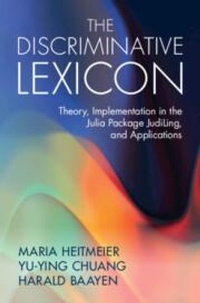
The Discriminative Lexicon
Theory, Implementation in the Julia Package JudiLing, and Applications
Will be published approx. on 31. January 2026
Book
Hardback
200 pages
978-1-009-63461-8 (ISBN)
Description
The 'Discriminative Lexicon Model' is a new theory of how we process words, which moves radically away from most standard theories of morphology. This book introduces the Discriminative Lexicon from both a practical and a theoretical perspective. The first half explains the basic theory and the main parts of 'JudiLing', the Julia package implementing the theory. This is complimented by theory boxes introducing the core concepts underlying the model, such as Matrix Multiplication and the Rescorla-Wagner learning rule. The second half provides a series of case studies spanning languages as diverse as Maltese, Biblical Hebrew, Dutch, Navajo, Estonian and French, as well as multilingual settings. It also shows how behavioural data like lexical decision reaction times, acoustic durations or tongue movements can be modelled. These are accompanied by practice exercises. It is essential reading for researchers and students in a wide range of linguistic fields, including phonetics and computational linguistics.
More details
Language
English
Place of publication
Cambridge
United Kingdom
Target group
College/higher education
Illustrations
Worked examples or Exercises
Dimensions
Height: 235 mm
Width: 157 mm
Thickness: 23 mm
Weight
650 gr
ISBN-13
978-1-009-63461-8 (9781009634618)
Copyright in bibliographic data and cover images is held by Nielsen Book Services Limited or by the publishers or by their respective licensors: all rights reserved.
Schweitzer Classification
Other editions
Additional editions
Maria Heitmeier | Yu-Ying Chuang | Harald Baayen
The Discriminative Lexicon
Theory, Implementation in the Julia Package JudiLing, and Applications
Book
approx. 01/2026
Cambridge University Press
€47.00
Not yet published
Persons
Maria Heitmeier did her Ph.D. at the Eberhard Karls University, applying computational modeling to explore how humans process words. She currently works as a data scientist.
Content
1. Introduction; 2. Julia fundamentals; 3. The dataset; 4. Representing words' forms'; 5. Representing words' meanings'; 6. Computing comprehension and production mappings; 7. Evaluating mapping accuracy; 8. Producing forms; 9. Outputting modelling results; 10. Cross-validation; 11. Deep discriminative learning in JudiLing; 12. Worked examples - internal validation; 13. Predicting behavioural data with the DLM; 14. Worked examples - external validation; 15. No escape from morphemes?; 16. Further topics; 17. Concluding remarks.