

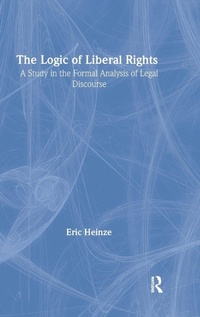
The Logic of Liberal Rights
A Study in the Formal Analysis of Legal Discourse
1st Edition
Published on 19. June 2003
Book
Hardback
352 pages
978-0-415-30056-8 (ISBN)
Description
The Logic of Liberal Rights uses basic logic to develop a model of argument presupposed in all disputes about civil rights and liberties. No prior training in logic is required, as each step is explained. This analysis does not merely apply general logic to legal arguments but is also specifically tailored to the issues of civil rights and liberties. It shows that all arguments about civil rights and liberties presuppose one fixed structure and that there can be no original argument in rights disputes, except within the confines of that structure. Concepts arising in disputes about rights, like 'liberal' or 'democratic', are not mere abstractions but have a fixed and precise character.
This book integrates themes in legal theory, political science and moral philosophy, as well as the philosophy of logic and language. For the advanced scholar, the book provides a model presupposed by leading theoretical schools (liberal and critical, positivist and naturalist). For the student it provides a systematic theory of civil rights and liberties. Examples are drawn from the European Convention in Human Rights but no special knowledge of the Convention is assumed, as the issues analysed arise throughout the world. Such issues include problems of free speech, religious freedom, privacy, torture, unlawful detention and private property.
This book integrates themes in legal theory, political science and moral philosophy, as well as the philosophy of logic and language. For the advanced scholar, the book provides a model presupposed by leading theoretical schools (liberal and critical, positivist and naturalist). For the student it provides a systematic theory of civil rights and liberties. Examples are drawn from the European Convention in Human Rights but no special knowledge of the Convention is assumed, as the issues analysed arise throughout the world. Such issues include problems of free speech, religious freedom, privacy, torture, unlawful detention and private property.
Reviews / Votes
'The formal analysis of rights has been sadly neglected by legal and political theorists in recent decades. It is therefore very interesting to find it revived and reinvigorated in this book. Also the author is careful to render the techniques of formal analysis intelligible and accessible...' - Nigel Simmonds, University of Cambridge; 'The idea that a formal structure underlies the immense diversity of views about rights is a fascinating one that merits careful consideration.' - Nigel Simmonds, University of Cambridge; '...it is very clearly written and well explained. It will render a highly technical approach much more accessible.' - Nigel Simmonds, University of CambridgeMore details
Series
Language
English
Place of publication
London
United Kingdom
Publishing group
Taylor & Francis Ltd
Target group
College/higher education
Professional and scholarly
Postgraduate and Professional
Dimensions
Height: 240 mm
Width: 161 mm
Thickness: 24 mm
Weight
696 gr
ISBN-13
978-0-415-30056-8 (9780415300568)
Copyright in bibliographic data and cover images is held by Nielsen Book Services Limited or by the publishers or by their respective licensors: all rights reserved.
Schweitzer Classification
Other editions
Additional editions
E-Book
02/2004
Routledge
€60.49
Available for download
E-Book
02/2004
Routledge
€60.49
Available for download
Person
Eric Heinze (JD, Harvard; PhD, Leiden) is Senior Lecturer in Law, University of London, Queen Mary. He has held fellowships from the Fulbright foundation and the French and German Governments. He teaches Legal Theory, Constitutional Law, Human Rights, and Public International Law. In addition to articles in those fields, his monographs include The Logic of Equality and Sexual Orientation: A Human Right.
Content
Part I Agents
Part II Harm
Part III Consent
Part IV Forms of Argument
Part V The Background Theories
Part II Harm
Part III Consent
Part IV Forms of Argument
Part V The Background Theories