

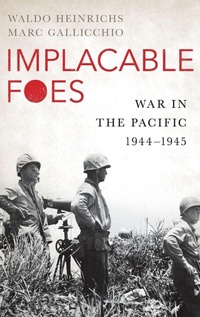
Implacable Foes
War in the Pacific, 1944-1945
Published on 24. August 2017
Book
Hardback
744 pages
978-0-19-061675-5 (ISBN)
Description
On 8 May 1945, Victory in Europe Day-shortened to "V.E. Day"-brought with it the demise of Nazi Germany. But for the Allies, the war was only half-won. Exhausted but exuberant American soldiers, ready to return home, were sent to join the fighting in the Pacific, which by the spring and summer of 1945 had turned into a gruelling campaign of bloody attrition against an enemy determined to fight to the last man. Germany had surrendered unconditionally. The Japanese would clearly make the conditions of victory extraordinarily high.
In the United States, Americans clamored for their troops to come home and for a return to a peacetime economy. Politics intruded upon military policy while a new and untested president struggled to strategize among a military command that was often mired in rivalry. The task of defeating the Japanese seemed nearly unsurmountable, even while plans to invade the home islands were being drawn. Army Chief of Staff General George C. Marshall warned of the toll that "the agony of enduring battle" would likely take. General Douglas MacArthur clashed with Marshall and Admiral Nimitz over the most effective way to defeat the increasingly resilient Japanese combatants. In the midst of this division, the Army began a program of partial demobilization of troops in Europe, which depleted units at a time when they most needed experienced soldiers. In this context of military emergency, the fearsome projections of the human cost of invading the Japanese homeland, and weakening social and political will, victory was salvaged by means of a horrific new weapon. As one Army staff officer admitted, "The capitulation of Hirohito saved our necks."
In Implacable Foes, award-winning historians Waldo Heinrichs (a veteran of both theatres of war in World War II) and Marc Gallicchio bring to life the final year of World War II in the Pacific right up to the dropping of the atomic bombs over Hiroshima and Nagasaki, evoking not only Japanese policies of desperate defense, but the sometimes rancorous debates on the home front. They deliver a gripping and provocative narrative that challenges the decision-making of U.S. leaders and delineates the consequences of prioritizing the European front. The result is a masterly work of military history that evaluates the nearly insurmountable trials associated with waging global war and the sacrifices necessary to succeed.
In the United States, Americans clamored for their troops to come home and for a return to a peacetime economy. Politics intruded upon military policy while a new and untested president struggled to strategize among a military command that was often mired in rivalry. The task of defeating the Japanese seemed nearly unsurmountable, even while plans to invade the home islands were being drawn. Army Chief of Staff General George C. Marshall warned of the toll that "the agony of enduring battle" would likely take. General Douglas MacArthur clashed with Marshall and Admiral Nimitz over the most effective way to defeat the increasingly resilient Japanese combatants. In the midst of this division, the Army began a program of partial demobilization of troops in Europe, which depleted units at a time when they most needed experienced soldiers. In this context of military emergency, the fearsome projections of the human cost of invading the Japanese homeland, and weakening social and political will, victory was salvaged by means of a horrific new weapon. As one Army staff officer admitted, "The capitulation of Hirohito saved our necks."
In Implacable Foes, award-winning historians Waldo Heinrichs (a veteran of both theatres of war in World War II) and Marc Gallicchio bring to life the final year of World War II in the Pacific right up to the dropping of the atomic bombs over Hiroshima and Nagasaki, evoking not only Japanese policies of desperate defense, but the sometimes rancorous debates on the home front. They deliver a gripping and provocative narrative that challenges the decision-making of U.S. leaders and delineates the consequences of prioritizing the European front. The result is a masterly work of military history that evaluates the nearly insurmountable trials associated with waging global war and the sacrifices necessary to succeed.
Reviews / Votes
This book is a superb piece of military and naval history. It blends the particular and the general, the battlefront and the homefront, the broader political and international and the militarily particular into an eminently readable narrative. It should be indispensable reading for anyone interested in the history of the Second World War. * Journal of Military History * This book brings to life those final years of World War II right up to the dropping of the atomic bombs over Hiroshima and Nagasaki, evoking not only Japanese policies of desperate defence, but the sometimes spiteful debates on the home-front. Heinrichs and Gallicchio deliver a gripping and provocative narrative that challenges the decision--making of US leaders and explains the consequences of prioritising the European front. * The Wavell Room: Contemporary British Military Thought * The great strength of Implacable Foes is in its understanding the many dimensions, political, strategic, and tactical, of the American war. * Taylor Downing, Military History Monthly * This book's strength undoubtedly lies in its extensive coverage of military operations and the naval activities that supported them. * David Hobbs, Mariner's Mirror * A valuable and revealing study. For readers familiar with the military campaigns, the book is essential reading for its lucid treatment of the pressures that imperiled critical operations in a truly global war... the contribution of this vital book is its portrait of history as lived desperately in the moment; of the varied troubles that beset planners and commanders in the war's horrific last year; and of the mettle and vision of an American president whom history should underrate no longer. Implacable Foes shows war operations as a human ordeal even at the highest level, fueled by the exhaustible human spirit. * Wall Street Journal * Two great historians have produced this stellar and extremely important book, adding critical new layers to the decision-making process of American leaders approaching the controversial end of the Asia-Pacific War. This is a thoroughly researched, judicious, and very sobering reminder of the complexity and uncertainty of events surrounding the final acts of World War II. * Richard Frank, author of Downfall: The End of the Imperial Japanese Empire and Guadalcanal: The Definitive Account of the Landmark Battle * A masterful history destined to be the definitive account of the final two years of America's war with Japan. The authors' comprehensive, original, and highly readable narrative sets new standards for understanding the political, military, and social pressures on U.S. leaders as they simultaneously fought a determined foe, demobilized American armed forces, and prepared for the complex transition to America's postwar domestic economy. * Edward Drea, author of Japan's Imperial Army * Implacable Foes is a superbly researched work of both original scholarship and synthesis on the last two years of the Pacific War by two eminent and award-winning historians. Their detailed analysis and conclusions will challenge some long-held beliefs about U.S. strategic planning and operations in this conflict while reinforcing others. * Mark A. Stoler, Editor, George C. Marshall Papers, Professor Emeritus of History University of Vermont * In their detailed and insightful analysis of the last year of the Pacific War, Waldo Heinrichs and Marc Gallicchio tie military operations closely with the political, strategic, logistical, and even cultural context to provide a thorough assessment of the war, and they do so without losing any of the inherent drama of events. * Craig Symonds, author of Midway and Operation Neptune: The D-Day Landings and the Allied Invasion of Europe *More details
Language
English
Place of publication
New York
United States
Target group
College/higher education
Professional and scholarly
Product notice
sewn/stitched
Cloth over boards
Dimensions
Height: 241 mm
Width: 171 mm
Thickness: 57 mm
Weight
1079 gr
ISBN-13
978-0-19-061675-5 (9780190616755)
Copyright in bibliographic data and cover images is held by Nielsen Book Services Limited or by the publishers or by their respective licensors: all rights reserved.
Schweitzer Classification
Other editions
Additional editions
Book
08/2019
Oxford University Press Inc
€27.50
Shipment within 15-20 days
E-Book
05/2017
1st Edition
OUP eBook
€9.99
Available for download
E-Book
05/2017
1st Edition
OUP eBook
€9.99
Available for download
Persons
Waldo Heinrichs is Dwight E. Stanford Professor Emeritus at San Diego State University. He is the author of American Ambassador: Joseph C. Grew and the Development of the United States Diplomatic Tradition, which won the Allan Nevins Prize.
Marc Gallicchio is a Professor of History at Villanova University and was a Fulbright Visiting Lecturer in Japan, 1998-1999 and 2004-2005. He is the author of The African American Encounter with Japan and China: Black Internationalism in Asia, 1895-1945, which won the Society of Historians of American Foreign Relations Robert H. Ferrell book prize.
Marc Gallicchio is a Professor of History at Villanova University and was a Fulbright Visiting Lecturer in Japan, 1998-1999 and 2004-2005. He is the author of The African American Encounter with Japan and China: Black Internationalism in Asia, 1895-1945, which won the Society of Historians of American Foreign Relations Robert H. Ferrell book prize.
Content
Introduction: The Reckoning
1. Gaining Momentum
2. Moving Ahead on New Guinea, April-July 1944
3. The Marianas Campaign, June-August 1944
4. Accelerating the Advance, August-October 1944
5. Leyte to Manila, October 1944-March 1945
6. Iwo Jima, February-March 1945
7. Recovering Luzon, February-June 1945
8. Beyond Human Endurance: Taking All of the Philippines, February-June 1945
9. Okinawa
10. Two Down and One to Go: The Home Front, March-June 1945
10. Potsdam, July-August 1945
11. Surrender at Last, August 1945
Conclusion
1. Gaining Momentum
2. Moving Ahead on New Guinea, April-July 1944
3. The Marianas Campaign, June-August 1944
4. Accelerating the Advance, August-October 1944
5. Leyte to Manila, October 1944-March 1945
6. Iwo Jima, February-March 1945
7. Recovering Luzon, February-June 1945
8. Beyond Human Endurance: Taking All of the Philippines, February-June 1945
9. Okinawa
10. Two Down and One to Go: The Home Front, March-June 1945
10. Potsdam, July-August 1945
11. Surrender at Last, August 1945
Conclusion