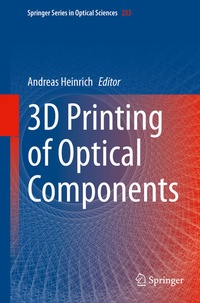
This edited volume reviews the current state of the art in the additive manufacturing of optical componentry, exploring key principles, materials, processes and applications.
A short introduction lets readers familiarize themselves with the fundamental principles of the 3D printing method. This is followed by a chapter on commonly-used and emerging materials for printing of optical components, and subsequent chapters are dedicated to specific topics and case studies. The high potential of additive manufactured optical components is presented based on different manufacturing techniques and accompanied with extensive examples - from nanooptics to large scale optics - and taking research and industrial perspectives. Readers are provided with an extensive overview of the new possibilities brought about by this alternative method for optical components manufacture. Finally, the limitations of the method with respect to manufacturing techniques, materials and optical properties of the generated objects are discussed.
With contributions from experts in academia and industry, this work will appeal to a wide readership, from undergraduate students through engineers to researchers interested in modern methods of manufacturing optical components.
Product info
Series
Edition
Language
Place of publication
Publishing group
Springer International Publishing
Target group
Professional and scholarly
Illustrations
31
100 farbige Tabellen, 192 farbige Abbildungen, 31 s/w Abbildungen
XII, 297 p. 223 illus., 192 illus. in color.
Dimensions
Height: 241 mm
Width: 160 mm
Thickness: 23 mm
Weight
ISBN-13
978-3-030-58959-2 (9783030589592)
DOI
10.1007/978-3-030-58960-8
Schweitzer Classification
Andreas Heinrich studied physics at Technical University Munich and received his Ph.D. in 2001. Until 2007, he headed a research group at Augsburg University focusing on optical investigations of the magnetic field penetration into superconductors. In 2006, he completed his postdoctoral lecture qualification. From 2007 to 2013, he went to industry. First, he worked as a project manager for research projects at Carl Zeiss SMT. Later on, he headed the metrology group within Carl Zeiss Corporate Research. Since 2013, he is a full Professor at Aalen University and working with his research group in the field of design and additive manufacturing of optical components for optical systems.
Chapter 1 Introduction into Additive ManufacturingChapter 2 Selective laser melting of reflective opticsChapter 3 3D printing of optics based on conventional printing technologiesChapter 4 3D printing of transparent glassesChapter 5 Industrial Scale Fabrication of Optical Components using High Precision 3D Printing: Aspects - Applications - PerspectivesChapter 6 3D-printed micro-optics by femtosecond direct laser writingChapter 7 Hybrid polymers for conventional and additive manufacturing of microoptical elementsIndex