

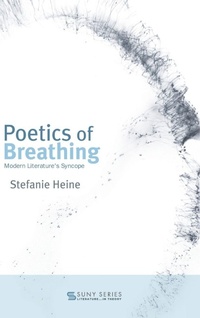
Poetics of Breathing
Modern Literature's Syncope
Published on 1. May 2021
Book
Hardback
438 pages
978-1-4384-8357-3 (ISBN)
Description
A comparative study of breath and breathing as a core poetic and compositional principle in modern literature.
Breathing and its rhythms-liminal, syncopal, and usually inconspicuous-have become a core poetic compositional principle in modern literature. Examining moments when breath's punctuations, cessations, inhalations, or exhalations operate at the limits of meaningful speech, Stefanie Heine explores how literary texts reflect their own mediality, production, and reception in alluding to and incorporating pneumatic rhythms, respiratory sound, and silent pauses. Through close readings of works by a series of pairs-Jack Kerouac and Allen Ginsberg; Robert Musil and Virginia Woolf; Samuel Beckett and Sylvia Plath; and Paul Celan and Herta Mueller-Poetics of Breathing suggests that each offers a different conception of literary or poetic breath as a precondition of writing. Presenting a challenge to historical and contemporary discourses that tie breath to the transcendent and the natural, Heine traces a decoupling of breath from its traditional association with life, and asks what literature might lie beyond.
Breathing and its rhythms-liminal, syncopal, and usually inconspicuous-have become a core poetic compositional principle in modern literature. Examining moments when breath's punctuations, cessations, inhalations, or exhalations operate at the limits of meaningful speech, Stefanie Heine explores how literary texts reflect their own mediality, production, and reception in alluding to and incorporating pneumatic rhythms, respiratory sound, and silent pauses. Through close readings of works by a series of pairs-Jack Kerouac and Allen Ginsberg; Robert Musil and Virginia Woolf; Samuel Beckett and Sylvia Plath; and Paul Celan and Herta Mueller-Poetics of Breathing suggests that each offers a different conception of literary or poetic breath as a precondition of writing. Presenting a challenge to historical and contemporary discourses that tie breath to the transcendent and the natural, Heine traces a decoupling of breath from its traditional association with life, and asks what literature might lie beyond.
Reviews / Votes
"Heine's critical approach to Nancy might be conceived of from the standpoint of Celan's famous term auseinandergeschrieben (written-apart), commented upon by Nancy in The Sense of the World (1993): so closely does Heine engage with Nancy's work that her own writing eventually splits from it, not by betraying it, but by putting it into a crisis of sorts-and thereby creating something new. A greater testament to Nancy, and to the writers Heine reads throughout this book, would be difficult to imagine." - Critical InquiryMore details
Series
Language
English
Place of publication
Albany, NY
United States
Target group
Professional and scholarly
US School Grade: College Graduate Student and over
Illustrations
1 Figures; 15 Illustrations, black and white
Dimensions
Height: 235 mm
Width: 157 mm
Thickness: 30 mm
Weight
861 gr
ISBN-13
978-1-4384-8357-3 (9781438483573)
Copyright in bibliographic data and cover images is held by Nielsen Book Services Limited or by the publishers or by their respective licensors: all rights reserved.
Schweitzer Classification
Other editions
Additional editions
E-Book
05/2021
1st Edition
De Gruyter
from
€91.99
Available for download
Person
Stefanie Heine is Assistant Professor of Comparative Literature in the Department of Arts and Cultural Studies at the University of Copenhagen. Her previous books include Reading Breath in Literature (coauthored with Arthur Rose, Naya Tsentourou, Corinne Saunders, and Peter Garrett).
Content
List of Illustrations
Acknowledgments
Preface
1. Movements of Syncopnea
2. Composed on the Breath: Authentic Voice, Embodiment, Innovation (Jack Kerouac, Allen Ginsberg)
3. Generative Caesurae: Mediality, Rhythm, Affect (Robert Musil, Virginia Woolf )
4. Impossible Expiration: Reduction, Inanimate Voices, Persisting Bodies (Samuel Beckett, Sylvia Plath)
5. Breath at Point Zero: Trauma, Commemoration, Haunting (Paul Celan, Herta Mueller)
6. Pneumatic Gender Dynamics, Queering Breath
Notes
Bibliography
Index
Acknowledgments
Preface
1. Movements of Syncopnea
2. Composed on the Breath: Authentic Voice, Embodiment, Innovation (Jack Kerouac, Allen Ginsberg)
3. Generative Caesurae: Mediality, Rhythm, Affect (Robert Musil, Virginia Woolf )
4. Impossible Expiration: Reduction, Inanimate Voices, Persisting Bodies (Samuel Beckett, Sylvia Plath)
5. Breath at Point Zero: Trauma, Commemoration, Haunting (Paul Celan, Herta Mueller)
6. Pneumatic Gender Dynamics, Queering Breath
Notes
Bibliography
Index