

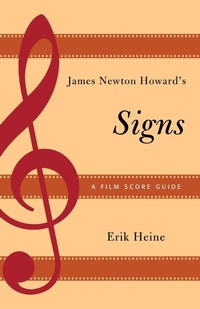
James Newton Howard's Signs
A Film Score Guide
Published on 14. January 2016
Book
Paperback/Softback
228 pages
978-1-4422-5603-3 (ISBN)
Description
Released in 2002, M. Night Shyamalan's Signs was the director's follow-up to The Sixth Sense and Unbreakable, and his third collaboration with composer James Newton Howard. Well received by audiences and critics alike, the film was often cited by reviewers for its music. With its dependence on a single motive, the score is unique in Howard's career, and one of his most effective and haunting works.
In James Newton Howard's Signs: A Film Score Guide, Erik Heine provides the first close reading of the composer's work. Heine discusses Howard's musical style and influences, as well as his ability to compose for a variety of genres, acknowledging him as one of the most versatile composers working today. The book shows how early sketches of cues for Signs were developed into the final score, allowing the reader insight into Howard's compositional process. The book also demonstrates how Howard's style is difficult to pigeonhole, since his focus is on serving the needs of the film.
Drawing on completed orchestrated scores, as well as other material from the James Newton Howard Archive at the University of Southern California, the level of musical detail provided in this volume is unsurpassed. As a book that addresses Howard's compositional style-and the only volume that significantly examines the music in any Shyamalan film-James Newton Howard's Signs: A Film Score Guide will be of interest to music scholars, film scholars, and fans of the composer's work.
In James Newton Howard's Signs: A Film Score Guide, Erik Heine provides the first close reading of the composer's work. Heine discusses Howard's musical style and influences, as well as his ability to compose for a variety of genres, acknowledging him as one of the most versatile composers working today. The book shows how early sketches of cues for Signs were developed into the final score, allowing the reader insight into Howard's compositional process. The book also demonstrates how Howard's style is difficult to pigeonhole, since his focus is on serving the needs of the film.
Drawing on completed orchestrated scores, as well as other material from the James Newton Howard Archive at the University of Southern California, the level of musical detail provided in this volume is unsurpassed. As a book that addresses Howard's compositional style-and the only volume that significantly examines the music in any Shyamalan film-James Newton Howard's Signs: A Film Score Guide will be of interest to music scholars, film scholars, and fans of the composer's work.
Reviews / Votes
This book is the first to examine the composer's work in detail, and in so doing demonstrates why and how James Newton Howard's film music style is challenging to pigeonhole. The comprehensive analysis in this book also affords the first significantly broad examination of the music in any of Shyamalan's films. It deserves a place in any thorough library of film and film musical studies. * Musique Fantastique *More details
Series
Language
English
Place of publication
United States
Publishing group
Bloomsbury Publishing Plc
Target group
Professional and scholarly
Illustrations
54 b/w illustrations; 15 tables
Dimensions
Height: 216 mm
Width: 140 mm
Thickness: 14 mm
Weight
328 gr
ISBN-13
978-1-4422-5603-3 (9781442256033)
Copyright in bibliographic data and cover images is held by Nielsen Book Services Limited or by the publishers or by their respective licensors: all rights reserved.
Schweitzer Classification
Other editions
Additional editions
E-Book
01/2016
1st Edition
Rowman & Littlefield Publishers
€61.99
Available for download
E-Book
01/2016
1st Edition
Rowman & Littlefield Publishers
€61.99
Available for download
Person
Erik Heine is professor of music at the Wanda L. Bass School of Music at Oklahoma City University. His research interests include film music, classical form and analysis, and music theory pedagogy. He is the author of multiple articles and book chapters on film music.