

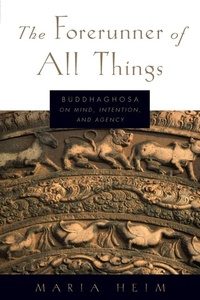
The Forerunner of All Things
Buddhaghosa on Mind, Intention, and Agency
Published on 14. November 2013
Book
Paperback/Softback
272 pages
978-0-19-933104-8 (ISBN)
Description
Scholars have long been intrigued by the Buddha's defining action (karma) as intention. This book explores systematically how intention and agency were interpreted in all genres of early Theravada thought. It offers a philosophical exploration of intention and motivation as they are investigated in Buddhist moral psychology. At stake is how we understand karma, the nature of moral experience, and the possibilities for freedom.
In contrast to many studies that assimilate Buddhist moral thinking to Western theories of ethics, the book attends to distinctively Buddhist ways of systematizing and theorizing their own categories. Arguing that meaning is a product of the explanatory systems used to explore it, the book pays particular attention to genre and to the 5th-century commentator Buddhaghosa's guidance on how to read Buddhist texts. The book treats all branches of the Pali canon (the Tipitaka, that is, the Suttas, the Abhidhamma, and the Vinaya), as well as narrative sources (the Dhammapada and the Jataka commentaries). In this sense it offers a comprehensive treatment of intention in the canonical Theravada sources. But the book goes further than this by focusing explicitly on the body of commentarial thought represented by Buddhaghosa. His work is at the center of the book's investigations, both insofar as he offers interpretative strategies for reading canonical texts, but also as he advances particular understandings of agency and moral psychology. The book offers the first book-length study devoted to Buddhaghosa's thought on ethics
In contrast to many studies that assimilate Buddhist moral thinking to Western theories of ethics, the book attends to distinctively Buddhist ways of systematizing and theorizing their own categories. Arguing that meaning is a product of the explanatory systems used to explore it, the book pays particular attention to genre and to the 5th-century commentator Buddhaghosa's guidance on how to read Buddhist texts. The book treats all branches of the Pali canon (the Tipitaka, that is, the Suttas, the Abhidhamma, and the Vinaya), as well as narrative sources (the Dhammapada and the Jataka commentaries). In this sense it offers a comprehensive treatment of intention in the canonical Theravada sources. But the book goes further than this by focusing explicitly on the body of commentarial thought represented by Buddhaghosa. His work is at the center of the book's investigations, both insofar as he offers interpretative strategies for reading canonical texts, but also as he advances particular understandings of agency and moral psychology. The book offers the first book-length study devoted to Buddhaghosa's thought on ethics
Reviews / Votes
This book will be a major contribution to scholarship in Buddhist Studies, as well as to the discipline of moral psychology more generally. The scholarship is impeccable, the attention to canonical material and secondary literature in Buddhist Studies as well as to relevant work in Western philosophy and social theory is meticulous. The book is rich in hermeneutical and philosophical insight, carefully argued, and written with uncommon perspicuity, grace and even humor I would not be surprised if it were to be recognized as one of the most significant recent contributions to Buddhist philosophy. * Jay L. Garfield, Kwan Im Thong Hood Cho Temple Professor of Humanities, Yale-NUS College * Throughout this original, humane, and often beautiful exploration of Buddhist moral thinking, Maria Heim allows herself to be taught and guided by the great Buddhist thinker Buddhaghosa about how to read Buddhist texts well and how to think reflectively about the nature of a moral person. The result is that we are introduced to a Buddhaghosa that we have not met before: an astute humanist always alert to the complexities of the moral life, and a contemporary with us, as it were, offering us fresh resources for our own efforts to make sense of ourselves as moral persons * Charles Hallisey, Harvard Divinity School *More details
Language
English
Place of publication
New York
United States
Target group
College/higher education
Dimensions
Height: 234 mm
Width: 156 mm
Thickness: 16 mm
Weight
468 gr
ISBN-13
978-0-19-933104-8 (9780199331048)
Copyright in bibliographic data and cover images is held by Nielsen Book Services Limited or by the publishers or by their respective licensors: all rights reserved.
Schweitzer Classification
Other editions
Additional editions
Book
11/2013
Oxford University Press Inc
€225.60
Shipment within 15-20 days
E-Book
09/2013
1st Edition
OUP eBook
€32.99
Available for download
Person
Associate Professor of Religion, Amherst College
Content
Table of Contents ; Abbreviations ; Introduction ; Chapter One: Constructing Experience: Intention in the Suttas ; Chapter Two: The Work of Intention: Mental Life in the Abhidhamma ; Chapter Three: Culpability and Disciplinary Culture in the Vinaya ; Chapter Four: Making Actions Intelligible: Intention and Mind in Stories ; Conclusion ; Bibliography ; Notes ; Index