

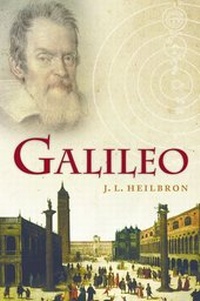
Galileo
Published on 14. January 2011
Book
Hardback
528 pages
978-0-19-958352-2 (ISBN)
Description
Four hundred years ago, in 1610, Galileo published the Siderius nuncius, or Starry Messenger, a 'hurried little masterpiece' in John Heilbron's words. Presenting to the world his remarkable observations using the recently invented telescope - of the craters of the moon, and the satellites of Jupiter, observations that forced changes to perceptions of the perfection of the heavens and the centrality of the Earth - the appearance of the little book is regarded as one of the greatest moments in the history of science. It was also a point of change in the life of Galileo himself, propelling him from professor to prophet. But this is not the biography of a mathematician. Certainly he spent the first half of his career as a professor of mathematics and has been called 'the divine mathematician'. Yet he was no more (or less) a mathematician than he was a musician, artist, writer, philosopher, or gadgeteer.
This fresh lively new biography of the 'father of science', planned to coincide with the 400th anniversary of publication of the Starry Messenger, paints a rounded picture of Galileo, and places him firmly within the rich texture of late Renaissance Florence, Pisa, and Padua, amid debates on the merits of Ariosto and Tasso, and the geometry of Dante's Inferno - debates in which the young Galileo played an active role. Galileo's character and career followed complex paths, moving from the creative but cautious humanist professor to a 'knight errant, quixotic and fearless', with increasing enemies, and leading ultimately and inevitably to a clash with a pope who was a former friend.
This fresh lively new biography of the 'father of science', planned to coincide with the 400th anniversary of publication of the Starry Messenger, paints a rounded picture of Galileo, and places him firmly within the rich texture of late Renaissance Florence, Pisa, and Padua, amid debates on the merits of Ariosto and Tasso, and the geometry of Dante's Inferno - debates in which the young Galileo played an active role. Galileo's character and career followed complex paths, moving from the creative but cautious humanist professor to a 'knight errant, quixotic and fearless', with increasing enemies, and leading ultimately and inevitably to a clash with a pope who was a former friend.
Reviews / Votes
Heilbron has produced that rare marvel, a splendid new view of a familiar figure, a witty, absorbing, and convincing account of the man and his epoch, destined for the wide readership Galileo himself once had. Eileen Reeves, ISIS Heilbron's polymathic expertise brings out the complex contours of Galileo's science in a relatively accessible form Nick Wilding, London Review of Books The most thorough and reliable introduction to Galileo now available, and also the best written Nick Wilding, London Review of Books Heilbron's book, to the best of my knowledge, explains more of Galileo's science than any other single book. American Scientist By far the richest account yet produced in English. Science Magazine Lively book. Mail on Sunday Mr Heilbron's ... has much richer scientific detail and will no doubt become the standard, comprehensive biography. International Herald Tribune Professor Heilbron provides a rounded portrait of Galileo. London Review of Books Heilbron's emphasis on Galileo's polymathy is a more accessible and undoubtedly valuable aspect of the book. Andrew Robinson, History Today As well as witticisms, Heilbron delights in scholarly details, and this book bears ample testimony to his assiduous research. Patricia Fara, BBC History Magazine Witty...scholarly...innovative...Heilbron's Galileo is no ordinary eulogy. Patricia Fara, BBC History, November 2010 An awesome command of the vast Galileo literature... [it] will no doubt become the standard, comprehensive biography. Owen Gingerich, New York Times Book Review A masterpiece...It far surpasses all previous biographies of Galileo. Impeccable scholarship. Nick Jardine, professor of the History and Philosophy of Sciences, Cambridge UniversityMore details
Language
English
Place of publication
Oxford
United Kingdom
Target group
General readers and popular science readers interested in the history of science.
Illustrations
Approx 30 black and white illustrations and a plate section
Dimensions
Height: 240 mm
Width: 167 mm
Thickness: 46.4 mm
Weight
969 gr
ISBN-13
978-0-19-958352-2 (9780199583522)
Copyright in bibliographic data and cover images is held by Nielsen Book Services Limited or by the publishers or by their respective licensors: all rights reserved.
Schweitzer Classification
Other editions
Person
Professor John Heilbron of the University of California at Berkeley is one of the most distinguished scholars on the Scientific Revolution. He is the author of Geometry Civilized (OUP, 1998) and The Sun in the Church (Harvard, 1999), on science and religion during the 17th century.
Content
1. A Florentine Education ; 2. A Tuscan Archimedes ; 3. Life in the Serenissima ; 4. Galilean Science ; 5. Calculated Risks ; 6. Miscalculated Risks ; 7. Vainglory ; 8. End Games ; Afterword