

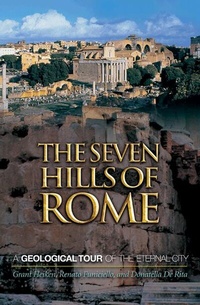
The Seven Hills of Rome
A Geological Tour of the Eternal City
Published on 25. July 2005
Book
Hardback
264 pages
978-0-691-06995-1 (ISBN)
Description
From humble beginnings, Rome became perhaps the greatest intercontinental power in the world. Why did this historic city become so much more influential than its neighbor, nearby Latium, which was peopled by more or less the same stock? Over the years, historians, political analysts, and sociologists have discussed this question ad infinitum, without considering one underlying factor that led to the rise of Rome - the geology now hidden by the modern city. This book demonstrates the important link between the history of Rome and its geologic setting in a lively, fact-filled narrative sure to interest geology and history buffs and travelers alike. The authors point out that Rome possessed many geographic advantages over surrounding areas: proximity to a major river with access to the sea, plateaus for protection, nearby sources of building materials, and most significantly, clean drinking water from springs in the Apennines. Even the resiliency of Rome's architecture and the stability of life on its hills are underscored by the city's geologic framework.
If carried along with a good city map, this book will expand the understanding of travelers who explore the eternal city's streets. Chapters are arranged geographically, based on each of the seven hills, the Tiber floodplain, ancient creeks that dissected the plateau, and ridges that rise above the right bank. As an added bonus, the last chapter consists of three field trips around the center of Rome, which can be enjoyed on foot or by using public transportation.
If carried along with a good city map, this book will expand the understanding of travelers who explore the eternal city's streets. Chapters are arranged geographically, based on each of the seven hills, the Tiber floodplain, ancient creeks that dissected the plateau, and ridges that rise above the right bank. As an added bonus, the last chapter consists of three field trips around the center of Rome, which can be enjoyed on foot or by using public transportation.
Reviews / Votes
A detailed description. -- Ingrid Rowland New York Review of Books Rome we know as a museum of empires and faiths, architecture and art collections: this fascinating little book shows how it may be a museum of the earth as well. -- Greg Woolf Times Literary Supplement This is a truly unusual book of great interest to amateur geologists, historians, and travelers. Library Journal A very interesting book on the geology of Rome and how that geology has strongly influenced the city's geography, history, economics, and culture since its earliest settlement. Choice This is a book of delights. A volcanologist and two geologists unpick the fabric of Rome, from its roots of silts and gravels overlain by volcanic flows to the summits of the seven hills. -- Maggie McDonald New Scientist Now here's a tourist guide to Rome with a difference...This isn't just a guide. The authors have also set out to awaken people to Rome's geological framework in the hope of making the city itself more sustainable. -- Sarah Barnett Geographical Magazine This fascinating and easy-to-read guidebook shows how the geography and geology of Rome allowed it to grow into the great center of civilization that it became... This book is for travelers and readers interested in both history and geology. Science News The writing in this joint Italian-American volume is delightfully clear, and the book is full of helpful illustrations. -- Ron Smith Georgia ReviewMore details
Language
English
Place of publication
New Jersey
United States
Target group
Professional and scholarly
College/higher education
Product notice
Trade binding
Illustrations
20 Maps
Dimensions
Height: 229 mm
Width: 152 mm
Weight
510 gr
ISBN-13
978-0-691-06995-1 (9780691069951)
Copyright in bibliographic data and cover images is held by Nielsen Book Services Limited or by the publishers or by their respective licensors: all rights reserved.
Schweitzer Classification
Other editions
Additional editions
Grant Heiken | Renato Funiciello | Donatella de Rita
The Seven Hills of Rome
A Geological Tour of the Eternal City
E-Book
10/2013
1st Edition
Princeton University Press
€37.99
Available for download
Grant Heiken | Renato Funiciello | Donatella de Rita
The Seven Hills of Rome
A Geological Tour of the Eternal City
Book
05/2007
Princeton University Press
€32.80
Article not available at the moment
Persons
Grant Heiken is a past president of the International Association of Volcanology. He is the author or co-author of several professional and general-interest books on geology, including "Volcanoes: Crucibles of Change" (Princeton). Renato Funiciello is Professor of Geology at the University of Roma Tre and Vice President of the National Institute for Geophysics. Donatella De Rita is Professor of Field Geology and the Geology of Volcanic Areas at the University of Roma Tre.
Content
Foreword, by Walter Veltroni vii Preface ix CHAPTER 1: A Tourist's Introduction to the Geology of Rome 1 Timelines 18 CHAPTER 2: Center of the Western World--The Capitoline (Campidoglio) Hill 27 CHAPTER 3: Palaces and Gardens--The Palatine (Palatino) Hill 37 CHAPTER 4: The Aventine (Aventino) Hill 51 CHAPTER 5: The Tiber Floodplain, Commerce, and Tragedy 59 CHAPTER 6: The Tiber's Tributaries in Rome--Clogged with Humankind's Debris 85 CHAPTER 7: The Western Heights--Janiculum, Vatican, and Monte Mario 110 CHAPTER 8: The Celian (Celio) Hill 123 CHAPTER 9: Largest of the Seven Hills--The Esquiline (Esquilino)153 CHAPTER 10: Upper Class--The Viminal (Viminale) and Quirinal (Quirinale) Hills 162 CHAPTER 11: Field Trips in and around Rome 174 The Seven Hills of Rome in Fifteen Stops 174 Panoramas, Piazzas, and Plateaus 195 A Field Trip to Rome, the City of Water 216 Acknowledgments 229 Further Reading 231 Index 237