

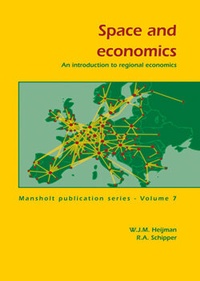
Space and Economics
An Introduction to Regional Economics
1st Edition
Published on 1. March 2010
Book
Paperback/Softback
280 pages
978-90-8686-097-5 (ISBN)
Description
The subject area Regional Economics is becoming more and more topical. This means that in economic analyses the production factor 'space' is of increasing importance. This study book aims at integrating space in the area of General Economics in an analytical way. This is different from an economic geographical approach where the latter is less analytical and more descriptive in nature. In our approach, models and their applications play a major role. The spreadsheet programme Excel is used as a convenient tool for the computation of model results. The description of major applications of Excel is included in the book, which makes it self contained. The book contains basic and more advanced subjects; to study the latter advanced subjects fruitfully the student should be familiar with the basic principles of economics. An important feature of the book is its European character.Where most textbooks in the area are US-based, by far the majority of the applications here are from Europe. Therefore, the regional statistical data and maps available in Eurostat have been used abundantly.
The area of regional economics contains two broad fields: the theory of location, including the basic principles of the economic theory of land use, which has a microeconomic character, and regional economic development, including spatial equilibrium theory, which is mainly macroeconomic in nature. In the book, both fields will be elaborated in detail.
The subject area Regional Economics is becoming more and more topical. This means that in economic analyses the production factor 'space' is of increasing importance. This study book aims at integrating space in the area of General Economics in an analytical way. This is different from an economic geographical approach where the latter is less analytical and more descriptive in nature. In our approach, models and their applications play a major role. The spreadsheet programme Excel is used as a convenient tool for the computation of model results. The description of major applications of Excel is included in the book, which makes it self contained. The book contains basic and more advanced subjects; to study the latter advanced subjects fruitfully the student should be familiar with the basic principles of economics. An important feature of the book is its European character.Where most textbooks in the area are US-based, by far the majority of the applications here are from Europe. Therefore, the regional statistical data and maps available in Eurostat have been used abundantly.
The area of regional economics contains two broad fields: the theory of location, including the basic principles of the economic theory of land use, which has a microeconomic character, and regional economic development, including spatial equilibrium theory, which is mainly macroeconomic in nature. In the book, both fields will be elaborated in detail.
The area of regional economics contains two broad fields: the theory of location, including the basic principles of the economic theory of land use, which has a microeconomic character, and regional economic development, including spatial equilibrium theory, which is mainly macroeconomic in nature. In the book, both fields will be elaborated in detail.
The subject area Regional Economics is becoming more and more topical. This means that in economic analyses the production factor 'space' is of increasing importance. This study book aims at integrating space in the area of General Economics in an analytical way. This is different from an economic geographical approach where the latter is less analytical and more descriptive in nature. In our approach, models and their applications play a major role. The spreadsheet programme Excel is used as a convenient tool for the computation of model results. The description of major applications of Excel is included in the book, which makes it self contained. The book contains basic and more advanced subjects; to study the latter advanced subjects fruitfully the student should be familiar with the basic principles of economics. An important feature of the book is its European character.Where most textbooks in the area are US-based, by far the majority of the applications here are from Europe. Therefore, the regional statistical data and maps available in Eurostat have been used abundantly.
The area of regional economics contains two broad fields: the theory of location, including the basic principles of the economic theory of land use, which has a microeconomic character, and regional economic development, including spatial equilibrium theory, which is mainly macroeconomic in nature. In the book, both fields will be elaborated in detail.
More details
Series
Language
English
Place of publication
Netherlands
Target group
College/higher education
Professional and scholarly
Illustrations
Illustrations, maps
Dimensions
Height: 240 mm
Width: 170 mm
Weight
530 gr
ISBN-13
978-90-8686-097-5 (9789086860975)
Copyright in bibliographic data and cover images is held by Nielsen Book Services Limited or by the publishers or by their respective licensors: all rights reserved.
Schweitzer Classification