

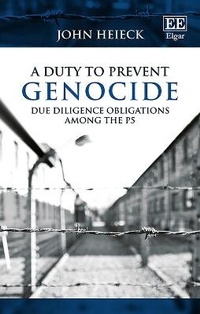
A Duty to Prevent Genocide
Due Diligence Obligations among the P5
Published on 28. September 2018
Book
Hardback
264 pages
978-1-78811-770-8 (ISBN)
Description
The permanent five (P5) members of the United Nations Security Council - China, France, Russia, the UK, and the USA - have a firm duty to prevent genocide in light of the due diligence standard under conventional, customary, and peremptory international law. This perceptive book explores the positive obligations of these states to act both within and without the Security Council context to prevent or suppress imminent or on-going genocide.
John Heieck successfully argues why the duty to prevent genocide is not only a customary, but also an absolute norm of international law, and analyses the scope of the due diligence standard regarding the duty to prevent genocide. In doing so, he considers the ramifications of this on the actions of the P5 members of the Security Council, both within and outside of this eminent body. Significantly, Heieck proposes a legal test for identifying jus cogens norms, and explores the effect of these on the actions and omissions of specifically identified members of the United Nations (UN).
Topical and insightful, A Duty to Prevent Genocide will be an important read for both academics and students of international law and politics who wish to further understand the legal nature of the duty of the P5 members to prevent genocide. It will also provide valuable insights for policymakers of the P5 member states.
John Heieck successfully argues why the duty to prevent genocide is not only a customary, but also an absolute norm of international law, and analyses the scope of the due diligence standard regarding the duty to prevent genocide. In doing so, he considers the ramifications of this on the actions of the P5 members of the Security Council, both within and outside of this eminent body. Significantly, Heieck proposes a legal test for identifying jus cogens norms, and explores the effect of these on the actions and omissions of specifically identified members of the United Nations (UN).
Topical and insightful, A Duty to Prevent Genocide will be an important read for both academics and students of international law and politics who wish to further understand the legal nature of the duty of the P5 members to prevent genocide. It will also provide valuable insights for policymakers of the P5 member states.
Reviews / Votes
'This is a closely argued and well-written book, which combines a firm grasp of controversial issues in international law, with a genuine and enthusiastic originality. Heieck's focus is the duty to prevent genocide. He asks the question how this duty affects the bedrock principle of the current international order - the prohibition of the use of force. Highly recommended for students and scholars of international law.'--Bill Bowring, University of London, UK'John Heieck wades into one of the murkiest and most politically fraught issues of our time - what the duty to prevent genocide requires of states, particularly the members of the P5 - and does so with aplomb. Future scholarship on genocide will ignore this brave and intelligent book at its peril.'
--Kevin Jon Heller, University of Amsterdam, the Netherlands
More details
Language
English
Place of publication
Cheltenham
United Kingdom
Target group
Professional and scholarly
Dimensions
Height: 234 mm
Width: 156 mm
ISBN-13
978-1-78811-770-8 (9781788117708)
Copyright in bibliographic data and cover images is held by Nielsen Book Services Limited or by the publishers or by their respective licensors: all rights reserved.
Schweitzer Classification
Person
John Heieck, University of Kent, Brussels School of International Studies, UK
Content
Contents: Introduction 1. The P5's Duty to Prevent Genocide under the Genocide Convention 2. The P5's Duty to Prevent Genocide under Customary International Law 3. The Conflict between the P5's Duty to Prevent Genocide and the P5's Rights and Duties under Conventional and Customary International Law 4. Resolving the Conflict between the P5's Duty to Prevent Genocide and the P5's Rights and Duties under Conventional and Customary Law Conclusion Bibliography Index