

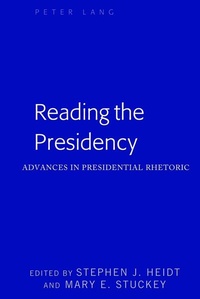
Reading the Presidency
Advances in Presidential Rhetoric
Published on 28. December 2018
Book
Hardback
348 pages
978-1-4331-3542-2 (ISBN)
Description
This edited collection explores ways to better understand the rhetorical workings of political executives, especially the United States president. Scholars of the presidency, rhetorical theorists and critics, and various authors examine the ways in which presidents use the institution, the media, and popular culture to instantiate, expand, and wield executive power.
More details
Other editions
Additional editions
Book
01/2019
Peter Lang Verlag
€62.90
Shipment within 7-9 days
E-Book
01/2019
1st Edition
Peter Lang Verlag
€65.99
Available for download
E-Book
01/2019
1st Edition
Peter Lang Verlag
€65.99
Available for download
Persons
Stephen J. Heidt earned his PhD at Georgia State University in Rhetoric and Politics. His work focuses on the intersections between the presidency and American foreign policy. He has published in Rhetoric & Public Affairs, Southern Communication Journal, and several edited volumes.
Mary E. Stuckey is Professor of Communication Arts and Sciences at Penn State University. She is the recipient of the National Communication Association's Distinguished Scholar Award. Her books have won the Roderick P. Hart Outstanding Book Award, the Marie Hochmuth Nichols Award, and the Bruce E. Gronbeck Political Communication Award.
Content
Acknowledgments - Stephen J. Heidt: Introduction: The Study of Presidential Rhetoric in Uncertain Times: Thoughts on Theory and Praxis - Section One: Reading the President through Institutions - Timothy Barney: Cartographer-in-Chief: Maps in Televisual Addresses and the Cold War President as Geographic Educator - Allison M. Prasch: Reading the Presidency In Situ: Obama in Cuba and the Significance of Place in U.S. Presidential Public Address - Milene Ortega/Mary E. Stuckey: The Other Presidential Rhetoric: Rhetorical Mobilization within the White House - Ryan Neville-Shepard: Genre-Busting: Campaign Speech Genres and the Rhetoric of Political Outsiders - Jay P. Childers/Cassandra C. Bird: The Rise of Comforter-in-Chief: Presidential Responses to Violence Since Reagan - Section Two: Reading the Presidency through Interactions - Ronald Walter Greene/Jay Alexander Frank: Obama's Command: Chemical Weapons in Syria and the Global Duties of a Rhetorical Presidency - Blake Abbott: Unpresidented: Articulating the Presidency in the Age of Trump - Stephen J. Heidt/Damien Smith Pfister: Trump, Twitter, and the Microdiatribe: The Short Circuits of Networked Presidential Public Address - Leah Ceccarelli: Pioneers, Prophets, and Profligates: George W. Bush's Presidential Interaction with Science - Belinda A. Stillion Southard: Negotiating the Limits of a Multiparty Democracy: Michelle Bachelet's Rhetoric of Commitment - Section Three: Reading the Presidency through Interruptions - Paul Johnson: The Debt Ceiling Debacle: Presidentialism as Cruel Optimism - Joel M. Lemuel: The Discursive Antecedents to Richard Nixon's War on Drugs - Leslie J. Harris: Home-Making, Nation-Making: American Womanhood in Progressive Era Presidential Rhetoric - Lisa Corrigan: White "Honky" Liberals, Rhetorical Disidentification, and Black Power during the Johnson Administration - David Zarefsky: Afterword: Reflections on Rhetoric and the Presidency - About the Contributors.