

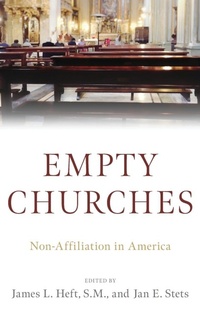
Empty Churches
Non-Affiliation in America
Published on 31. March 2021
Book
Hardback
384 pages
978-0-19-752931-7 (ISBN)
Description
Based in the idea that social phenomena are best studied through the lens of different disciplinary perspectives, Empty Churches studies the growing number of individuals who no longer affiliate with a religious tradition. Co-editors Jan Stets, a social psychologist, and James Heft, a historian of theology, bring together leading scholars in the fields of sociology, developmental psychology, gerontology, political science, history, philosophy, and pastoral theology.
The scholars in this volume explore the phenomenon by drawing from each other's work to understand better the multi-faceted nature of non-affiliation today. They explore the complex impact that non-affiliation has on individuals and the wider society, and what the future looks like for religion in America. The book also features insightful perspectives from parents of young adults and interviews with pastors struggling with this issue who address how we might address this trend. Empty Churches provides a rich and thoughtful analysis on non- affiliation in American society from multiple scholarly perspectives. The increasing growth of non-affiliation threatens the vitality and long-term stability of religious institutions, and this book offers guidance on maintaining the commitment and community at the heart of these institutions.
The scholars in this volume explore the phenomenon by drawing from each other's work to understand better the multi-faceted nature of non-affiliation today. They explore the complex impact that non-affiliation has on individuals and the wider society, and what the future looks like for religion in America. The book also features insightful perspectives from parents of young adults and interviews with pastors struggling with this issue who address how we might address this trend. Empty Churches provides a rich and thoughtful analysis on non- affiliation in American society from multiple scholarly perspectives. The increasing growth of non-affiliation threatens the vitality and long-term stability of religious institutions, and this book offers guidance on maintaining the commitment and community at the heart of these institutions.
Reviews / Votes
Prefaced by the Bishop of San Diego, this important interdisciplinary study co-directed by a theologian (James L. Heft) and a sociologist (Jan E. Stets) attempts to understand the phenomenon of religious disaffiliation which, after having affected European countries, manifests itself today in the United States, more or less spared on this point until now. * Jean Louis OrmiA?res, Archives de sciences sociales des religions * I highly recommend this book, both for the extensive answers it provides to its guiding research questions, and for the avenues it charts for future research. * James C Cavendish, Sociology of Religion * This volume is descriptive with a practical aim. * Rebecca Irwin-Diehl, American Catholic Studies. * Empty Churches makes a significant contribution to understanding contemporary religious trends and offers valuable insights for scholars and practitioners alike. This book is particularly relevant for academics in religious studies,sociology, and political science, as well as for clergy and church leaders seeking to address declining participation. Its balanced treatment of statistical analysis and pastoral application makes it a valuable resource for anyone interested in the evolving landscape of faith and institutional religion. * Tianji Ma, Religious Studies Review *More details
Language
English
Place of publication
New York
United States
Target group
Professional and scholarly
Dimensions
Height: 240 mm
Width: 161 mm
Thickness: 25 mm
Weight
743 gr
ISBN-13
978-0-19-752931-7 (9780197529317)
Copyright in bibliographic data and cover images is held by Nielsen Book Services Limited or by the publishers or by their respective licensors: all rights reserved.
Schweitzer Classification
Other editions
Additional editions
Book
03/2021
Oxford University Press Inc
€53.80
Shipment within 15-20 days
E-Book
01/2021
OUP eBook
€22.99
Available for download
E-Book
01/2021
OUP eBook
€22.99
Available for download
Persons
James L. Heft, S. M., served as professor and chair of the Theology Department at the University of Dayton for six years, Provost for eight years, and Chancellor and Professor of Faith and Culture for 10 years, before moving to the University of Southern California in 2006 as the Alton Brooks Professor of Religion and now the Founder and President Emeritus of the Institute for Advanced Catholic Studies. He is the author, editor and co-editor of fourteen books, including Catholicism and Interreligious Dialogue (OUP 2011) and Catholic High Schools: Facing the New Realities (OUP 2011).
Jan E. Stets is Professor and Director of the Social Psychology Research Laboratory at the University of California, Riverside. She is the former Director of the Sociology Program at the National Science Foundation, and a former co-editor of Social Psychology Quarterly.
Jan E. Stets is Professor and Director of the Social Psychology Research Laboratory at the University of California, Riverside. She is the former Director of the Sociology Program at the National Science Foundation, and a former co-editor of Social Psychology Quarterly.
Content
Preface: Robert M. McElroy, Bishop of San Diego
Chapter 1: Introduction: An Interdisciplinary Analysis of Non-Affiliation
Jan E. Stets, University of California, Riverside
WHO ARE THEY?
Chapter 2: The Many Meanings of Non-Affiliation
Nancy Ammerman, Boston University
Chapter 3: The Many Meanings of the Secular
Joseph O. Baker, East Tennessee State University
Chapter 4: Lapsed Catholics and Other Religious Non-Affiliates
Carol Ann MacGregor and Ashlyn Haycook, Loyola University New Orleans
Chapter 5: Affiliates and Non-Affiliates in Later Life
Vern Bengtson, University of Southern California, and Gabrielle Gonzales, Camille Endacott, and Samantha Copping Kang, University of California, Santa Barbara
WHERE DO THEY COME FROM?
Chapter 6: Developmental Views on Youth Religious Non-Affiliation
Sam A. Hardy, Brigham Young University and Gregory S. Longo, Eastern University
Chapter 7: Religious Non-Affiliation: Expelled by the Right
William V. Trollinger, University of Dayton
Chapter 8: The Transformation of Religion: Drawn by the Left
Matthew S. Hedstrom, University of Virginia
WHAT ARE SOME CONSEQUENCES?
Chapter 9: Non-religiosity, Secularism, and Civil Society
David E. Campbell, University of Notre Dame
Chapter 10: Religious Non-Affiliation and Objections of Conscience
Bernard G. Prusak, King's College
ADDRESSING THE CHALLENGE
Chapter 11: Reports from Faith Community Leaders in the South
Elizabeth Kirkland Cahill
Chapter 12: Cultivating Faith in Young Adults
Kerry A. Robinson, Leadership Roundtable
Chapter 13: Understanding and Responding to Non-Affiliation
James L. Heft, University of Southern California
Epilogue:
Jan E. Stets, University of California, Riverside and James L. Heft, University of Southern California
Notes
Index
Chapter 1: Introduction: An Interdisciplinary Analysis of Non-Affiliation
Jan E. Stets, University of California, Riverside
WHO ARE THEY?
Chapter 2: The Many Meanings of Non-Affiliation
Nancy Ammerman, Boston University
Chapter 3: The Many Meanings of the Secular
Joseph O. Baker, East Tennessee State University
Chapter 4: Lapsed Catholics and Other Religious Non-Affiliates
Carol Ann MacGregor and Ashlyn Haycook, Loyola University New Orleans
Chapter 5: Affiliates and Non-Affiliates in Later Life
Vern Bengtson, University of Southern California, and Gabrielle Gonzales, Camille Endacott, and Samantha Copping Kang, University of California, Santa Barbara
WHERE DO THEY COME FROM?
Chapter 6: Developmental Views on Youth Religious Non-Affiliation
Sam A. Hardy, Brigham Young University and Gregory S. Longo, Eastern University
Chapter 7: Religious Non-Affiliation: Expelled by the Right
William V. Trollinger, University of Dayton
Chapter 8: The Transformation of Religion: Drawn by the Left
Matthew S. Hedstrom, University of Virginia
WHAT ARE SOME CONSEQUENCES?
Chapter 9: Non-religiosity, Secularism, and Civil Society
David E. Campbell, University of Notre Dame
Chapter 10: Religious Non-Affiliation and Objections of Conscience
Bernard G. Prusak, King's College
ADDRESSING THE CHALLENGE
Chapter 11: Reports from Faith Community Leaders in the South
Elizabeth Kirkland Cahill
Chapter 12: Cultivating Faith in Young Adults
Kerry A. Robinson, Leadership Roundtable
Chapter 13: Understanding and Responding to Non-Affiliation
James L. Heft, University of Southern California
Epilogue:
Jan E. Stets, University of California, Riverside and James L. Heft, University of Southern California
Notes
Index