

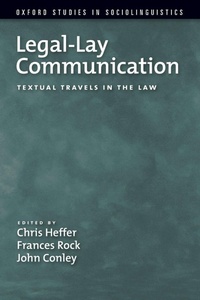
Legal-Lay Communication
Textual Travels in the Law
Published on 12. September 2013
Book
Paperback/Softback
352 pages
978-0-19-974683-5 (ISBN)
Description
This volume responds to a growing interest in the language of legal settings by situating the study of language and law within contemporary theoretical debates in discourse studies, linguistic anthropology, and sociolinguistics. The chapters in the collection explore many of the common occasions when those acting on behalf of the legal system, such as the police, lawyers and judges, interact with those coming into contact with the legal system, such as suspects and witnesses. However the chapters do this work through the conceptual lens of 'textual travel', or the way that texts move across space and time and are transformed along the way. Collectively, notions of textual travel shed new light on the ways in which texts can influence, and are influenced by, social and legal life.
With contributions from leading experts in language and law, Legal-Lay Communication explores such 'textual travel' themes as the mediating role of technologies in the investigatory stages of the legal process, the centrality of intertextuality in the legal construction of cases in court, the transformative effects of recontextualization in processes of judicial decision-making, and the way that processes of textual travel disturb the apparent permanence of legal categorization. The book challenges both the notion of legal text as a static repository of meaning and the very idea of legal-lay or lay-legal communication.
With contributions from leading experts in language and law, Legal-Lay Communication explores such 'textual travel' themes as the mediating role of technologies in the investigatory stages of the legal process, the centrality of intertextuality in the legal construction of cases in court, the transformative effects of recontextualization in processes of judicial decision-making, and the way that processes of textual travel disturb the apparent permanence of legal categorization. The book challenges both the notion of legal text as a static repository of meaning and the very idea of legal-lay or lay-legal communication.
Reviews / Votes
The importance of this collection, both theoretical and practical, cannot be overstated. Its immediate contribution is obvious, namely that it improves our understanding of communication and interaction between legal and lay participants at various stages of legal processes * Hanna H Wei, Discourse Studies *More details
Series
Language
English
Place of publication
New York
United States
Target group
College/higher education
Professional and scholarly
Illustrations
7 black and white
Dimensions
Height: 234 mm
Width: 156 mm
Thickness: 21 mm
Weight
596 gr
ISBN-13
978-0-19-974683-5 (9780199746835)
Copyright in bibliographic data and cover images is held by Nielsen Book Services Limited or by the publishers or by their respective licensors: all rights reserved.
Schweitzer Classification
Other editions
Additional editions
Book
09/2013
Oxford University Press Inc
€211.10
Shipment within 15-20 days
E-Book
07/2013
1st Edition
OUP eBook
€28.49
Available for download
Persons
Chris Heffer is a Senior Lecturer in Language and Communication at Cardiff University, Wales, and the author of The Language of Jury Trial.
Frances Rock is a Senior Lecturer at Cardiff University and the author of Communicating Rights: The Language of Arrest and Detention. She is one of the editors of the International Journal of Speech, Language and the Law.
John Conley is William Rand Kenan, Jr. Professor of Law at the University of North Carolina at Chapel Hill. He is the co-author of Just Words: Law, Language, and Power and co-editor of Polar: The Political and Legal Anthropology Review.
Frances Rock is a Senior Lecturer at Cardiff University and the author of Communicating Rights: The Language of Arrest and Detention. She is one of the editors of the International Journal of Speech, Language and the Law.
John Conley is William Rand Kenan, Jr. Professor of Law at the University of North Carolina at Chapel Hill. He is the co-author of Just Words: Law, Language, and Power and co-editor of Polar: The Political and Legal Anthropology Review.
Content
I. INTRODUCTION ; 1. Textual Travel in Legal-Lay Communication ; Frances Rock, Chris Heffer and John Conley ; II. POLICE INVESTIGATION AS TEXTUAL MEDIATION ; 2. The Transformation of Discourse in Emergency Calls to the Police ; Mark Garner and Edward Johnson ; 3. From Legislation to the Courts: Providing Safe Passage for Legal Texts through the Challenges of a Police Interview ; Georgina Heydon ; 4. 'Every Link in the Chain': The Police Interview as Textual Intersection ; Frances Rock ; III. THE LEGAL CASE AS INTERTEXTUAL CONSTRUCTION ; 5. Theatrics in the Courtroom: The Intertextual Construction of Legal Cases ; Katrijn Maryns ; 6. Talk and Text in the Criminal Law Process ; Martha Komter ; 7. Embedding Police Interviews in the Prosecution Case in the Shipman Trial ; Alison Johnson ; 8. Tracing the Crime Narratives within the Palmer Trial (1856): From the Lawyer's Opening Speeches to the Judge's Summing Up ; Dawn Archer ; IV. JUDICIAL DISCOURSE AS LEGAL RECONTEXTUALIZATION ; 9. Post-Penetration Rape and the Decontextualization of Witness Testimony ; Susan Ehrlich ; 10. Communication and Magic: Authorized Voice, Legal-Linguistic Habitus and the Recontextualization of "Beyond Reasonable Doubt" ; Chris Heffer ; 11. Troubling the Legal-Lay Distinction: Litigant Briefs, Oral Argument, and a Public Hearing about Same-Sex Marriage ; Karen Tracy and Erica Delgadillo ; V. CROSSING CULTURAL AND IDEOLOGICAL CATEGORIES IN LAY-LEGAL COMMUNICATION ; 12. The Discourse of DNA: Giving Informed Consent to Genetic Research ; John Conley, Jean Cadigan, Arlene Davis, Allison Dobson,Erin Edwards, Wendell Fortson and Robert Mitchell ; 13. Travelling Texts: The Legal-Lay Interface in The Highway Code ; Bethan Davies ; 14. The Journey Beyond Legitimacy: Moving Forward from What We Know about ; Rape ; Shonna Trinch ; VI. CONCLUSION ; 15. Travelled Texts ; John Conley, Chris Heffer, Frances Rock