

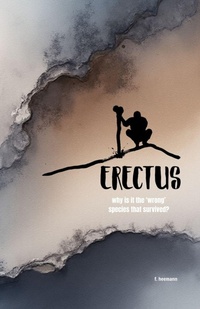
Erectus
Why is it the 'wrong' species that survived?
Published on 3. March 2026
Book
Paperback/Softback
102 pages
978-65-988126-6-9 (ISBN)
Description
Erectus is a philosophical and scientific investigation into the possibility that the human species which endured was not the one best suited for long¿term survival. Drawing on evolutionary biology, paleoanthropology, cognitive neuroscience, and existential philosophy, Felipe Heemann examines the profound disparity between our extraordinary technical efficacy and our catastrophic evolutionary effectiveness.
Where Homo erectus persisted for more than a million years in relative ecological equilibrium, Homo sapiens developed a hypertrophied cortex and a recursive, symbolic language that allowed us to inhabit psychological pasts and imagined futures-temporalities that generate chronic anxiety, depression, and existential dread. These forms of suffering are not civilizational malfunctions to be corrected, but structural consequences of our neurocognitive architecture.
Rejecting romantic primitivism and human exceptionalism alike, Erectus confronts the brutal naturalistic possibility that our survival was an accident whose costs we are only beginning to understand. Without consolation or optimism, the book invites the reader to face the mirror of our lineage with clarity, rigor, and a rare existential honesty.
More details
Series
Language
English
Product notice
Paperback (trade)
Unsewn / adhesive bound
Dimensions
Height: 216 mm
Width: 140 mm
Thickness: 8 mm
Weight
202 gr
ISBN-13
978-65-988126-6-9 (9786598812669)
Copyright in bibliographic data and cover images is held by Nielsen Book Services Limited or by the publishers or by their respective licensors: all rights reserved.
Schweitzer Classification
Person
Felipe Heemann A. Ribeiro is a professor, evolutionary biologist, molecular neurobiologist, and linguist whose scholarly formation extends equally into Physics and Mathematics. He has dedicated his intellectual trajectory to reconstructing the bridges between Science and the Humanities that modernity has systematically dismantled. A graduate in Biological Sciences from the University of São Paulo (USP), his work moves across these fields and into Philosophy, tracing the contours of a restless and transdisciplinary mind. His essays invite the reader into the history of ideas - guided by scientific rigor and the sensitivity of a committed educator. In his pages, Science ceases to be mere explanation: it becomes narrative, beauty, and revelation.