

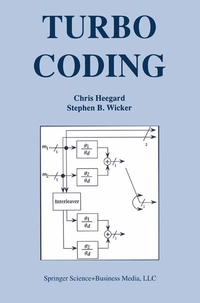
Turbo Coding
Published on 30. November 1998
Book
Hardback
XXIV, 206 pages
978-0-7923-8378-9 (ISBN)
Description
When the 50th anniversary of the birth of Information Theory was celebrated at the 1998 IEEE International Symposium on Informa tion Theory in Boston, there was a great deal of reflection on the the year 1993 as a critical year. As the years pass and more perspec tive is gained, it is a fairly safe bet that we will view 1993 as the year when the "early years" of error control coding came to an end. This was the year in which Berrou, Glavieux and Thitimajshima pre sented "Near Shannon Limit Error-Correcting Coding and Decoding: Turbo Codes" at the International Conference on Communications in Geneva. In their presentation, Berrou et al. claimed that a combi nation of parallel concatenation and iterative decoding can provide reliable communications at a signal to noise ratio that is within a few tenths of a dB of the Shannon limit. Nearly fifty years of striving to achieve the promise of Shannon's noisy channel coding theorem had come to an end. The implications of this result were immediately apparent to all -coding gains on the order of 10 dB could be used to dramatically extend the range of communication receivers, increase data rates and services, or substantially reduce transmitter power levels. The 1993 ICC paper set in motion several research efforts that have permanently changed the way we look at error control coding.
More details
Series
Edition
1999 ed.
Language
English
Place of publication
New York
United States
Target group
Professional and scholarly
Research
Illustrations
XXIV, 206 p.
Dimensions
Height: 241 mm
Width: 160 mm
Thickness: 18 mm
Weight
524 gr
ISBN-13
978-0-7923-8378-9 (9780792383789)
DOI
10.1007/978-1-4757-2999-3
Schweitzer Classification
Other editions
Additional editions
Chris Heegard | Stephen B. Wicker
Turbo Coding
Book
12/2010
Springer
€160.49
Shipment within 15-20 days
Content
1 Introduction.- 2 Binary Codes, Graphs, and Trellises.- 3 Interleaving.- 4 Concatenated Codes.- 5 BCE and PCE Performance.- 6 Turbo Decoding.- 7 Belief Propagation and Parallel Decoding.