

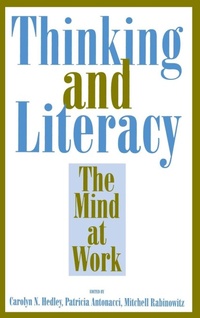
Thinking and Literacy
The Mind at Work
Published on 1. March 1995
Book
Hardback
328 pages
978-0-8058-1547-4 (ISBN)
Description
This volume explores higher level, critical, and creative thinking, as well as reflective decision making and problem solving -- what teachers should emphasize when teaching literacy across the curriculum. Focusing on how to encourage learners to become independent thinking, learning, and communicating participants in home, school, and community environments, this book is concerned with integrated learning in a curriculum of inclusion. It emphasizes how to provide a curriculum for students where they are socially interactive, personally reflective, and academically informed.
Contributors are authorities on such topics as cognition and learning, classroom climates, knowledge bases of the curriculum, the use of technology, strategic reading and learning, imagery and analogy as a source of creative thinking, the nature of motivation, the affective domain in learning, cognitive apprenticeships, conceptual development across the disciplines, thinking through the use of literature, the impact of the media on thinking, the nature of the new classroom, developing the ability to read words, the bilingual, multicultural learner, crosscultural literacy, and reaching the special learner.
The applications of higher level thought to classroom contexts and materials are provided, so that experienced teacher educators, and psychologists are able to implement some of the abstractions that are frequently dealt with in texts on cognition. Theoretical constructs are grounded in educational experience, giving the volume a practical dimension. Finally, appropriate concerns regarding the new media, hypertext, bilingualism, and multiculturalism as they reflect variation in cognitive experience within the contexts of learning are presented.
Contributors are authorities on such topics as cognition and learning, classroom climates, knowledge bases of the curriculum, the use of technology, strategic reading and learning, imagery and analogy as a source of creative thinking, the nature of motivation, the affective domain in learning, cognitive apprenticeships, conceptual development across the disciplines, thinking through the use of literature, the impact of the media on thinking, the nature of the new classroom, developing the ability to read words, the bilingual, multicultural learner, crosscultural literacy, and reaching the special learner.
The applications of higher level thought to classroom contexts and materials are provided, so that experienced teacher educators, and psychologists are able to implement some of the abstractions that are frequently dealt with in texts on cognition. Theoretical constructs are grounded in educational experience, giving the volume a practical dimension. Finally, appropriate concerns regarding the new media, hypertext, bilingualism, and multiculturalism as they reflect variation in cognitive experience within the contexts of learning are presented.
More details
Language
English
Place of publication
New York
United States
Publishing group
Taylor & Francis Inc
Target group
College/higher education
Professional and scholarly
Dimensions
Height: 235 mm
Width: 157 mm
Thickness: 22 mm
Weight
630 gr
ISBN-13
978-0-8058-1547-4 (9780805815474)
Copyright in bibliographic data and cover images is held by Nielsen Book Services Limited or by the publishers or by their respective licensors: all rights reserved.
Schweitzer Classification
Other editions
Additional editions
E-Book
11/2013
1st Edition
Routledge
€65.99
Available for download
E-Book
11/2013
1st Edition
Routledge
€65.99
Available for download
Book
03/1995
Routledge
€73.00
Shipment within 10-20 days
Persons
Carolyn N. Hedley, Patricia Antonacci, Mitchell Rabinowitz
Content
Contents: Preface. Part I: Theoretical Views of Cognitive Processing and Literacy.C.N. Hedley, W.E. Hedley, Thinking and Literacy: The Mind at Work in the Classroom. J.R. Searle, The Problem of Consciousness. S.M. Smith, Creative Cognition: Demystifying Creativity. B. Barron, N. Vye, L. Zech, D. Schwartz, J. Bransford, S. Goldman, J. Pellegrino, J. Morris, S. Garrison, R. Kantor, Creating Contexts for Community-Based Problem Solving: The Jasper Challenge Series. R.J. Marzano, Enhancing Thinking and Reasoning in the English Language Arts. G. Comstock, Television and the American Child. Part II: Literacy Learning.N.S. Baron, Rembrandt at the Sixteenth Chapel: Demystifying Language Acquisition. M. Rabinowitz, R. Steinfeld, SIVL: The Instructional Design Underlying a Foreign Language Vocabulary Tutor. T.M. Bologna, Integration of Abilities That Foster Emerging Literacy. L.C. Ehri, Teachers Need to Know How Word Reading Processes Develop to Teach Reading Effectively to Beginners. Part III: Creating Contexts for Thinking and Literacy.C.B.G. London, The Case for Multiculturism in Transforming Education. S.M. Carver, Cognitive Apprenticeships: Putting Theory into Practice on a Large Scale. E.J. Holubec, D.W. Johnson, R.T. Johnson, Cooperative Learning in Reading and Language Arts. R. Bernhardt, P. Antonacci, In Search of Thinking Environments. Part IV: Strategies For Thinking and Learning.P. Antonacci, J.M. Colasacco, Thinking Apprenticeships: Cognitive Learning Environments: (TACLE). A.V. Ciardiello, A Case for Case-Based Instruction. R.T. Vacca, E.V. Newton, Responding to Literary Texts.