

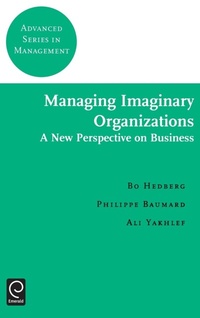
Managing Imaginary Organizations
Published on 13. December 2002
Book
Hardback
220 pages
978-0-08-043916-7 (ISBN)
Description
Traditionally, organizations have consisted of collections of people who physically gather together in one place to carry out some kind of coordinated activity. Today, however, business is increasingly relying on "virtual" processes in which people engage in internet-mediated interactions that often span the globe. These processes create intangible "imaginary organizations" that exist largely as a concept in the minds of electronically interacting individuals. As more and more high value-added work is performed by knowledge workers interacting through electronically mediated networks, however, managers and management researchers must evolve new concepts for monitoring, interpreting, assessing, and managing activities carried out in such virtual settings. This volume presents an important multidisciplinary approach to understanding these new kinds of imaginary organizations and their processes. Close reading of the papers in this volume should reward the reader with new insights into the inner workings of the new kinds of virtual organizations and processes that are gaining increasing prominence in business.
More details
Series
Language
English
Place of publication
London
United Kingdom
Publishing group
Emerald Publishing Limited
Target group
Professional and scholarly
Dimensions
Height: 235 mm
Width: 157 mm
Thickness: 17 mm
Weight
476 gr
ISBN-13
978-0-08-043916-7 (9780080439167)
Copyright in bibliographic data and cover images is held by Nielsen Book Services Limited or by the publishers or by their respective licensors: all rights reserved.
Schweitzer Classification
Content
Unpacking the Concept of Imaginary Organizations: Imaginary organizations - the extended enterprise opens new perspectives, B. Hedberg; Trust-based control, C. Maravelias; Learning from experience in imaginary organizations, M. Holmqvist; The sustainability of imaginary organizations - balancing knowledge and trust, P. Baumard. Managing Imaginary Organizations: Boundaryless organizations and organisational subjectivity, A. Yakhlef; Things that matter - a computerized system as a part of an emerging action net, L. Porsander; Organizing artificial sellers - exploring the automation of e-commerce, R. Gatarski; Building and sustaining brand equity in the imaginary organization: rationale, criteria and modeling, H. Uggla. Investigating Imaginary Organizations: Studying the imaginary and tracing net behavior - notes on methodology, S. Lundkvist, F. Sjostrand.