

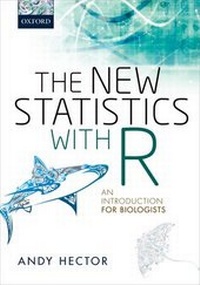
The New Statistics with R
An Introduction for Biologists
Published on 29. January 2015
Book
Paperback/Softback
224 pages
978-0-19-872906-8 (ISBN)
Description
Statistical methods are a key tool for all scientists working with data, but learning the basic mathematical skills can be one of the most challenging components of a biologist's training. This accessible book provides a contemporary introduction to the classical techniques and modern extensions of linear model analysis: one of the most useful approaches in the analysis of scientific data in the life and environmental sciences. It emphasizes an estimation-based
approach that accounts for recent criticisms of the over-use of probability values, and introduces alternative approaches using information criteria. Statistics are introduced through worked analyses performed in R, the free open source programming language for statistics and graphics, which is rapidly
becoming the standard software in many areas of science and technology. These analyses use real data sets from ecology, evolutionary biology and environmental science, and the data sets and R scripts are available as support material. The book's structure and user friendly style stem from the author's 20 years of experience teaching statistics to life and environmental scientists at both the undergraduate and graduate levels.
The New Statistics with R is suitable for senior undergraduate and graduate students, professional researchers, and practitioners in the fields of ecology, evolution, environmental studies, and computational biology.
Supporting material for the book is available at the author's website: www.plantecol.org/contemporary-analysis-for-ecology/
approach that accounts for recent criticisms of the over-use of probability values, and introduces alternative approaches using information criteria. Statistics are introduced through worked analyses performed in R, the free open source programming language for statistics and graphics, which is rapidly
becoming the standard software in many areas of science and technology. These analyses use real data sets from ecology, evolutionary biology and environmental science, and the data sets and R scripts are available as support material. The book's structure and user friendly style stem from the author's 20 years of experience teaching statistics to life and environmental scientists at both the undergraduate and graduate levels.
The New Statistics with R is suitable for senior undergraduate and graduate students, professional researchers, and practitioners in the fields of ecology, evolution, environmental studies, and computational biology.
Supporting material for the book is available at the author's website: www.plantecol.org/contemporary-analysis-for-ecology/
Reviews / Votes
The book is suitable for undergraduate and graduate students, researchers and practitioners in biological sciences. I found it refreshing and worthy of wide use. * Basil Jarvis, The Biologist * [T]his book is of great interest ... it is important to evaluate its value as a teaching tool for R for biologists. ... [T]he book's strength is that it takes an applied scientist through the necessary basic statistics, and shows step by step how to work with real data. The New Statistics with R is, furthermore, a great textbook for computer exercise sessions in any introductory statistical class (especially for the life sciences). With its help, one shouldbe able to design a very attractive course for both applied and more theoretical students. * Krzysztof Bartoszek, Systematic Biology * ... overall the book gives useful, ecumenical, and reliable statistical advice. I would recommend it for courses that are trying to equip students who already know elementary statistics with the basic tools they need to understand and perform analyses of real, messy data. * Ben Bolker, Quarterly Review of Biology *
More details
Language
English
Place of publication
Oxford
United Kingdom
Target group
College/higher education
Dimensions
Height: 241 mm
Width: 168 mm
Thickness: 10 mm
Weight
426 gr
ISBN-13
978-0-19-872906-8 (9780198729068)
Copyright in bibliographic data and cover images is held by Nielsen Book Services Limited or by the publishers or by their respective licensors: all rights reserved.
Schweitzer Classification
Other editions
New editions
Book
06/2021
2nd Edition
Oxford University Press
€55.00
Available immediately
Additional editions
Book
01/2015
Oxford University Press
€113.89
Article exhausted; check different version
Person
Andy Hector is Professor of Ecology in the University of Oxford's Department of Plant Sciences. He currently convenes and teaches statistics on the Quantitative Methods for Biologists course for undergraduates. He is a community ecologist interested in biodiversity loss and its consequences for ecosystem functioning, stability and services and scientific PI of the Sabah Biodiversity Experiment. He has contributed to several publications on ecological
analysis.
analysis.
Content
1. Introduction ; 2. Comparing Groups: Analysis of Variance ; 3. Comparing Groups: Student's t test ; 4. Linear Regression ; 5. Comparisons using Estimates and Intervals ; 6. Interactions ; 7. Analysis of Covariance: ANCOVA ; 8. Maximum Likelihood and Generalized Linear Models ; 9. Generalized Linear Models for Data with Non-Normal Distributions ; 10. Mixed Effects Models ; 11. Generalized Linear Mixed-effects Models ; 12. Final Thoughts ; Appendix 1: A very short introduction to the R programming language for statistics and graphics