

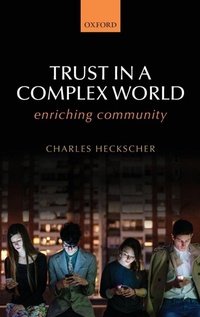
Trust in a Complex World
Enriching Community
Published on 29. October 2015
Book
Hardback
336 pages
978-0-19-870855-1 (ISBN)
Description
Can we rebuild trust in a time of increasing conflict and paralysis? Or rather, can we build trust, for the first time, wide and strong enough to bring us together to work on the complex problems of our age?
Relations of trust have been weakened over the past century by a historic expansion of communication and cross-cultural interaction, and the advance of complex, fluid relationships. Now the rapid rise of the internet has accelerated the disruption. Many long for the comfort and security of relations in which one knew whom to trust and what to expect; yet at the same time they may embrace the dynamism and creativity that comes from mixing of cultures and perspectives.
This book explores current conflicts and confusions of relations and identities, using both general theory and specific cases. It argues that we are at a catalyzing moment in a long transition from a community in which the prime rule was tolerance, to one with a commitment to understanding; from one where it was considered wrong to argue about cultural differences, to one where such arguments are essential.
The development of this rich community is essential as well as difficult. Complex societies produce complex challenges, from climate change to inequality to the risk-laden opportunities of bioengineering, that demand collaboration among people with widely varying views. Such brewing crises cannot be worked through without far more deliberate discussion and cooperation, and higher levels of trust, than we have today. This book explores many challenges ahead and suggests some practical directions for resolving them.
Relations of trust have been weakened over the past century by a historic expansion of communication and cross-cultural interaction, and the advance of complex, fluid relationships. Now the rapid rise of the internet has accelerated the disruption. Many long for the comfort and security of relations in which one knew whom to trust and what to expect; yet at the same time they may embrace the dynamism and creativity that comes from mixing of cultures and perspectives.
This book explores current conflicts and confusions of relations and identities, using both general theory and specific cases. It argues that we are at a catalyzing moment in a long transition from a community in which the prime rule was tolerance, to one with a commitment to understanding; from one where it was considered wrong to argue about cultural differences, to one where such arguments are essential.
The development of this rich community is essential as well as difficult. Complex societies produce complex challenges, from climate change to inequality to the risk-laden opportunities of bioengineering, that demand collaboration among people with widely varying views. Such brewing crises cannot be worked through without far more deliberate discussion and cooperation, and higher levels of trust, than we have today. This book explores many challenges ahead and suggests some practical directions for resolving them.
Reviews / Votes
a compelling work of social theory that illuminates the promise of an emerging 21st century institutional form: the "rich community" built on diversity and differentiated identities joined by collaboration and mutual adjustment. Professor Heckscher documents its rise and the fumbles and controversies along the way, arguing that the shared sensibility of this kind of loosely-bounded, fluid, Internet-enabled community is necessary to solve major world problems such as climate change, global conflict, or racial tensions. The book harks back to Weber in its emphasis on patterns of meaning, yet is highly relevant to the big questions of our time * Rosabeth Moss Kanter, Harvard Business School * At a moment in which social scientists seem to be shying away from the big questions that animated classical social theory, Trust in a Complex World takes on the most significant problems of our time and addresses them in a fresh and compelling way. Building upon a deep foundation of social theory, knowledge of the social-science literature, and just plain erudition, the author argues convincingly that both traditional and communitarian forms of community are unequal to the challenges contemporary societies face, and (with appropriate caution and reflexivity) proposes as third model of community, better adapted to current conditions and inchoate in several contemporary institutions, that offers a potential solution. In both diagnosis and prescription, this is a book with which every social scientist - indeed, every educated citizen - will find it profitable to read and engage. * Paul DiMaggio, Princeton University * Our world seems to grow ever more fragmented, even as technology allows us to connect with others around the world on a daily basis. [Those on the political right and left both advocate for greater community, although they often mean different things.] Charles Hecksher's Trust in a Complex World lays out how we can build the trust we need to solve the big problems we face as a species. He advocates for a "rich community" that allows people to collaborate across the boundaries that traditionally separated us. [It is a hopeful book for an anxious age.] * Gerald F. Davis, Wilbur K. Pierpont Professor of Management, The University of Michigan *More details
Language
English
Place of publication
Oxford
United Kingdom
Target group
College/higher education
Dimensions
Height: 240 mm
Width: 161 mm
Thickness: 23 mm
Weight
669 gr
ISBN-13
978-0-19-870855-1 (9780198708551)
Copyright in bibliographic data and cover images is held by Nielsen Book Services Limited or by the publishers or by their respective licensors: all rights reserved.
Schweitzer Classification
Other editions
Additional editions
E-Book
10/2015
1st Edition
OUP eBook
€35.49
Available for download
Person
Charles Heckscher is a Professor at Rutgers University and co-Director of the Center for the Study of Collaboration in Work and Society. His research has focused on organization change and the changing nature of employee representation. He has also worked in many industries as a practitioner and consultant on processes of organizational development. Before coming to Rutgers he worked for the Communications Workers' Union and taught Human Resources Management at the Harvard Business School. His books include The New Unionism, White-Collar Blues, Agents of Change, and The Collaborative Enterprise.
Content
Preface: a Navigational Overview ; 1. Trust and Community ; 2. Past: Associational Community in the Modern Era ; 3. Present: The Decline of the Modern Community ; 4. Future Emergent: Rich Community and the Interactive Sensibility ; 5. Future Anticipated: Working Out the Rich Community ; 6. Collaboration: Working Together in a Rich Community ; 7. The Contest for Legitimacy ; 8. Conclusion ; 9. Theoretical Framework ; 10. Survey