

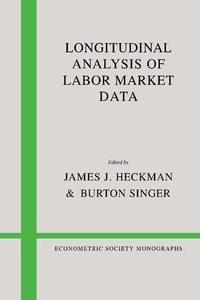
Longitudinal Analysis of Labor Market Data
Published on 30. October 2008
Book
Paperback/Softback
428 pages
978-0-521-08818-3 (ISBN)
Description
Longitudinal Analysis of Labor Market Data presents a set of papers by leading scholars on methods for analysing the longitudinal data that is available on numerous topics of interest to social scientists. Because many sources of longitudinal data record labour market phenomena such as unemployment, labour supply, earnings mobility, job turnover and participation in training programmes, all of the papers collected in this volume focus on models of the labour market. The main methodological points, however, are more general and apply to such diverse areas as demography, life science analysis and training evaluation, to name only a few, potential avenues of application. The book contains important methodological contributions to the emerging field of longitudinal analysis and is of interest to a wide range of social scientists.
More details
Series
Language
English
Place of publication
Cambridge
United Kingdom
Target group
Professional and scholarly
Product notice
Paperback (trade)
Illustrations
Worked examples or Exercises
Dimensions
Height: 229 mm
Width: 152 mm
Thickness: 25 mm
Weight
691 gr
ISBN-13
978-0-521-08818-3 (9780521088183)
Copyright in bibliographic data and cover images is held by Nielsen Book Services Limited or by the publishers or by their respective licensors: all rights reserved.
Schweitzer Classification
Other editions
Additional editions
James J. Heckman | Burton S. Singer
Longitudinal Analysis of Labor Market Data
Book
10/1985
Cambridge University Press
€86.66
Article exhausted; check for reprint
Previous edition
James J. Heckman | Burton S. Singer
Longitudinal Analysis of Labor Market Data
Book
10/1985
Cambridge University Press
€86.66
Article exhausted; check for reprint
Content
Part I. Econometric studies: 1. Heterogeneity, omitted variable bias, and duration dependence Gary Chamberlain; 2. Social science duration analysis James J. Heckman and Burton Singer; 3. Interpreting empirical models of labor supply in an intertemporal framework with uncertainty Thomas E. MaCurdy; 4. Alternative methods for evaluating the impact of interventions James J. Heckman and Richard Robb, Jr.; Part II. Statistical studies: 5. Weighting, misclassification, and other issues in the analysis of survey samples of life histories Jan M. Hoerr; 6. Statistical models for longitudinal labor market data based on counting processes Per Kragh Andersen; 7. Assessing qualitative features of longitudinal data Haling Frydman and Burton Singer; Part III. Sociometric studies: 8. Effects of labor market structure on job shift patterns Nancy Brandon Tuma; 9.School enrollment, military enlistment, and the transition to work: implications for the age pattern of employment Robert D. Mare and Christopher Winship.