

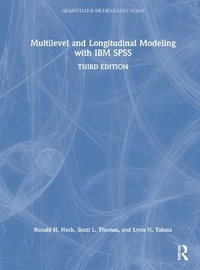
Multilevel and Longitudinal Modeling with IBM SPSS
3rd Edition
Published on 12. April 2022
Book
Hardback
484 pages
978-0-367-42460-2 (ISBN)
Description
Multilevel and Longitudinal Modeling with IBM SPSS, Third Edition, demonstrates how to use the multilevel and longitudinal modeling techniques available in IBM SPSS Versions 25-27. Annotated screenshots with all relevant output provide readers with a step-by-step understanding of each technique as they are shown how to navigate the program. Throughout, diagnostic tools, data management issues, and related graphics are introduced. SPSS commands show the flow of the menu structure and how to facilitate model building, while annotated syntax is also available for those who prefer this approach. Extended examples illustrating the logic of model development and evaluation are included throughout the book, demonstrating the context and rationale of the research questions and the steps around which the analyses are structured.
The book opens with the conceptual and methodological issues associated with multilevel and longitudinal modeling, followed by a discussion of SPSS data management techniques that facilitate working with multilevel, longitudinal, or cross-classified data sets. The next few chapters introduce the basics of multilevel modeling, developing a multilevel model, extensions of the basic two-level model (e.g., three-level models, models for binary and ordinal outcomes), and troubleshooting techniques for everyday-use programming and modeling problems along with potential solutions. Models for investigating individual and organizational change are next developed, followed by models with multivariate outcomes and, finally, models with cross-classified and multiple membership data structures. The book concludes with thoughts about ways to expand on the various multilevel and longitudinal modeling techniques introduced and issues (e.g., missing data, sample weights) to keep in mind in conducting multilevel analyses.
Key features of the third edition:
Thoroughly updated throughout to reflect IBM SPSS Versions 26-27.
Introduction to fixed-effects regression for examining change over time where random-effects modeling may not be an optimal choice.
Additional treatment of key topics specifically aligned with multilevel modeling (e.g., models with binary and ordinal outcomes).
Expanded coverage of models with cross-classified and multiple membership data structures.
Added discussion on model checking for improvement (e.g., examining residuals, locating outliers).
Further discussion of alternatives for dealing with missing data and the use of sample weights within multilevel data structures.
Supported by online data sets, the book's practical approach makes it an essential text for graduate-level courses on multilevel, longitudinal, latent variable modeling, multivariate statistics, or advanced quantitative techniques taught in departments of business, education, health, psychology, and sociology. The book will also prove appealing to researchers in these fields. The book is designed to provide an excellent supplement to Heck and Thomas's An Introduction to Multilevel Modeling Techniques, Fourth Edition; however, it can also be used with any multilevel or longitudinal modeling book or as a stand-alone text.
The book opens with the conceptual and methodological issues associated with multilevel and longitudinal modeling, followed by a discussion of SPSS data management techniques that facilitate working with multilevel, longitudinal, or cross-classified data sets. The next few chapters introduce the basics of multilevel modeling, developing a multilevel model, extensions of the basic two-level model (e.g., three-level models, models for binary and ordinal outcomes), and troubleshooting techniques for everyday-use programming and modeling problems along with potential solutions. Models for investigating individual and organizational change are next developed, followed by models with multivariate outcomes and, finally, models with cross-classified and multiple membership data structures. The book concludes with thoughts about ways to expand on the various multilevel and longitudinal modeling techniques introduced and issues (e.g., missing data, sample weights) to keep in mind in conducting multilevel analyses.
Key features of the third edition:
Thoroughly updated throughout to reflect IBM SPSS Versions 26-27.
Introduction to fixed-effects regression for examining change over time where random-effects modeling may not be an optimal choice.
Additional treatment of key topics specifically aligned with multilevel modeling (e.g., models with binary and ordinal outcomes).
Expanded coverage of models with cross-classified and multiple membership data structures.
Added discussion on model checking for improvement (e.g., examining residuals, locating outliers).
Further discussion of alternatives for dealing with missing data and the use of sample weights within multilevel data structures.
Supported by online data sets, the book's practical approach makes it an essential text for graduate-level courses on multilevel, longitudinal, latent variable modeling, multivariate statistics, or advanced quantitative techniques taught in departments of business, education, health, psychology, and sociology. The book will also prove appealing to researchers in these fields. The book is designed to provide an excellent supplement to Heck and Thomas's An Introduction to Multilevel Modeling Techniques, Fourth Edition; however, it can also be used with any multilevel or longitudinal modeling book or as a stand-alone text.
More details
Series
Edition
3rd edition
Language
English
Place of publication
London
United Kingdom
Publishing group
Taylor & Francis Ltd
Target group
College/higher education
Illustrations
425 s/w Abbildungen, 423 s/w Photographien bzw. Rasterbilder, 2 s/w Zeichnungen, 186 s/w Tabellen
186 Tables, black and white; 2 Line drawings, black and white; 423 Halftones, black and white; 425 Illustrations, black and white
Dimensions
Height: 280 mm
Width: 210 mm
Weight
1380 gr
ISBN-13
978-0-367-42460-2 (9780367424602)
Copyright in bibliographic data and cover images is held by Nielsen Book Services Limited or by the publishers or by their respective licensors: all rights reserved.
Schweitzer Classification
Other editions
Additional editions
Ronald H. Heck | Scott L. Thomas | Lynn N. Tabata
Multilevel and Longitudinal Modeling with IBM SPSS
Book
04/2022
3rd Edition
Routledge
€75.60
Shipment within 15-20 days
Ronald H. Heck | Scott L. Thomas | Lynn N. Tabata
Multilevel and Longitudinal Modeling with IBM SPSS
E-Book
04/2022
3rd Edition
Routledge
€69.99
Available for download
Ronald H. Heck | Scott L. Thomas | Lynn N. Tabata
Multilevel and Longitudinal Modeling with IBM SPSS
E-Book
04/2022
3rd Edition
Routledge
€69.99
Available for download
Previous edition
Ronald H. Heck | Scott L. Thomas | Lynn N. Tabata
Multilevel and Longitudinal Modeling with IBM SPSS
Book
07/2013
2nd Edition
Routledge
€222.84
Article exhausted; check for reprint
Persons
Ronald H. Heck is professor in the College of Education at the University of Hawai?i at Manoa. His research interests include school effects on student learning, educational policy, and research methods.
Scott L. Thomas is John P. "Jack" Ellbogen Dean in the College of Education at the University of Wyoming. His research interests include higher education policy and finance, sociology of education, and research methods.
Lynn N. Tabata was a graduate faculty member and research consultant at the University of Hawai'i at Manoa. Her research interests included broadening educational access to higher education, faculty participation in distance education, and the application of technological innovations in higher education.
Scott L. Thomas is John P. "Jack" Ellbogen Dean in the College of Education at the University of Wyoming. His research interests include higher education policy and finance, sociology of education, and research methods.
Lynn N. Tabata was a graduate faculty member and research consultant at the University of Hawai'i at Manoa. Her research interests included broadening educational access to higher education, faculty participation in distance education, and the application of technological innovations in higher education.
Content
1. Introduction to Multilevel Modeling with IBM SPSS 2. Preparing and Examining the Data for Multilevel Analyses 3. Defining a Basic Two-Level Multilevel Regression Model 4. Extending the Two-Level Univariate Model 5. Examining Individual Change with Repeated Measures Data 6. Applications of Mixed Models for Longitudinal Data 7. Multivariate Multilevel Models 8. Cross-Classified Multilevel Models 9. Further Considerations in Modeling Hierarchical Data