

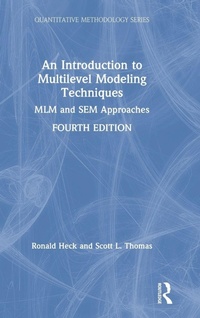
An Introduction to Multilevel Modeling Techniques
MLM and SEM Approaches
4th Edition
Published on 7. April 2020
Book
Hardback
388 pages
978-0-367-18242-7 (ISBN)
Description
Multilevel modelling is a data analysis method that is frequently used to investigate hierarchal data structures in educational, behavioural, health, and social sciences disciplines. Multilevel data analysis exploits data structures that cannot be adequately investigated using single-level analytic methods such as multiple regression, path analysis, and structural modelling. This text offers a comprehensive treatment of multilevel models for univariate and multivariate outcomes. It explores their similarities and differences and demonstrates why one model may be more appropriate than another, given the research objectives.
New to this edition:
An expanded focus on the nature of different types of multilevel data structures (e.g., cross-sectional, longitudinal, cross-classified, etc.) for addressing specific research goals;
Varied modelling methods for examining longitudinal data including random-effect and fixed-effect approaches;
Expanded coverage illustrating different model-building sequences and how to use results to identify possible model improvements;
An expanded set of applied examples used throughout the text;
Use of four different software packages (i.e., Mplus, R, SPSS, Stata), with selected examples of model-building input files included in the chapter appendices and a more complete set of files available online.
This is an ideal text for graduate courses on multilevel, longitudinal, latent variable modelling, multivariate statistics, or advanced quantitative techniques taught in psychology, business, education, health, and sociology. Recommended prerequisites are introductory univariate and multivariate statistics.
New to this edition:
An expanded focus on the nature of different types of multilevel data structures (e.g., cross-sectional, longitudinal, cross-classified, etc.) for addressing specific research goals;
Varied modelling methods for examining longitudinal data including random-effect and fixed-effect approaches;
Expanded coverage illustrating different model-building sequences and how to use results to identify possible model improvements;
An expanded set of applied examples used throughout the text;
Use of four different software packages (i.e., Mplus, R, SPSS, Stata), with selected examples of model-building input files included in the chapter appendices and a more complete set of files available online.
This is an ideal text for graduate courses on multilevel, longitudinal, latent variable modelling, multivariate statistics, or advanced quantitative techniques taught in psychology, business, education, health, and sociology. Recommended prerequisites are introductory univariate and multivariate statistics.
Reviews / Votes
"Developing a basic modeling strategy that researchers can follow to investigate multilevel data structures can be challenging. Heck and Thomas have once again presented a must-have reference book to get the job done. This edition's use of four different software packages and additional easy-to-follow illustrative examples enhance what was already a superb resource for both students and researchers." - George A. Marcoulides, University of California, Santa Barbara, USAMore details
Series
Edition
4th edition
Language
English
Place of publication
London
United Kingdom
Publishing group
Taylor & Francis Ltd
Target group
College/higher education
Illustrations
59 s/w Abbildungen, 56 s/w Photographien bzw. Rasterbilder, 3 s/w Zeichnungen, 95 s/w Tabellen
95 Tables, black and white; 3 Line drawings, black and white; 56 Halftones, black and white; 59 Illustrations, black and white
Dimensions
Height: 235 mm
Width: 157 mm
Thickness: 26 mm
Weight
736 gr
ISBN-13
978-0-367-18242-7 (9780367182427)
Copyright in bibliographic data and cover images is held by Nielsen Book Services Limited or by the publishers or by their respective licensors: all rights reserved.
Schweitzer Classification
Other editions
Additional editions
Ronald Heck | Scott L. Thomas
An Introduction to Multilevel Modeling Techniques
MLM and SEM Approaches
Book
04/2020
4th Edition
Routledge
€89.70
Shipment within 15-20 days
Ronald Heck | Scott L. Thomas
An Introduction to Multilevel Modeling Techniques
MLM and SEM Approaches
E-Book
03/2020
4th Edition
Routledge
€80.49
Available for download
Ronald Heck | Scott L. Thomas
An Introduction to Multilevel Modeling Techniques
MLM and SEM Approaches
E-Book
03/2020
4th Edition
Routledge
€80.49
Available for download
Previous edition
Ronald Heck | Scott L. Thomas
An Introduction to Multilevel Modeling Techniques
MLM and SEM Approaches Using Mplus, Third Edition
Book
03/2015
3rd Edition
Routledge
€222.84
Article exhausted; check for reprint
Persons
Ronald H. Heck is Professor of Education at the University of Hawai'i at Manoa. His areas of interest include organizational theory, policy, and quantitative research methods.
Scott L. Thomas is Professor and Dean of the College of Education and Social Services, University of Vermont. His specialties include sociology of education, policy, and quantitative research methods
Scott L. Thomas is Professor and Dean of the College of Education and Social Services, University of Vermont. His specialties include sociology of education, policy, and quantitative research methods
Content
Preface
1. Introduction
2. Getting Started with Multilevel Analysis
3. Multilevel Regression Models
4. Extending the Two-Level Regression Model
5. Methods for Examining Individual and Organizational Change
6. Multilevel Models with Categorical Variables
7. Multilevel Structural Equation Variables
8. Multilevel Latent Growth and Mixture Models
9. Data Consideration in Examining Multilevel Models
1. Introduction
2. Getting Started with Multilevel Analysis
3. Multilevel Regression Models
4. Extending the Two-Level Regression Model
5. Methods for Examining Individual and Organizational Change
6. Multilevel Models with Categorical Variables
7. Multilevel Structural Equation Variables
8. Multilevel Latent Growth and Mixture Models
9. Data Consideration in Examining Multilevel Models