

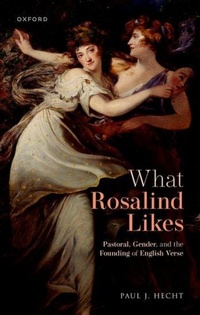
What Rosalind Likes
Pastoral, Gender, and the Founding of English Verse
Published on 13. July 2022
Book
Hardback
216 pages
978-0-19-285720-0 (ISBN)
Description
What Rosalind Likes begins with the strange ferocity of Elizabethan responses to poetry: a woman named Rosalind expresses scorn for a shepherd's poems, and a character in a play loses his temper and storms off stage at the sound of a blank verse line. What are these people so angry about? Thus begins a journey into a world where the details of poetic form and vagaries of Latin translation are caught up in the dynamics of gender, sexuality, class, and race, and power, where too much alliteration, for example, could destabilize your gender or pose a threat to national security. Situated in the crucial final two decades of the sixteenth century, What Rosalind Likes takes three figures named "Rosalind" in works by Spenser (The Shepheardes Calender), Lodge (Rosalynde), and Shakespeare (As You Like It) to create a new approach to literary history and feminist criticism.
The development and emergence of Rosalind as one of the most famous and beloved characters in the Shakespeare canon is thus connected to the troubled history of Virgilian reception, to tensions between aesthetics and sexual empowerment and powerlessness, to methodology associated with postcritique, including surface reading and the valorization of negative emotions, and to queer theology. The book ends by thinking about Rosalind with respect to the poetry of Mary Wroth, and examining depictions of Rosalind on stage and screen by Dora Jordan and Katharine Hepburn.
The development and emergence of Rosalind as one of the most famous and beloved characters in the Shakespeare canon is thus connected to the troubled history of Virgilian reception, to tensions between aesthetics and sexual empowerment and powerlessness, to methodology associated with postcritique, including surface reading and the valorization of negative emotions, and to queer theology. The book ends by thinking about Rosalind with respect to the poetry of Mary Wroth, and examining depictions of Rosalind on stage and screen by Dora Jordan and Katharine Hepburn.
Reviews / Votes
What Rosalind Likes is a fascinating book...The book is intricate and will reward readers with prior knowledge of both Elizabethan literature and gender studies. * Choice * The main strengths of Hecht's monograph lie in the technical close readings he provides of both English and Latin poetry and the connections he is able to tease out from these to other contemporary sources. * Archiv fuer das Studium der neueren Sprachen und Literaturen, 260:2 *More details
Language
English
Place of publication
Oxford
United Kingdom
Target group
Professional and scholarly
Product notice
sewn/stitched
Cloth over boards
Dimensions
Height: 211 mm
Width: 145 mm
Thickness: 28 mm
Weight
408 gr
ISBN-13
978-0-19-285720-0 (9780192857200)
Copyright in bibliographic data and cover images is held by Nielsen Book Services Limited or by the publishers or by their respective licensors: all rights reserved.
Schweitzer Classification
Other editions
Additional editions
E-Book
06/2022
1st Edition
OUP eBook
€49.99
Available for download
E-Book
06/2022
1st Edition
OUP eBook
€49.99
Available for download
Person
Paul J. Hecht was educated at Amherst College and Cornell University and has been Associate Professor of English at Purdue University Northwest since 2016, where he teaches literature and directs student productions of early modern drama. He is the author of several essays on early modern poetry and drama, and co-editor, with J. B. Lethbridge, of Spenser in the Moment (Fairleigh Dickinson University Press, 2015, reissued 2017).
Content
1: Introduction: What Rosalind Likes
2: Spenser's Rosalind: Flawed Poetry and Feminist Experiments
3: Lodge's Rosalind: Virtuous Lightness and Queer Mythography
4: Shakespeare's Rosalind: Homoeroticism, Tyranny, and Pastoral Concord
5: Mary Wroth, Dora Jordan, and Katharine Hepburn
Bibliography
2: Spenser's Rosalind: Flawed Poetry and Feminist Experiments
3: Lodge's Rosalind: Virtuous Lightness and Queer Mythography
4: Shakespeare's Rosalind: Homoeroticism, Tyranny, and Pastoral Concord
5: Mary Wroth, Dora Jordan, and Katharine Hepburn
Bibliography