

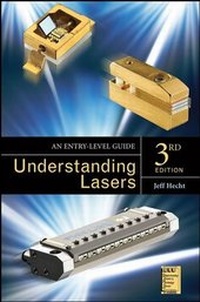
Understanding Lasers
An Entry-Level Guide
3rd Edition
Published on 24. June 2008
Book
Paperback/Softback
496 pages
978-0-470-08890-6 (ISBN)
Description
An up-to-date and easy-to-follow introduction to laser technology
Laser technology has become important in a wide range of practical applications, ranging from medicine and consumer electronics to telecommunications and military technology. Lasers are also vital tools on the cutting edge of research-eighteen recipients of the Nobel Prize received the award for laser-related research, including the laser itself, holography, laser cooling, and Bose-Einstein condensates.
Updated to reflect advancements since publication of the previous edition, Understanding Lasers, Third Edition offers an introduction to lasers and associated equipment at a level that nontechnicians can fundamentally understand. The author focuses on real-world lasers and assumes only a minimal background in algebra, making the book a practical, easy-to-follow guide for a broad audience.
Beginning with an overview of how lasers work, what they do, and how they're used, the book goes on to explore:
* Optics and laser accessories
* Semiconductor diode lasers
* Gas lasers
* Low-power laser applications
* Solid-state and fiber lasers
* High-power laser applications
* Lasers in research
Complete with conceptual drawings, tables, and multiple-choice quizzes with answers provided at the back of the book, Understanding Lasers, Third Edition serves as an ideal introduction to the subject for advanced high school students, undergraduate physics and engineering students, and professionals who work with lasers but lack formal training.
Laser technology has become important in a wide range of practical applications, ranging from medicine and consumer electronics to telecommunications and military technology. Lasers are also vital tools on the cutting edge of research-eighteen recipients of the Nobel Prize received the award for laser-related research, including the laser itself, holography, laser cooling, and Bose-Einstein condensates.
Updated to reflect advancements since publication of the previous edition, Understanding Lasers, Third Edition offers an introduction to lasers and associated equipment at a level that nontechnicians can fundamentally understand. The author focuses on real-world lasers and assumes only a minimal background in algebra, making the book a practical, easy-to-follow guide for a broad audience.
Beginning with an overview of how lasers work, what they do, and how they're used, the book goes on to explore:
* Optics and laser accessories
* Semiconductor diode lasers
* Gas lasers
* Low-power laser applications
* Solid-state and fiber lasers
* High-power laser applications
* Lasers in research
Complete with conceptual drawings, tables, and multiple-choice quizzes with answers provided at the back of the book, Understanding Lasers, Third Edition serves as an ideal introduction to the subject for advanced high school students, undergraduate physics and engineering students, and professionals who work with lasers but lack formal training.
Reviews / Votes
"This book is an easy-to-follow guide that requires a minimal background in algebra. The use of simple language, drawings, tables and multiple-choice quizzes make this book an ideal text for advanced high school students, undergraduates studying physics and engineering, and professionals who work with lasers but lack a formal knowledge of the subject." (Optics & Photonic News, April 2009) "College-level libraries strong in science and technology titles will appreciate this easy introduction guide to laser technology, which moves from the foundations of how lasers work and how they are used to discussions of specific advanced laser types, applications, and the science involved." (The Midwest Book Review, September 2008)More details
Series
Edition
3. Auflage
Language
English
Place of publication
United States
Publishing group
John Wiley & Sons Inc
Target group
Professional and scholarly
Illustrations
Photos: 25 B&W, 0 Color; Drawings: 125 B&W, 0 Color; Tables: 10 B&W, 0 Color
Dimensions
Height: 23.8 cm
Width: 15.4 cm
Thickness: 2.2 cm
Weight
678 gr
ISBN-13
978-0-470-08890-6 (9780470088906)
Schweitzer Classification
Other editions
New editions
Book
02/2019
4th Edition
Wiley-IEEE Press
€105.00
Shipment within 15-20 days
Additional editions
E-Book
09/2011
3rd Edition
Wiley-IEEE Press
€77.99
Available for download
Previous edition

Book
12/1993
2nd Edition
Wiley
€68.91
Article exhausted; check for reprint
Person
Jeff Hecht is a science and technology writer who has covered the laser industry for more than thirty years. He cofounded Lasers & Optronics magazine and has been a contributing editor to Laser Focus World since 1991, where he was also managing editor for seven years. He has been a Boston correspondent for New Scientist magazine since 1984 and is the author of eleven books. He has taught short courses on optics at SPIE, OSA, and IEEE LEOS conferences. He is a member of the IEEE, APS, OSA, and the National Association of Science Writers.
Content
Preface.
CHAPTER 1 Introduction and Overview.
CHAPTER 2 Physical Basics.
CHAPTER 3 How Lasers Work.
CHAPTER 4 Laser Characteristics.
CHAPTER 5 Optics and Laser Accessories.
CHAPTER 6 Types of Lasers.
CHAPTER 7 Gas Lasers.
CHAPTER 8 Solid-State and Fiber Lasers.
CHAPTER 9 Semiconductor Diode Lasers.
CHAPTER 10 Other Lasers and Related Sources.
CHAPTER 11 Low-Power Laser Applications.
CHAPTER 12 High-Power Laser Applications.
CHAPTER 13 Lasers In Research.
Answers to Quiz Questions.
Appendix A: Laser Safety.
Appendix B: Handy Numbers and Formulas.
Appendix C: Resources and Suggested Readings.
Glossary.
Index.
CHAPTER 1 Introduction and Overview.
CHAPTER 2 Physical Basics.
CHAPTER 3 How Lasers Work.
CHAPTER 4 Laser Characteristics.
CHAPTER 5 Optics and Laser Accessories.
CHAPTER 6 Types of Lasers.
CHAPTER 7 Gas Lasers.
CHAPTER 8 Solid-State and Fiber Lasers.
CHAPTER 9 Semiconductor Diode Lasers.
CHAPTER 10 Other Lasers and Related Sources.
CHAPTER 11 Low-Power Laser Applications.
CHAPTER 12 High-Power Laser Applications.
CHAPTER 13 Lasers In Research.
Answers to Quiz Questions.
Appendix A: Laser Safety.
Appendix B: Handy Numbers and Formulas.
Appendix C: Resources and Suggested Readings.
Glossary.
Index.