

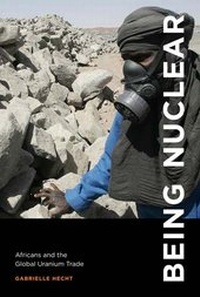
Being Nuclear
Africans and the Global Uranium Trade
Published on 2. March 2012
Book
Hardback
480 pages
978-0-262-01726-8 (ISBN)
Description
Uranium from Africa has long been a major source of fuel for nuclear power and atomic
weapons, including the bomb dropped on Hiroshima. In 2003, after the infamous "yellow cake from
Niger," Africa suddenly became notorious as a source of uranium, a component of nuclear
weapons. But did that admit Niger, or any of Africa's other uranium-producing countries, to the
select society of nuclear states? Does uranium itself count as a nuclear thing? In this book,
Gabrielle Hecht lucidly probes the question of what it means for something--a state, an object, an
industry, a workplace--to be "nuclear."
Hecht shows that questions
about being nuclear--a state that she calls "nuclearity"--lie at the heart of today's
global nuclear order and the relationships between "developing nations" (often former
colonies) and "nuclear powers" (often former colonizers). Hecht enters African nuclear
worlds, focusing on miners and the occupational hazard of radiation exposure. Could a mine be a
nuclear workplace if (as in some South African mines) its radiation levels went undetected and
unmeasured? With this book, Hecht is the first to put Africa in the nuclear world, and the nuclear
world in Africa. By doing so, she remakes our understanding of the nuclear age.
weapons, including the bomb dropped on Hiroshima. In 2003, after the infamous "yellow cake from
Niger," Africa suddenly became notorious as a source of uranium, a component of nuclear
weapons. But did that admit Niger, or any of Africa's other uranium-producing countries, to the
select society of nuclear states? Does uranium itself count as a nuclear thing? In this book,
Gabrielle Hecht lucidly probes the question of what it means for something--a state, an object, an
industry, a workplace--to be "nuclear."
Hecht shows that questions
about being nuclear--a state that she calls "nuclearity"--lie at the heart of today's
global nuclear order and the relationships between "developing nations" (often former
colonies) and "nuclear powers" (often former colonizers). Hecht enters African nuclear
worlds, focusing on miners and the occupational hazard of radiation exposure. Could a mine be a
nuclear workplace if (as in some South African mines) its radiation levels went undetected and
unmeasured? With this book, Hecht is the first to put Africa in the nuclear world, and the nuclear
world in Africa. By doing so, she remakes our understanding of the nuclear age.
More details
Language
English
Place of publication
Cambridge, Mass.
United States
Publishing group
MIT Press Ltd
Target group
US School Grade: College Graduate Student and over
Illustrations
53 s/w Photographien bzw. Rasterbilder
53 b&w photos
Dimensions
Height: 229 mm
Width: 152 mm
Thickness: 0 mm
Weight
454 gr
ISBN-13
978-0-262-01726-8 (9780262017268)
Copyright in bibliographic data and cover images is held by Nielsen Book Services Limited or by the publishers or by their respective licensors: all rights reserved.
Schweitzer Classification
Other editions
Additional editions
Book
08/2014
MIT Press
€29.20
Article exhausted; check different version
E-Book
03/2012
MIT Press
€29.49
Available for download
Person
Gabrielle Hecht is Professor of History at the University of Michigan. She is the author of The Radiance of France: Nuclear Power and National Identity after World War II and editor of Entangled Geographies: Empire and Technopolitics in the Global Cold War, both published by the MIT Press.