

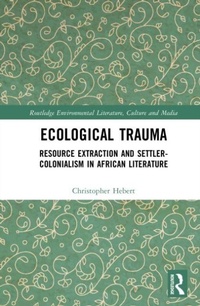
Ecological Trauma
Description
Intervening in debates across literary trauma theory and ecocriticism, this book argues that in an age increasingly defined by the impacts of anthropogenic climate change on society and ecology, it is necessary to graft the ethical concerns of trauma studies onto the lessons of ecocriticism, especially in the context of African literatures.
Drawing upon a corpus of African literary texts ranging temporally from 1950 to 2021 and geographically from Nigeria and Cameroon to South Africa, Botswana, Zambia, and Zimbabwe, this book examines how ecological trauma is bound up in human systems of exchange, extraction, and domination. Each text portrays ecological trauma from a different geographical and historical perspective, but they all underscore the wide-ranging ecological and human costs of resource extraction and settler-colonialism across the African continent. Ultimately, this book explores the connections between human and nonhuman communities victimized by anthropogenic climate change and dissects the difficult relationships between land, ecology, and human influence.
This book will be of interest to scholars and graduate students working in the fields of African literatures, the environmental humanities, trauma studies, and postcolonial studies, as well as all those interested in narrative in the Anthropocene.
More details
Other editions
Additional editions

Person
Christopher R. Hebert is an independent scholar working at the intersection of ecocriticism and literary trauma theory. He holds a B.S. in English from the United States Military Academy at West Point, and an M.A. and Ph.D. in African Studies from Ghent University, Belgium where he was a Fulbright Scholar from 2021-2022. His work has previously been published in Research in African Literatures and ARIEL: A Review of International English Literature.
Content
Introduction: The Question of Ecological Trauma 1. Imagining the Natural World in West African Ecofiction 2. Resource Extraction as Ecological Trauma in the Niger Delta and Beyond 3. Settler-Colonialism and Environmental Violence in South African Fiction 4. Cultivation, Disintegration, and Regeneration in the Works of Southern African Women Writers 5. Africanfuturist Visions of Ecological Crisis Conclusion