

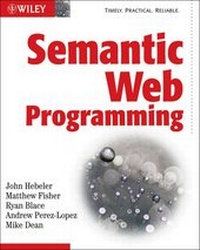
Semantic Web Programming
Published on 9. April 2009
Book
Paperback/Softback
652 pages
978-0-470-41801-7 (ISBN)
Unfortunately, price unknown
Article exhausted; check different version
Description
The next major advance in the Web-Web 3.0-will be built on semantic Web technologies, which will allow data to be shared and reused across application, enterprise, and community boundaries. Written by a team of highly experienced Web developers, this book explains examines how this powerful new technology can unify and fully leverage the ever-growing data, information, and services that are available on the Internet. Helpful examples demonstrate how to use the semantic Web to solve practical, real-world problems while you take a look at the set of design principles, collaborative working groups, and technologies that form the semantic Web. The companion Web site features full code, as well as a reference section, a FAQ section, a discussion forum, and a semantic blog.
More details
Other editions
Additional editions
John Hebeler | Matthew Fisher | Ryan Blace
Semantic Web Programming
E-Book
02/2011
Wiley
€28.99
Available for download
John Hebeler | Matthew Fisher | Ryan Blace
Semantic Web Programming
Valuation, Exploitation, and Infringement Damages
E-Book
04/2009
Wiley
€28.99
Available for download
Persons
John Hebeler has more than two decades of large-scale software development experience. Matt Fisher has more than fifteen years in software and systems development. Ryan Blace is a Semantic Web developer and has worked on multiple large-scale Semantic Web-based knowledge management systems. Andrew Perez-Lopez is a software developer with several years of experience with Semantic Web information systems.
Content
Foreword.
Introduction.
Part One Introducing Semantic Web Programming.
Chapter 1 Preparing to Program a Semantic Web of Data.
Chapter 2 Hello Semantic Web World.
Part Two Foundations of Semantic Web Programming.
Chapter 3 Modeling Information.
Chapter 4 Incorporating Semantics.
Chapter 5 Modeling Knowledge in the Real World.
Chapter 6 Discovering Information.
Chapter 7 Adding Rules.
Part Three Building Semantic Web Applications.
Chapter 8 Applying a Programming Framework.
Chapter 9 Combining Information.
Chapter 10 Aligning Information.
Chapter 11 Sharing Information.
Part Four Expanding Semantic Web Programming.
Chapter 12 Developing and Using Semantic Services.
Chapter 13 Managing Space and Time.
Chapter 14 Semantic Web Patterns and Best Practices.
Chapter 15 Moving Forward.
Appendix A RDF.
Appendix B The OWL Web Ontology Language.
Appendix C SWRL.
Appendix D SPARQL.
Appendix E Jena Reference Guide.
Appendix F Installation Reference Guide.
Index.
Introduction.
Part One Introducing Semantic Web Programming.
Chapter 1 Preparing to Program a Semantic Web of Data.
Chapter 2 Hello Semantic Web World.
Part Two Foundations of Semantic Web Programming.
Chapter 3 Modeling Information.
Chapter 4 Incorporating Semantics.
Chapter 5 Modeling Knowledge in the Real World.
Chapter 6 Discovering Information.
Chapter 7 Adding Rules.
Part Three Building Semantic Web Applications.
Chapter 8 Applying a Programming Framework.
Chapter 9 Combining Information.
Chapter 10 Aligning Information.
Chapter 11 Sharing Information.
Part Four Expanding Semantic Web Programming.
Chapter 12 Developing and Using Semantic Services.
Chapter 13 Managing Space and Time.
Chapter 14 Semantic Web Patterns and Best Practices.
Chapter 15 Moving Forward.
Appendix A RDF.
Appendix B The OWL Web Ontology Language.
Appendix C SWRL.
Appendix D SPARQL.
Appendix E Jena Reference Guide.
Appendix F Installation Reference Guide.
Index.