

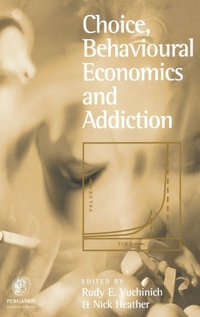
Choice, Behavioural Economics and Addiction
Published on 13. November 2003
Book
Hardback
458 pages
978-0-08-044056-9 (ISBN)
Description
Choice, Behavioural Economics and Addiction is about the theory, data, and applied implications of choice-based models of substance use and addiction. The distinction between substance use and addiction is important, because many individuals use substances but are not also addicted to them. The behavioural economic perspective has made contributions to the analysis of both of these phenomena and, while the major focus of the book is on theories of addiction, it is necessary also to consider the behavioural economic account of substance use in order to place the theories in their proper context and provide full coverage of the contribution of behavioural economics to this field of study.
The book discusses the four major theories of addiction that have been developed in the area of economic science/behavioural economics. They are:
* hyperbolic discounting
* melioration
* relative addiction
* rational addiction
The main objective of the book is to popularise these ideas among addiction researchers, academics and practitioners. The specific aims are to articulate the shared and distinctive elements of these four theories, to present and discuss the latest empirical work on substance abuse and addiction that is being conducted in this area, and to articulate a range of applied implications of this body of work for clinical, public health and public policy initiatives.
The book is based on an invitation-only conference entitled, Choice, Behavioural Economics and Addiction: Theory, Evidence and Applications held at the University of Alabama at Birmingham, March 30 - April 1, 2001. The conference was attended by prominent scientists and scholars, representing a range of disciplines concerned with theories of addiction and their consequences for policy and practice. The papers in the book are based on the papers given at the above conference, together with commentaries by distinguished experts and, in many cases, replies to these comments by the presenters.
The book discusses the four major theories of addiction that have been developed in the area of economic science/behavioural economics. They are:
* hyperbolic discounting
* melioration
* relative addiction
* rational addiction
The main objective of the book is to popularise these ideas among addiction researchers, academics and practitioners. The specific aims are to articulate the shared and distinctive elements of these four theories, to present and discuss the latest empirical work on substance abuse and addiction that is being conducted in this area, and to articulate a range of applied implications of this body of work for clinical, public health and public policy initiatives.
The book is based on an invitation-only conference entitled, Choice, Behavioural Economics and Addiction: Theory, Evidence and Applications held at the University of Alabama at Birmingham, March 30 - April 1, 2001. The conference was attended by prominent scientists and scholars, representing a range of disciplines concerned with theories of addiction and their consequences for policy and practice. The papers in the book are based on the papers given at the above conference, together with commentaries by distinguished experts and, in many cases, replies to these comments by the presenters.
Reviews / Votes
"I highly recommend this ground-breaking book on the behavioural economics of choice applied to the analysis of addictive behaviour. The material presented in this exciting work represents a cutting-edge integration of basic behavioural science and economic theory by the leading experts and proponents of behavioural choice theories. What is revolutionary about this approach is that it moves the addictions field from its traditional preoccupation with internal biological/genetic determinants of addiction as a pathological disease to a new formulation that views addictive behaviour as a 'rational' choice? It is 'must reading' for students and professionals alike in the addictions field, including researchers and practitioners in the clinical, public health, and public policy areas. When it comes to making a decision about whether to read this book, in my view it is clearly a 'Win/Win' choice." --G. Alan Marlatt, PhD. Director, Addictive Behaviors Research Center, Professor of Psychology, University of Washington, USAMore details
Language
English
Place of publication
London
United Kingdom
Publishing group
Elsevier Science & Technology
Target group
Professional and scholarly
For specialist workers in the addictions field including clinical psychologists, psychiatrists, sociologists and economists.
Product notice
Laminated cover
Dimensions
Height: 241 mm
Width: 161 mm
Thickness: 32 mm
Weight
812 gr
ISBN-13
978-0-08-044056-9 (9780080440569)
Copyright in bibliographic data and cover images is held by Nielsen Book Services Limited or by the publishers or by their respective licensors: all rights reserved.
Schweitzer Classification
Other editions
Additional editions
Nick Heather | Nick Heather | Rudy E. Vuchinich
Choice, Behavioural Economics and Addiction
E-Book
11/2003
Pergamon
€124.00
Available for download
Persons
Content
Views from Four Theories of Addiction. Other Perspectives on Addiction. Empirical Studies of Addiction. Practical Implications.