

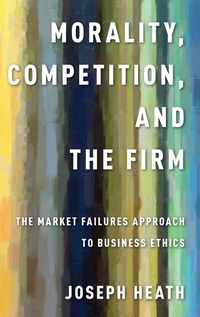
Morality, Competition, and the Firm
The Market Failures Approach to Business Ethics
Published on 11. September 2014
Book
Hardback
424 pages
978-0-19-999048-1 (ISBN)
Description
In this collection of provocative essays, Joseph Heath provides a compelling new framework for thinking about the moral obligations that private actors in a market economy have toward each other and to society. In a sharp break with traditional approaches to business ethics, Heath argues that the basic principles of corporate social responsibility are already implicit in the institutional norms that structure both marketplace competition and the modern business corporation. In four new and nine previously published essays, Heath articulates the foundations of a "market failures" approach to business ethics. Rather than bringing moral concerns to bear upon economic activity as a set of foreign or externally imposed constraints, this approach seeks to articulate a robust conception of business ethics derived solely from the basic normative justification for capitalism. The result is a unified theory of business ethics, corporate law, economic regulation, and the welfare state, which offers a reconstruction of the central normative preoccupations in each area that is consistent across all four domains. Beyond the core theory, Heath offers new insights on a wide range of topics in economics and philosophy, from agency theory and risk management to social cooperation and the transaction cost theory of the firm.
Reviews / Votes
Undergraduate and graduate students in business and society courses might be well served by focusing on these two sections of the book; later chapters balance the text by delving further into details for those desiring much greater depth or conducting research on the subject. There is also an outstanding bibliography ... Highly recommended. * Choice * ... Morality, Competition, and the Firm is a rich anthology. Itas a tour-de-force of political economy, corporate governance, and business ethics. It contains powerful critiques of virtue ethics and the misuse of moral psychology by other business ethicists. It is valuable reading for anyone interested narrowly in business ethics, but also more broadly in political philosophy or the intersection of politics, philosophy, and economics. * Jason Brennan, Kennedy Institute of Ethics Journal * ...the book is well worth engaging by anyone interested in economics, agency theory, fiduciary concerns, public policy, corporate governance, and of course, business ethics. Heath is to be commended for this provocative book, explaining a provocative approach to business ethics (market failures approach) that sees as its guiding star the always elusive Pareto-optimal market conditions. I know it has informed my own approach to how I will teach stakeholder theory, theory of the firm, and competition in future courses. * Notre Dame Philosophical Reviews Online *More details
Language
English
Place of publication
New York
United States
Target group
College/higher education
Professional and scholarly
Illustrations
10 illus.
Dimensions
Height: 240 mm
Width: 161 mm
Thickness: 27 mm
Weight
798 gr
ISBN-13
978-0-19-999048-1 (9780199990481)
Copyright in bibliographic data and cover images is held by Nielsen Book Services Limited or by the publishers or by their respective licensors: all rights reserved.
Schweitzer Classification
Other editions
Additional editions
Book
03/2020
Oxford University Press Inc
€57.10
Shipment within 15-20 days
E-Book
08/2014
1st Edition
OUP eBook
€24.99
Available for download
Person
Joseph Heath is a Professor in the Department of Philosophy as well as the School of Public Policy and Governance at the University of Toronto. He is the author of numerous scholarly works, including Communicative Action and Rational Choice (2001) and Following the Rules (2008). In 2012 he was appointed a fellow of the Trudeau Foundation.
Content
Acknowledgements ; Introduction ; Part 1: The Corporation and Society ; 1. A Market Failures Approach to Business Ethics ; 2. Stakeholder Theory, Corporate Governance and Public Management (with Wayne Norman) ; 3. Business Ethics Without Stakeholders ; 4. An Adversarial Ethic for Business: or, When Sun-Tzu met the Stakeholder ; 5. Business Ethics and the 'End of History' in Corporate Law ; Part 2: Cooperation and the Market ; 6. Contractualism: Micro and Macro ; 7. Efficiency as the Implicit Morality of the Market ; 8. The History of the Invisible Hand ; 9. The Benefits of Cooperation ; Part 3: Extending the Framework ; 10. The Uses and Abuses of Agency Theory ; 11. Business Ethics and Moral Motivation: a Criminological Perspective ; 12. Business Ethics After Virtue ; 13. Reasonable Restrictions on Underwriting ; Bibliography ; Index