

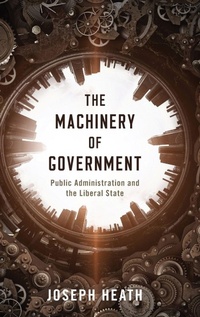
The Machinery of Government
Public Administration and the Liberal State
Published on 22. September 2020
Book
Hardback
440 pages
978-0-19-750961-6 (ISBN)
Description
In political theory, the traditional model of state power was that elected officials make policy decisions which are then faithfully executed by a lower cadre of public servants. The complexity of the modern state, however, leaves this model outdated. The vast number of economic and social problems it confronts is such that a great deal of rule-making power is now delegated to a class of civil servants. Yet many political philosophers have not taken this model up, and the field has ignored the important role played by the class of "permanent" state officials--the "deep state" as some call it--in liberal states.
In most liberal democracies for example, the central bank is as independent as the supreme court, yet deals with a wide range of economic, social, and political issues. How do these public servants make these policy decisions? What normative principles inform their judgments? In The Machinery of Government, Joseph Heath attempts to answer these questions. He looks to the actual practice of public administration to see how normative questions are addressed. More broadly, he attempts to provide the outlines of a "philosophy of the executive" by taking seriously the claim to political authority of the most neglected of the three branches of the state. Heath both provides a corrective to the prevailing tendency to underestimate the contribution of civil servants to the success of liberal-democratic welfare states, and suggests a more satisfactory account of the principles implicit in public administration.
In most liberal democracies for example, the central bank is as independent as the supreme court, yet deals with a wide range of economic, social, and political issues. How do these public servants make these policy decisions? What normative principles inform their judgments? In The Machinery of Government, Joseph Heath attempts to answer these questions. He looks to the actual practice of public administration to see how normative questions are addressed. More broadly, he attempts to provide the outlines of a "philosophy of the executive" by taking seriously the claim to political authority of the most neglected of the three branches of the state. Heath both provides a corrective to the prevailing tendency to underestimate the contribution of civil servants to the success of liberal-democratic welfare states, and suggests a more satisfactory account of the principles implicit in public administration.
Reviews / Votes
Readers will find this book a fresh take on an enduring problem ... there is little doubt it will stimulate lively thought and discussion. * M. E. Ethridge, CHOICE * The Machinery of Government is a valuable book. Heath's methodological approach-involving a careful examination of current practice along with a reconstruction of its implicit moral underpinning-presents a refreshing alternative to the conceptual approach taken by many applied ethicists. He avoids handing down tablets containing uninformed and impractical prescriptions; he succeeds in blending moral analysis with a deep understanding of the day-to-day requirements of governance. * Alexander Schaefer, The Independent Review *More details
Language
English
Place of publication
New York
United States
Target group
Professional and scholarly
Dimensions
Height: 240 mm
Width: 161 mm
Thickness: 28 mm
Weight
819 gr
ISBN-13
978-0-19-750961-6 (9780197509616)
Copyright in bibliographic data and cover images is held by Nielsen Book Services Limited or by the publishers or by their respective licensors: all rights reserved.
Schweitzer Classification
Other editions
Additional editions
E-Book
08/2020
OUP eBook
€17.49
Available for download
E-Book
08/2020
OUP eBook
€17.49
Available for download
Person
Joseph Heath is Professor in the Department of Philosophy and the Munk School of Global Affairs and Public Policy at the University of Toronto. A fellow of the Royal Society of Canada and the Trudeau Foundation, Heath is the author of several books, both popular and academic. His most recent, Morality, Competition and the Firm (Oxford University Press 2014), is a collection of papers on business ethics and the normative foundations of market economies. He is also the author of Enlightenment 2.0, which won the Shaughnessy Cohen prize for Political Writing in Canada.
Content
1. Taking Public Administration Seriously
1.1 Inside the machine
1.2 Beyond discretion
1.3 Administrative power
1.4 The permanent civil service
1.5 Political neutrality
1.6 Liberalism or democracy?
1.7 Conclusion
2. A General Framework for the Ethics of Public Administration
2.1 Preliminary clarifications
2.2 Three models of accountability
2.3 The hierarchical model
2.4 The popular model
2.5 The vocational model
2.6 Conclusion
3. Liberalism: From Classical to Modern
3.1 Before liberalism
3.2 The rise of classical liberalism
3.3 The triumph of classical liberalism
3.4 The decline of classical liberalism
3.5 The rise of modern liberalism
3.6 Conclusion
4. Efficiency and the Rise of the Welfare State
4.1 The egalitarian model
4.2 The communitarian model
4.3 The public-economic model
4.4 Assessing the models
4.5 Wagner's law
4.6 The rent-seeking view
4.7 Conclusion
5. Cost-Benefit Analysis as an Expression of Liberal Neutrality
5.1 "Embedded" CBA
5.2 Provision of a public good
5.3 Imposing a regulation
5.4 Assessing safety
5.5 Rationing health care
5.6 Environmental goods
5.7 The three-step procedure
5.8 Conclusion
6. Administrative Discretion and the Rule of Law
6.1 Discretion
6.2 Varieties of discretion
6.3 Discretionary enforcement
6.4 The morality of law
6.5 Administrative law
6.6 Conclusion
7. Paternalism and Individual Freedom
7.1 Mill's argument
7.2 Bureaucratic paternalism
7.3 The Harm Principle
7.4 Hyperbolic discounting
7.5 Cognitive bias
7.6 The nudge framework
7.7 Conclusion
1.1 Inside the machine
1.2 Beyond discretion
1.3 Administrative power
1.4 The permanent civil service
1.5 Political neutrality
1.6 Liberalism or democracy?
1.7 Conclusion
2. A General Framework for the Ethics of Public Administration
2.1 Preliminary clarifications
2.2 Three models of accountability
2.3 The hierarchical model
2.4 The popular model
2.5 The vocational model
2.6 Conclusion
3. Liberalism: From Classical to Modern
3.1 Before liberalism
3.2 The rise of classical liberalism
3.3 The triumph of classical liberalism
3.4 The decline of classical liberalism
3.5 The rise of modern liberalism
3.6 Conclusion
4. Efficiency and the Rise of the Welfare State
4.1 The egalitarian model
4.2 The communitarian model
4.3 The public-economic model
4.4 Assessing the models
4.5 Wagner's law
4.6 The rent-seeking view
4.7 Conclusion
5. Cost-Benefit Analysis as an Expression of Liberal Neutrality
5.1 "Embedded" CBA
5.2 Provision of a public good
5.3 Imposing a regulation
5.4 Assessing safety
5.5 Rationing health care
5.6 Environmental goods
5.7 The three-step procedure
5.8 Conclusion
6. Administrative Discretion and the Rule of Law
6.1 Discretion
6.2 Varieties of discretion
6.3 Discretionary enforcement
6.4 The morality of law
6.5 Administrative law
6.6 Conclusion
7. Paternalism and Individual Freedom
7.1 Mill's argument
7.2 Bureaucratic paternalism
7.3 The Harm Principle
7.4 Hyperbolic discounting
7.5 Cognitive bias
7.6 The nudge framework
7.7 Conclusion