

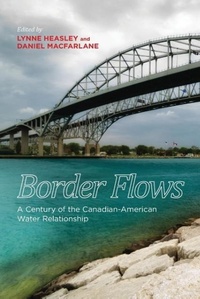
Border Flows
A Century of the Canadian-American Water Relationship
Published on 30. November 2016
Book
Paperback/Softback
352 pages
978-1-55238-895-2 (ISBN)
Description
Declining access to fresh water is one of the twenty-first century's most pressing environmental and human rights challenges, yet the struggle for water is not a new cause. The 8,800-kilometer border dividing Canada and the United States contains more than 20% of the world's total freshwater resources, and Border Flows traces the century-long effort by Canada and the United States to manage and care for their ecologically and economically shared rivers and lakes. Ranging across the continent, from the Great Lakes to the Northwest Passage to the Salish Sea, the histories in Border Flows offer critical insights into the historical struggle to care for these vital waters. From multiple perspectives, the book reveals alternative paradigms in water history, law, and policy at scales from the local to the transnational. Students, concerned citizens, and policymakers alike will benefit from the lessons to be found along this critical international border.
Reviews / Votes
This collection of thoughtful essays by an impressive group of expert contributors examines separation and inter-action along the aquatic borders, boundaries, and borderlands shared by Canada and the United States. How distinct jurisdictions as neighbours at various political levels have and will con-tinue to face common challenges makes this volume a valuable record of aquatic envi-ronmental history and a source of insights into the future of water, aptly described by the editors as aa fundamental environmental and moral concern of the twenty-first century.a -Jamie Benidickson, Faculty of Law and Centre for Environmental Law and Global Sustainability, University of Ottawa These impressive essays penetrate many dualisms-abundance and scarcity, Canada and the U.S., local and regional, science and humanities, and geography and history to name a few. The accomplished authors provide both rich details and expansive views of the transborder territory and illuminate both the shared and dissimilar interests of the two principal political entities, while exposing the mutual concerns that float atop the border-defying and fluid topic of water. Riding the rapids of a tumultuous subject, the contributors make sense of the highly contentious and complex issues for academic and lay readers alike. -Craig E. Colten, Carl O. Sauer Professor, Department of Geography & Anthropology, Louisiana State University Reading this book was like taking a boundary waters canoe trip with experienced guides narrating the landscape and humanityas place in it. They taught me about lakes, fish, and flora; law, politics, and prejudice; photographs, fish-buying, and ice-sail-ing. In the evening after dinner, around the campfire, these boundary waters guides spoke from their hearts about their love of nature and longing for a just world in the final section of the book entitled aFinding Our Place.a It was inspiring and enjoyable. I heartily recommend the journey. -Paul Hirt, Professor of History and Sustainability, Arizona State University "....This book presents close analyses of this paradox, as experienced in the waters and landscapes of the border regions of Canada and the United States. The editors, both at Western Michigan University, have brought together in this nicely constructed volume an international cast of historians and other scholars....". Bocking, S. (2018) Border Flows demonstrates the value of reaching across ideological and methodological boundaries that divide academic disciplines . . . the editors' keen sense for organization and the myriad conceptual connections that reach across each section, link this collection of articles to a larger aquatic context. This book will appeal to students and scholars from a wide variety of academic backgrounds and will serve as an excellent text for courses in legal history, environmental history, foreign relations, and borderlands studies. This edited collection represents a fine addition to the historiography of borders and water. - Erik Reardon, Canadian Journal of HistoryMore details
Series
Language
English
Place of publication
Calgary
Canada
Target group
Professional and scholarly
Product notice
Paperback (trade)
Unsewn / adhesive bound
Illustrations
35 illustrations, maps, photographs, and diagrams/charts
Dimensions
Height: 229 mm
Width: 152 mm
Thickness: 25 mm
Weight
549 gr
ISBN-13
978-1-55238-895-2 (9781552388952)
Copyright in bibliographic data and cover images is held by Nielsen Book Services Limited or by the publishers or by their respective licensors: all rights reserved.
Schweitzer Classification
Persons
Lynne Heasley is an Associate Professor with the Department of History and the Institute of the Environment and Sustainability at Western Michigan University. Her research examines the intersections and complex problems of ecology, economics, and culture in the Great Lakes-St. Lawrence basin. She is the author of A Thousand Pieces of Paradise: Landscape and Property in the Kickapoo Valley. Lynne Heasley is an Associate Professor with the Department of History and the Institute of the Environment and Sustainability at Western Michigan University. Her research examines the intersections and complex problems of ecology, economics, and culture in the Great Lakes-St. Lawrence basin. She is the author of A Thousand Pieces of Paradise: Landscape and Property in the Kickapoo Valley. FrA (c)dA (c)ric Lasserre is a professor of Geography at Laval University, Directeur du Centre QuA (c)bA (c)cois d'Atudes gA (c)opolitiques and a research associate at Groupe d'A (c)tudes et de recherche sur l'Asie contemporaine. Daniel Macfarlane is an assistant professor in the Institute of the Environment and Sustainability at Western Michigan University. Graeme Wynn is a professor of historical geography at the University of British Columbia and editor of BC Studies. He is a Fellow of The Royal Society of Canada and lives in Vancouver. Daniel Macfarlane is an assistant professor in the Institute of the Environment and Sustainability at Western Michigan University.
Content
List of Figures
Acknowledgements
Introduction
Negotiating Abundance and Scarcity: Introduction to a Fluid Border
Lynne Heasley and Daniel Macfarlane
Part One
Finding the Border: Political Ecologies of Water Governance and Tenure
Openings: Political Ecologies on the Border
Dave Dempsey
A Citizen's Legal Primer on the Boundary Waters Treaty, International Joint Commission, and Great Lakes Water Management
Noah D. Hall and Peter Starr
Treaties, Wars, and Salish Sea Watersheds: The Constructed Boundaries of Water Governance
Emma S. Norman and Alice Cohen
Contesting the Northwest Passage: Four Far-North Narravies
Andrea Charron
Part Two
Constructing the Border: Hydropolitics, Nationalism, and Maegaprojects
Openings: Transboundary Power Flows
Matthew Evendeen
Quebec's Water Export Schemes: The Rise and Fall of a Resource Development Idea
FrEdEric Lasserre
Engineering a Treaty: The Negotiation of the Columbia River Treaty of 1961/1964< br> Jeremy Mouat
Part Three
Challenging the Border: Ecological Agents of Change
Openings: Border Ecologies in Boundary Waters
James W. Feldman
Lines that Don't Divide: Telling Tales about Animals, Chemicals, and People in the Salish Sea
Resiliency and Collapse: Lake Trout, Sea Lamprey, and Fisheries Management in Lake Superior
Nancy Langston
Part Four
Reflections in the Water
Openings: The Lakes at Night
Jerry Dennis
Finding Our Place
Crossings
Jeremy Mouat
Meditations on Ice
Colin A.M. Duncan and Andrew Marcille
Bordering on Significance?
Daniel Macfarlane
To Market, to Market
Joseph E. Taylor III
Leading Waters
Noah D. Hall
On Frames, Perspectives, and Vanishing Points
Lynne Heasley
Headwaters of Hope
Dave Dempsey
AfterwordKeeping Up the Flow
Graeme Wynn
Further Reading
Contributions
Index
Acknowledgements
Introduction
Negotiating Abundance and Scarcity: Introduction to a Fluid Border
Lynne Heasley and Daniel Macfarlane
Part One
Finding the Border: Political Ecologies of Water Governance and Tenure
Openings: Political Ecologies on the Border
Dave Dempsey
A Citizen's Legal Primer on the Boundary Waters Treaty, International Joint Commission, and Great Lakes Water Management
Noah D. Hall and Peter Starr
Treaties, Wars, and Salish Sea Watersheds: The Constructed Boundaries of Water Governance
Emma S. Norman and Alice Cohen
Contesting the Northwest Passage: Four Far-North Narravies
Andrea Charron
Part Two
Constructing the Border: Hydropolitics, Nationalism, and Maegaprojects
Openings: Transboundary Power Flows
Matthew Evendeen
Quebec's Water Export Schemes: The Rise and Fall of a Resource Development Idea
FrEdEric Lasserre
Engineering a Treaty: The Negotiation of the Columbia River Treaty of 1961/1964< br> Jeremy Mouat
Part Three
Challenging the Border: Ecological Agents of Change
Openings: Border Ecologies in Boundary Waters
James W. Feldman
Lines that Don't Divide: Telling Tales about Animals, Chemicals, and People in the Salish Sea
Resiliency and Collapse: Lake Trout, Sea Lamprey, and Fisheries Management in Lake Superior
Nancy Langston
Part Four
Reflections in the Water
Openings: The Lakes at Night
Jerry Dennis
Finding Our Place
Crossings
Jeremy Mouat
Meditations on Ice
Colin A.M. Duncan and Andrew Marcille
Bordering on Significance?
Daniel Macfarlane
To Market, to Market
Joseph E. Taylor III
Leading Waters
Noah D. Hall
On Frames, Perspectives, and Vanishing Points
Lynne Heasley
Headwaters of Hope
Dave Dempsey
AfterwordKeeping Up the Flow
Graeme Wynn
Further Reading
Contributions
Index