

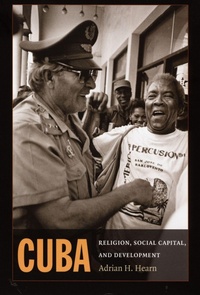
Cuba
Religion, Social Capital, and Development
Will be published approx. on 18. August 2008
Book
Hardback
232 pages
978-0-8223-4180-2 (ISBN)
Description
When Cuba's centralized system for providing basic social services began to erode in the early 1990s, Christian and Afro-Cuban religious groups took on new social and political responsibilities. They began to work openly with state institutions on projects such as the promotion of Afro-Cuban heritage to encourage tourism, and community welfare initiatives to confront drug use, prostitution, and housing decay. In this rich ethnography, the anthropologist Adrian H. Hearn provides a detailed, on-the-ground analysis of how the Cuban state and local religious groups collaborate on community development projects and work with the many foreign development agencies operating in Cuba. Hearn argues that the growing number of collaborations between state and non-state actors has begun to consolidate the foundations of a civil society in Cuba.While conducting research, Hearn lived for one year each in two SanterIa temple-houses: one located in Old Havana and the other in Santiago de Cuba. During those stays he conducted numerous interviews: with the historian of Havana and the conservationist of Santiago de Cuba (officials roughly equivalent to mayors in the United States), acclaimed writers, influential leaders of Afro-Cuban religions, and many citizens involved in community development initiatives. Hearn draws on those interviews, his participant observation in the temple-houses, case studies, and archival research to convey the daily life experiences and motivations of religious practitioners, development workers, and politicians. Using the concept of social capital, he explains the state's desire to incorporate tightly knit religious groups into its community development projects, and he illuminates a fundamental challenge facing Cuba's religious communities: how to maintain their spiritual integrity and internal solidarity while participating in state-directed projects.
Reviews / Votes
"This is one of the best studies on civil society in Cuba that I have read. Adrian H. Hearn combines first-rate ethnography, theoretical sophistication, and a solid understanding of the complexities of the Cuban political context. By focusing on Afro-Cuban religious communities and international NGOs, Hearn shows how the interpenetration of state and citizen action has shaped civil society in Cuba. The result is a fascinating analysis of the ongoing transformations within the Cuban Revolution."-Ariel C. Armony, Katz Distinguished Associate Professor of Government, Colby College "This volume reveals the complexity of Cuban society through remarkable ethnographic research. Based on years of research in Cuba, the work documents the inner workings of communities that use deeply held religious beliefs to promote development projects aimed at securing basic needs. Through skillful analysis, Adrian H. Hearn reveals the realities of life for ordinary Cubans. This book is a major contribution to our understanding of contemporary Cuba, as well as an exemplar for all those interested in how religion and community development can intersect."-Margaret Crahan, author of Religion, Culture, and Society: The Case of CubaMore details
Language
English
Place of publication
North Carolina
United States
Target group
Professional and scholarly
College/higher education
Product notice
Cloth over boards
Illustrations
21 photographs, 2 maps
Dimensions
Height: 236 mm
Width: 157 mm
Thickness: 20 mm
Weight
1225 gr
ISBN-13
978-0-8223-4180-2 (9780822341802)
Copyright in bibliographic data and cover images is held by Nielsen Book Services Limited or by the publishers or by their respective licensors: all rights reserved.
Schweitzer Classification
Other editions
Additional editions
E-Book
08/2008
1st Edition
De Gruyter
€198.99
Available for download
Person
Adrian H. Hearn, an anthropologist, is an ARC Future Fellow at the University of Sydney.
Content
Acknowledgments vii
Introduction: Structure and Spirit 1
Chapter 1. Spirits in Motion: Folklore and Function 31
Chapter 2. State Decentraliation and the Collaborative Spirit 67
Chapter 3. Sustainable Sovereignty: International NGOs and Civil Society in Cuba 103
Chapter 4. Patriotic Spirits: Religious Welfare Programs and Politics of Syncretism 135
Conclusion: Development and Dialogue 181
Notes 191
References 195
Index 213
Introduction: Structure and Spirit 1
Chapter 1. Spirits in Motion: Folklore and Function 31
Chapter 2. State Decentraliation and the Collaborative Spirit 67
Chapter 3. Sustainable Sovereignty: International NGOs and Civil Society in Cuba 103
Chapter 4. Patriotic Spirits: Religious Welfare Programs and Politics of Syncretism 135
Conclusion: Development and Dialogue 181
Notes 191
References 195
Index 213