

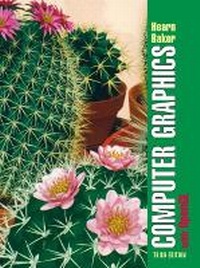
Computer Graphics with OpenGL
United States Edition
3rd Edition
Published on 3. October 2003
Book
Hardback
880 pages
978-0-13-015390-6 (ISBN)
Description
For junior- to graduate-level courses in computer graphics.
Assuming no background in computer graphics, this junior- to graduate-level course presents basic principles for the design, use, and understanding of computer graphics systems and applications. The authors, authorities in their field, offer an integrated approach to two-dimensional and three-dimensional graphics topics. A comprehensive explanation of the popular OpenGL programming package, along with C++ programming examples illustrates applications of the various functions in the OpenGL basic library and the related GLU and GLUT packages.
Assuming no background in computer graphics, this junior- to graduate-level course presents basic principles for the design, use, and understanding of computer graphics systems and applications. The authors, authorities in their field, offer an integrated approach to two-dimensional and three-dimensional graphics topics. A comprehensive explanation of the popular OpenGL programming package, along with C++ programming examples illustrates applications of the various functions in the OpenGL basic library and the related GLU and GLUT packages.
More details
Edition
3rd edition
Language
English
Place of publication
United States
Publishing group
Pearson Education (US)
Target group
College/higher education
Dimensions
Height: 210 mm
Width: 260 mm
Thickness: 40 mm
Weight
250 gr
ISBN-13
978-0-13-015390-6 (9780130153906)
Copyright in bibliographic data and cover images is held by Nielsen Book Services Limited or by the publishers or by their respective licensors: all rights reserved.
Schweitzer Classification
Other editions
New editions
Donald Hearn | M. Baker | Warren Carithers
Computer Graphics with Open GL
Book
01/2011
4th Edition
Pearson
€173.31
Article is exhausted; no reprint
Previous edition
Book
10/1996
2nd Edition
Pearson
€64.36
Article exhausted; check for reprint
Persons
Donald Hearn joined the Computer Science faculty at the University of Illinois at Urbana-Champaign in 1985. Dr. Hearn has taught a wide range of courses in computer graphics, scientific visualization, computational science, mathematics, and applied science. Also, he has directed numerous research projects and published a variety of technical articles in these areas.
M. Pauline Baker is on the faculty of the Computer Science Department and the School for Informatics at Indiana University-Purdue University. Dr- Baker is also a Distinguished Scientist and the Director of the Pervasive Technology Lab for Visualization and Interactive Spaces, and she collaborates with research groups on the use of computer graphics and virtual reality to explore scientific data. Previously, Dr. Baker was the Associate Director for Visualization and Virtual Environments at NCSA (National Center for Supercomputer Applications), University of Illinois.
M. Pauline Baker is on the faculty of the Computer Science Department and the School for Informatics at Indiana University-Purdue University. Dr- Baker is also a Distinguished Scientist and the Director of the Pervasive Technology Lab for Visualization and Interactive Spaces, and she collaborates with research groups on the use of computer graphics and virtual reality to explore scientific data. Previously, Dr. Baker was the Associate Director for Visualization and Virtual Environments at NCSA (National Center for Supercomputer Applications), University of Illinois.
Content
1. A Survey of Computer Graphics.
2. Overview of Graphics Systems.
3. Graphics Output Primitives.
4. Attributes of Graphics Primitives.
5. Geometric Transformations.
6. Two-Dimensional Viewing.
7. Three-Dimensional Viewing.
8. Three-Dimensional Object Representations.
9. Visible-Surface Detection Methods.
10. Illumination Models and Surface-Rendering Methods.
11. Interactive Input Methods and Graphical User Interfaces.
12. Color Models and Color Applications.
13. Computer Animation.
14. Hierarchical Modeling.
2. Overview of Graphics Systems.
3. Graphics Output Primitives.
4. Attributes of Graphics Primitives.
5. Geometric Transformations.
6. Two-Dimensional Viewing.
7. Three-Dimensional Viewing.
8. Three-Dimensional Object Representations.
9. Visible-Surface Detection Methods.
10. Illumination Models and Surface-Rendering Methods.
11. Interactive Input Methods and Graphical User Interfaces.
12. Color Models and Color Applications.
13. Computer Animation.
14. Hierarchical Modeling.