

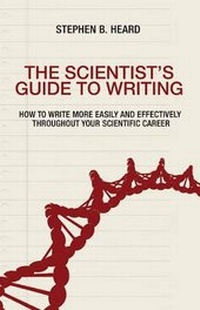
The Scientist's Guide to Writing
How to Write More Easily and Effectively throughout Your Scientific Career
Published on 12. April 2016
Book
Hardback
320 pages
978-0-691-17021-3 (ISBN)
Description
The ability to write clearly is critical to any scientific career. The Scientist's Guide to Writing provides practical advice to help scientists become more effective writers so that their ideas have the greatest possible impact. Drawing on his own experience as a scientist, graduate adviser, and editor, Stephen Heard emphasizes that the goal of all scientific writing should be absolute clarity; that good writing takes deliberate practice; and that what many scientists need are not long lists of prescriptive rules but rather direct engagement with their behaviors and attitudes when they write. He combines advice on such topics as how to generate and maintain writing momentum with practical tips on structuring a scientific paper, revising a first draft, handling citations, responding to peer reviews, managing coauthorships, and more. In an accessible, informal tone, The Scientist's Guide to Writing explains essential techniques that students, postdoctoral researchers, and early-career scientists need to write more clearly, efficiently, and easily.
* Emphasizes writing as a process, not just a product* Encourages habits that improve motivation and productivity* Explains the structure of the scientific paper and the function of each part* Provides detailed guidance on submission, review, revision, and publication* Addresses issues related to coauthorship, English as a second language, and more
* Emphasizes writing as a process, not just a product* Encourages habits that improve motivation and productivity* Explains the structure of the scientific paper and the function of each part* Provides detailed guidance on submission, review, revision, and publication* Addresses issues related to coauthorship, English as a second language, and more
Reviews / Votes
"Heard provides a well-written, useful guide across the various scientific specialties, emphasizing the need to create a paper that clearly reflects the goal of the writer and also has literary merit."--Choice "In an accessible, informal tone, this book explains essential techniques that students, postdoctoral researches, and early career scientists need to write more clearly, efficiently, and easily."--Lunar and Planetary Information BulletinMore details
Language
English
Place of publication
New Jersey
United States
Target group
College/higher education
Professional and scholarly
Product notice
Trade binding
Illustrations
17 tables.
Dimensions
Height: 235 mm
Width: 152 mm
Weight
397 gr
ISBN-13
978-0-691-17021-3 (9780691170213)
Copyright in bibliographic data and cover images is held by Nielsen Book Services Limited or by the publishers or by their respective licensors: all rights reserved.
Schweitzer Classification
Person
Stephen B. Heard is professor of biology at the University of New Brunswick in Canada and associate editor of the journal American Naturalist.
Content
Preface vii Part I. What Writing Is 1. On Bacon, Hobbes, and Newton, and the Selfishness of Writing Well 3 2. Genius, Craft, and What This Book Is About 11 Part II. Behavior 3. Reading 17 4. Managing Your Writing Behavior 22 5. Getting Started 30 6. Momentum 42 Part III. Content and Structure 7. Finding and Telling Your Story 57 8. The Canonical Structure of the Scientific Paper 74 9. Front Matter and Abstract 79 10. The Introduction Section 84 11. The Methods Section 89 12. The Results Section 99 13. The Discussion Section 120 14. Back Matter 126 15. Citations 132 16. Deviations from the IMRaD Canon 138 Part IV. Style 17. Paragraphs 149 18. Sentences 159 19. Words 174 20. Brevity 182 Part V. Revision 21. Self-Revision 193 22. Friendly Review 204 23. Formal Review 211 24. Revision and the "Response to Reviews" 222 Part VI. Some Loose Threads 25. The Diversity of Writing Forms 233 26. Managing Coauthorships 247 27. Writing in English for Non-Native Speakers 260 Part VII. Final Thoughts 28. On Whimsy, Jokes, and Beauty: Can Scientific Writing Be Enjoyed? 273 Acknowledgements 287 References 289 Permanent URLs 299 Index 303