

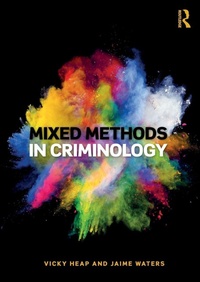
Mixed Methods in Criminology
1st Edition
Published on 11. January 2019
Book
Paperback/Softback
300 pages
978-1-138-30946-3 (ISBN)
Description
Mixed Methods in Criminology is the first book to bring together the discipline of criminology with the mixed methods research strategy, which has become increasingly prominent within criminological teaching and research.
The book is structured so that it charts the course of a criminological mixed methods study. Starting with an introduction to mixed methods and its implications for criminology and criminological research, the book then works systematically through the planning stages of a research project. Developing research questions, aims and objectives is discussed alongside literature searching skills and the project planning process, before the principles and practice of ethical research are summarised. Next come chapters on philosophy, mixed methods design, combining the data, research design and sampling, data collection methods and data analysis; delivering a comprehensive overview of how to undertake a mixed methods research project in practice. This is followed by a chapter on troubleshooting, which provides useful advice from experienced mixed methods researchers, before a detailed account of how to write-up mixed methods research is presented. The book concludes with a range of real-life mixed methods case studies to demonstrate how the techniques outlined in this book have been employed in reality and to inspire new criminological mixed methods projects.
Providing straightforward, easy to follow guidance, Mixed Methods in Criminology is the essential student companion for any criminological mixed methods research project. Drawing on the authors' years of experience teaching research methods, the book is written in a supportive and encouraging tone that will serve as a reference and guide for those embarking on their adventures 'in the field'.
The book is structured so that it charts the course of a criminological mixed methods study. Starting with an introduction to mixed methods and its implications for criminology and criminological research, the book then works systematically through the planning stages of a research project. Developing research questions, aims and objectives is discussed alongside literature searching skills and the project planning process, before the principles and practice of ethical research are summarised. Next come chapters on philosophy, mixed methods design, combining the data, research design and sampling, data collection methods and data analysis; delivering a comprehensive overview of how to undertake a mixed methods research project in practice. This is followed by a chapter on troubleshooting, which provides useful advice from experienced mixed methods researchers, before a detailed account of how to write-up mixed methods research is presented. The book concludes with a range of real-life mixed methods case studies to demonstrate how the techniques outlined in this book have been employed in reality and to inspire new criminological mixed methods projects.
Providing straightforward, easy to follow guidance, Mixed Methods in Criminology is the essential student companion for any criminological mixed methods research project. Drawing on the authors' years of experience teaching research methods, the book is written in a supportive and encouraging tone that will serve as a reference and guide for those embarking on their adventures 'in the field'.
More details
Language
English
Place of publication
London
United Kingdom
Publishing group
Taylor & Francis Ltd
Target group
College/higher education
Illustrations
45 s/w Abbildungen, 45 s/w Zeichnungen, 35 s/w Tabellen
35 Tables, black and white; 45 Line drawings, black and white; 45 Illustrations, black and white
Dimensions
Height: 246 mm
Width: 174 mm
Thickness: 17 mm
Weight
566 gr
ISBN-13
978-1-138-30946-3 (9781138309463)
Copyright in bibliographic data and cover images is held by Nielsen Book Services Limited or by the publishers or by their respective licensors: all rights reserved.
Schweitzer Classification
Other editions
Additional editions
Vicky Heap | Jaime Waters
Mixed Methods in Criminology
Book
01/2019
1st Edition
Routledge
€206.90
Shipment within 10-20 days
Vicky Heap | Jaime Waters
Mixed Methods in Criminology
E-Book
01/2019
1st Edition
Routledge
€53.99
Available for download
Vicky Heap | Jaime Waters
Mixed Methods in Criminology
E-Book
01/2019
1st Edition
Routledge
€53.99
Available for download
Persons
Vicky Heap is Senior Lecturer in Criminology and Fellow of the Sheffield Institute for Policy Studies at Sheffield Hallam University. She conducts research and lectures in the areas of anti-social behaviour, crime prevention and research methods. Her current research examines victims' experiences of anti-social behaviour and the implementation of the Community Trigger and Community Remedy policies from the Anti-Social Behaviour, Crime and Policing Act (2014).
Jaime Waters is Senior Lecturer in Criminology and Fellow of the Sheffield Institute for Policy Studies at Sheffield Hallam University. She has been teaching criminological research methods since 2004 and publishes on methodological issues. Her main research interests include illegal drug use, gambling, and emotional labour, and she published her first research monograph, Illegal Drug Use Through the Lifecourse (with David Moxon, Routledge) in 2017.
Jaime Waters is Senior Lecturer in Criminology and Fellow of the Sheffield Institute for Policy Studies at Sheffield Hallam University. She has been teaching criminological research methods since 2004 and publishes on methodological issues. Her main research interests include illegal drug use, gambling, and emotional labour, and she published her first research monograph, Illegal Drug Use Through the Lifecourse (with David Moxon, Routledge) in 2017.
Content
Foreword Professor Shadd Maruna
Acknowledements
List of Figures
List of Tables
Chapter 1. Introduction to Mixed Methods
Chapter 2. Creating a Mixed Methods Question and Project Planning
Chapter 3. Ethics
Chapter 4. Philosophy
Chapter 5. Mixed Methods Design
Chapter 6. Combining the Data
Chapter 7. Research Design and Sampling
Chapter 8. Data Collection Methods
Chapter 9. Data Analysis
Chapter 10. Critique
Chapter 11. Troubleshooting
Chapter 12. Writing-Up
Chapter 13. Case Studies
Glossary of Key Terms
References
Acknowledements
List of Figures
List of Tables
Chapter 1. Introduction to Mixed Methods
Chapter 2. Creating a Mixed Methods Question and Project Planning
Chapter 3. Ethics
Chapter 4. Philosophy
Chapter 5. Mixed Methods Design
Chapter 6. Combining the Data
Chapter 7. Research Design and Sampling
Chapter 8. Data Collection Methods
Chapter 9. Data Analysis
Chapter 10. Critique
Chapter 11. Troubleshooting
Chapter 12. Writing-Up
Chapter 13. Case Studies
Glossary of Key Terms
References