

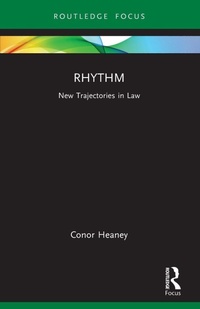
Rhythm
New Trajectories in Law
1st Edition
Published on 27. May 2024
Book
Paperback/Softback
116 pages
978-1-032-39547-0 (ISBN)
Description
This book analyses the conceptual and concrete relationships between rhythm and law.
Rhythm is the unfolding of ordered and regulated movement. Law operates through the ordering and regulation of movement. Adopting a 'rhythmanalytical' perspective - which treats natural and social phenomena in terms of their rhythms, repetitions, motions, and movements - this book offers an account of how legal institutions and practices can be theorised and explained in terms of rhythm. It demonstrates how the category of rhythm has jurisprudential significance, from how Plato envisaged the functioning of the city-state, to the operation of the common law, as well as in our relationship to contemporary digital technology. In music, rhythm 'orders' the movement of sound, binding together the motions and vibrations of sound in such a way that is neither pure noise nor pure mechanics. In this way, rhythm can be deployed as a concept in the analysis of one of the central purposes of legal institutions and practices: to order the movements of bodies, whether the bodies of citizens in everyday life or of prisoners in rituals of punishment. This book engages with the mutual intersections and points of illumination between rhythm and law, such as ritual, measure, order, and change.
This book is an experimental rhythmanalysis of law, offering conceptual and methodological starting points, as well as proposing directions that could be deployed in future research. It is aimed primarily at legal scholars intrigued by rhythmanalysis and rhythmanalysts more generally. This book will also be of interest to those in the fields of philosophy, political and legal theory, sociology, and other social sciences.
Rhythm is the unfolding of ordered and regulated movement. Law operates through the ordering and regulation of movement. Adopting a 'rhythmanalytical' perspective - which treats natural and social phenomena in terms of their rhythms, repetitions, motions, and movements - this book offers an account of how legal institutions and practices can be theorised and explained in terms of rhythm. It demonstrates how the category of rhythm has jurisprudential significance, from how Plato envisaged the functioning of the city-state, to the operation of the common law, as well as in our relationship to contemporary digital technology. In music, rhythm 'orders' the movement of sound, binding together the motions and vibrations of sound in such a way that is neither pure noise nor pure mechanics. In this way, rhythm can be deployed as a concept in the analysis of one of the central purposes of legal institutions and practices: to order the movements of bodies, whether the bodies of citizens in everyday life or of prisoners in rituals of punishment. This book engages with the mutual intersections and points of illumination between rhythm and law, such as ritual, measure, order, and change.
This book is an experimental rhythmanalysis of law, offering conceptual and methodological starting points, as well as proposing directions that could be deployed in future research. It is aimed primarily at legal scholars intrigued by rhythmanalysis and rhythmanalysts more generally. This book will also be of interest to those in the fields of philosophy, political and legal theory, sociology, and other social sciences.
More details
Series
Language
English
Place of publication
London
United Kingdom
Publishing group
Taylor & Francis Ltd
Target group
College/higher education
Postgraduate and Undergraduate
Dimensions
Height: 216 mm
Width: 140 mm
Thickness: 7 mm
Weight
169 gr
ISBN-13
978-1-032-39547-0 (9781032395470)
Copyright in bibliographic data and cover images is held by Nielsen Book Services Limited or by the publishers or by their respective licensors: all rights reserved.
Schweitzer Classification
Other editions
Additional editions
Book
10/2022
1st Edition
Routledge
€71.70
Shipment within 10-20 days
E-Book
10/2022
1st Edition
Routledge
€25.99
Available for download
E-Book
10/2022
1st Edition
Routledge
€25.99
Available for download
Person
Conor Heaney is Lecturer in Legal Theory / Law & Society in the Law School, University of Strathclyde, Glasgow, UK.
Content
Introduction. the clock, the monastery, & the prison time-table 1. rhythm as object & principle 2. cosmological & nomological order 3. the law of time & the temporalities of law-making Conclusion. repeat to fade