

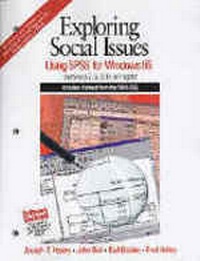
Exploring Social Issues
Using SPSS for Windows 95 Versions 7.5, 8.0, or Higher
1st Edition
Published on 12. November 1998
Book
Paperback/Softback
416 pages
978-0-7619-8600-3 (ISBN)
Description
This revised edition guides users of SPSS for Windows 95 and, like its predecessor, helps teach students how to `do' social science, by showing how compelling social issues can be explored by analyzing social data. The book is written specifically for beginning research students and is accompanied by a data disk. It stresses active learning, as students are guided step-by-step through the exercises. No previous experience with computers, Windows, SPSS, statistics, or social research is required. An Instructor's Manual is available to lecturers who adopt the book, and request it on their institution's letterhead.
More details
Language
English
Place of publication
Thousand Oaks
United States
Target group
College/higher education
Dimensions
Height: 279 mm
Width: 216 mm
Weight
971 gr
ISBN-13
978-0-7619-8600-3 (9780761986003)
Copyright in bibliographic data and cover images is held by Nielsen Book Services Limited or by the publishers or by their respective licensors: all rights reserved.
Schweitzer Classification
Other editions
New editions
Book
04/2009
3rd Edition
SAGE Publications Inc
€157.00
Shipment within 10-20 days
Previous edition

Joseph F. Healey | etc.
Exploring Social Issues Using SPSS for Windows
Book
04/1997
Pine Forge
€46.00
Article exhausted; check for reprint
Persons
Joseph F. Healey is Professor Emeritus of Sociology at Christopher Newport University in Virginia. He received his PhD in sociology and anthropology from the University of Virginia. An innovative and experienced teacher of numerous race and ethnicity courses, he has written articles on minority groups, the sociology of sport, social movements, and violence, and he is also the author of Statistics: A Tool for Social Research (10th ed., 2014). John Boli, Emory University, is the author or co-author of six books and many articles and chapters on education, globalization, and political sociology, including The Globalization Reader (Blackwell,1999), Constructing World Culture (Stanford University Press,1999), Cream of the Crop (Basic Books, 1994) and Institutional Structure: Constituting State, Society, and the Individual (Sage, 1987). Earl Babbie was born in Detroit, Michigan, in 1938, but his family chose to return to Vermont 3 months later, and he grew up there and in New Hampshire. In 1956, he set off for Harvard Yard, where he spent the next 4 years learning more than he initially planned. After 3 years with the US Marine Corps, mostly in Asia, he began graduate studies at the University of California-Berkeley. He received his PhD from Berkeley in 1969. He taught sociology at the University of Hawaii from 1968 through 1979, took time off from teaching and research to write full-time for 8 years, and then joined the faculty at Chapman University in Southern California in 1987. Although he is the author of several research articles and monographs, he is best known for the many textbooks he has written, which have been widely adopted in colleges throughout the United States and the world. He also has been active in the American Sociological Association for 25 years and currently serves on the ASA's executive committee. He is also past president of the Pacific Sociological Association and California Sociological Association.
Fred Halley, Associate Professor Emeritus, SUNY-Brockport, received his bachelor's degree in sociology and philosophy from Ashland College and his master's and doctorate degrees from Case Western Reserve University and the University of Missouri, respectively. Since 1970, he has worked to bring both instructional and research computer applications into the undergraduate sociology curriculum. Halley has been recognized for his leadership in the instructional computing sections of the Eastern and Midwest Sociological Societies and the American Sociological Association. At Brockport, he served as a collegewide social science computing consultant and directed Brockport's Institute for Social Science Research and the College's Data Analysis Laboratory. Off campus, Halley directed and consulted on diverse community research projects that were used to establish urban magnet schools, evaluate a Head Start family service center, locate an expressway, and design a public transportation system for a rural county. Now residing in Rochester, New York, he plays an active role in a faith-based mentoring program for ex-offenders, and he volunteers for Micrecycle, an organization that refurbishes computers used by those on the other side of the computer divide in schools, daycares, youth centers, and other community organizations.
Fred Halley, Associate Professor Emeritus, SUNY-Brockport, received his bachelor's degree in sociology and philosophy from Ashland College and his master's and doctorate degrees from Case Western Reserve University and the University of Missouri, respectively. Since 1970, he has worked to bring both instructional and research computer applications into the undergraduate sociology curriculum. Halley has been recognized for his leadership in the instructional computing sections of the Eastern and Midwest Sociological Societies and the American Sociological Association. At Brockport, he served as a collegewide social science computing consultant and directed Brockport's Institute for Social Science Research and the College's Data Analysis Laboratory. Off campus, Halley directed and consulted on diverse community research projects that were used to establish urban magnet schools, evaluate a Head Start family service center, locate an expressway, and design a public transportation system for a rural county. Now residing in Rochester, New York, he plays an active role in a faith-based mentoring program for ex-offenders, and he volunteers for Micrecycle, an organization that refurbishes computers used by those on the other side of the computer divide in schools, daycares, youth centers, and other community organizations.
Content
Getting Started
Social Research, Data Sets and Frequency Distributions
Theory and Research
The Scientific Method
Describing the Sample
Culture
What Do Americans Value?
A Controversy in Values
Attitudes about Abortion in 1996/99
Socialization
What Kinds of Children Do Americans Want?
Crime
Fear, Law Enforcement and Punishment
Inequality and Social Class in the United States
Inequality and Gender
Inequality and Race
The Family Institution
Forms and Functions
The Political Institution in the United States
Voter Turnout, Presidential Choice and the Gender Gap
Appendix A
Variable Names, Item Wordings, and Codes for all Data Sets
Appendix B
SPSS Commands Used in this Book
Index / Glossary
Social Research, Data Sets and Frequency Distributions
Theory and Research
The Scientific Method
Describing the Sample
Culture
What Do Americans Value?
A Controversy in Values
Attitudes about Abortion in 1996/99
Socialization
What Kinds of Children Do Americans Want?
Crime
Fear, Law Enforcement and Punishment
Inequality and Social Class in the United States
Inequality and Gender
Inequality and Race
The Family Institution
Forms and Functions
The Political Institution in the United States
Voter Turnout, Presidential Choice and the Gender Gap
Appendix A
Variable Names, Item Wordings, and Codes for all Data Sets
Appendix B
SPSS Commands Used in this Book
Index / Glossary