

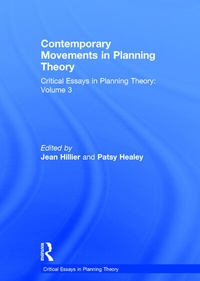
Contemporary Movements in Planning Theory
Critical Essays in Planning Theory: Volume 3
1st Edition
Published on 25. March 2008
Book
Hardback
574 pages
978-0-7546-2725-8 (ISBN)
Description
Planning Theory has a history of common debates about ideas and practices and is rooted in a critical concern for the 'improvement' of human and environmental well-being, particularly as pursued through interventions which seek to shape environmental conditions and place qualities. The third and final volume in this series covers Contemporary Movements in Planning Theory and topics include communicative practices and the negotiation of meaning, networks, institutions and relations, and the complexity 'turn'. The articles selected represent the most influential and controversial recent work in planning theory and are supplemented by detailed introductions by the editors.
More details
Series
Language
English
Place of publication
London
United Kingdom
Publishing group
Taylor & Francis Ltd
Target group
College/higher education
Dimensions
Height: 244 mm
Width: 169 mm
Weight
1220 gr
ISBN-13
978-0-7546-2725-8 (9780754627258)
Copyright in bibliographic data and cover images is held by Nielsen Book Services Limited or by the publishers or by their respective licensors: all rights reserved.
Schweitzer Classification
Other editions
Additional editions
Patsy Healey | Jean Hillier
Contemporary Movements in Planning Theory
Critical Essays in Planning Theory: Volume 3
E-Book
03/2017
Routledge
€60.49
Available for download
Patsy Healey | Jean Hillier
Contemporary Movements in Planning Theory
Critical Essays in Planning Theory: Volume 3
E-Book
03/2017
Routledge
€60.49
Available for download
Persons
Jean Hillier is Associate Dean and Chair of Sustainability and Urban Planning at RMIT University, Melbourne, Australia and Patsy Healey is Emeritus Professor at the School of Architecture, Planning and Landscape, University of Newcastle upon Tyne, UK.
Content
Contents: Introduction; Part I Communicative Practices and the Negotiation of Meaning: Introduction: The transactive style of planning, John Friedmann; Understanding planning practice, John Forester; A planner's day: knowledge and action in communicative practice, Patsy Healey; The argumentative or rhetorical turn in planning, James A. Throgmorton; Planning theory's emerging paradigm: communicative action and interactive practice, Judith E. Innes; Strategies, processes and plans, Patsy Healey; Consensus-building as role-playing and bricolage: toward a theory of collaborative planning, Judith E. Innes and David E. Booher; Communicative planning theory: a Foucauldian assessment, RaphaA<<l Fischler; Strife: urban planning and agonism, John PlA?ger; Conflicting rationalities: implications for planning theory and ethics, Vanessa Watson. Part II Networks, Institutions and Relations: Introduction; Planning and the network city: discursive correspondences, Robert A. Beauregard; Postscript: a manifesto for a progressive networked urbanism, Stephen Graham and Simon Marvin; Network power in collaborative planning, David E. Booher and Judith E. Innes; Going round the back? Complex networks and informal action in local planning processes, Jean Hillier; The treatment of space and place in the new strategic spatial planning in Europe, Patsy Healey; Property rights, planning and markets: managing spontaneous cities, Chris Webster and Lawrence Wai-Chung Lai; The logic of critical communicative planning: transaction cost alteration, Tore Sager. Part III The Complexity 'Turn' - Hope, Critique and Post-Structuralism: Introduction; Towards a planning imagination for the 21st century, Leonie Sandercock; Urban informality: toward an epistemology of planning, Ananya Roy; Spaces of insurgent citizenship, James Holston; Coping with uncertainty in planning, Karen S. Christensen; Metaphors in complexity theory and planning, Angelique Chettiparamb; And if the global were small and noncoherent?