

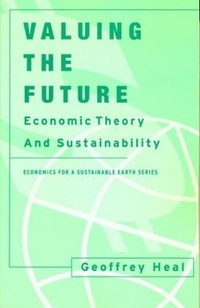
Valuing the Future
Economic Theory and Sustainability
Published on 18. October 2000
Book
Paperback/Softback
224 pages
978-0-231-11307-6 (ISBN)
Description
With issues like global warming and the loss of biodiversity becoming increasingly important to policymakers and scientists worldwide, the issue of sustainability cannot be ignored as we move toward the twenty-first century. Not surprisingly, the sustainable management of the biosphere has in recent years been the subject of much attention among ecologists, environmental engineers, and other members of the scientific community. Yet although these issues are clearly rooted in economic behavior and organization, the question of sustainability is not one that has been addressed directly by economists. Now, with Valuing the Future, economist Geoffrey Heal presents a coherent framework for understanding the earth's future from an economic perspective. Heal's model begins with a reconciliation of the economist's and environmentalist's time horizon: in economics, discussions of "the long run" generally refer to a much shorter timeline than do those of the earth sciences. The book shows the benefits of viewing the environment as an economic asset that should be understood as a part of a nation's income and explains how this approach can lead to more conservative patterns of resource use.
Stepping beyond merely theoretical generalities, Valuing the Future offers a dynamic new blueprint for comprehending sustainability. Chapters provide complete mathematical templates for the valuation of a depletable stock and of renewable resources, the proper calculation of national income, and the conduct of cost-benefit analysis. It will be of great value to economic theorists, environmental economists and policymakers, providing a powerful new model for scientists concerned with environmental sustainability.
Stepping beyond merely theoretical generalities, Valuing the Future offers a dynamic new blueprint for comprehending sustainability. Chapters provide complete mathematical templates for the valuation of a depletable stock and of renewable resources, the proper calculation of national income, and the conduct of cost-benefit analysis. It will be of great value to economic theorists, environmental economists and policymakers, providing a powerful new model for scientists concerned with environmental sustainability.
Reviews / Votes
Careful, rigorous analyses such as those conducted in this book should help focus the debate about the perplexing and consequential issues that fall under the rubric of sustainability. -- Jeffrey A. Krautkraemer Journal of Economic LiteratureMore details
Series
Language
English
Place of publication
New York
United States
Target group
Professional and scholarly
Product notice
Paperback (trade)
Illustrations
27 drawings
Weight
326 gr
ISBN-13
978-0-231-11307-6 (9780231113076)
Copyright in bibliographic data and cover images is held by Nielsen Book Services Limited or by the publishers or by their respective licensors: all rights reserved.
Schweitzer Classification
Other editions
Additional editions
Book
01/1999
Columbia University Press
€89.76
Article exhausted; check different version
Person
Geoffrey Heal is Garrett Professor of Public Policy and Business Responsibility and professor of economics and finance of the Graduate School of Business at Columbia University. A past president of the Association of Environmental and Resource Economists, he is the author of many scientific articles and thirteen books, including Economic Theory and Exhaustible Resources and Nature and the Marketplace.
Content
Appendix Project evaluation National welfare Measuring national income Policy issues Capital and renewable resources Exhaustibility and accumulation Capital accumulation Investment in a backstop Renewable resources revisited Depletion revisited Alternatives to utilitarianism A broader perspective Renewable resources Valuing a depletable stock The classical formulation Sustainability within a classical framework