

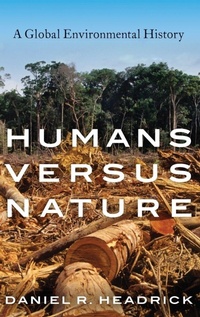
Humans versus Nature
A Global Environmental History
Published on 5. March 2020
Book
Hardback
624 pages
978-0-19-086471-2 (ISBN)
Description
Since the appearance of Homo sapiens on the planet hundreds of thousands of years ago, human beings have sought to exploit their environments, extracting as many resources as their technological ingenuity has allowed. As technologies have advanced in recent centuries, that impulse has remained largely unchecked, exponentially accelerating the human impact on the environment.
Humans versus Nature tells a history of the global environment from the Stone Age to the present, emphasizing the adversarial relationship between the human and natural worlds. Nature is cast as an active protagonist, rather than a mere backdrop or victim of human malfeasance. Daniel R. Headrick shows how environmental changes--epidemics, climate shocks, and volcanic eruptions--have molded human societies and cultures, sometimes overwhelming them. At the same time, he traces the history of anthropogenic changes in the environment--species extinctions, global warming, deforestation, and resource depletion--back to the age of hunters and gatherers and the first farmers and herders. He shows how human interventions such as irrigation systems, over-fishing, and the Industrial Revolution have in turn harmed the very societies that initiated them.
Throughout, Headrick examines how human-driven environmental changes are interwoven with larger global systems, dramatically reshaping the complex relationship between people and the natural world. In doing so, he roots the current environmental crisis in the deep past.
Humans versus Nature tells a history of the global environment from the Stone Age to the present, emphasizing the adversarial relationship between the human and natural worlds. Nature is cast as an active protagonist, rather than a mere backdrop or victim of human malfeasance. Daniel R. Headrick shows how environmental changes--epidemics, climate shocks, and volcanic eruptions--have molded human societies and cultures, sometimes overwhelming them. At the same time, he traces the history of anthropogenic changes in the environment--species extinctions, global warming, deforestation, and resource depletion--back to the age of hunters and gatherers and the first farmers and herders. He shows how human interventions such as irrigation systems, over-fishing, and the Industrial Revolution have in turn harmed the very societies that initiated them.
Throughout, Headrick examines how human-driven environmental changes are interwoven with larger global systems, dramatically reshaping the complex relationship between people and the natural world. In doing so, he roots the current environmental crisis in the deep past.
Reviews / Votes
Those of us who teach world environmental history will find this a nearly essential textbook, yet the work is valuable to anyone teaching world history. It may allow whole new environmental units to be placed easily into an existing course framework. At the very least, practitioners can consult chapters to incorporate specific examples or ideas more fully into their surveys. In the end, Headrick's work is the best textbook on global environmental history to date. * Thomas Anderson, World History Connected * ...the ultimate reference work on global environmental history. * Eric L. Jones, University of Buckingham, EH.net * Headrick's book is the most comprehensive global environmental history in existence. It synthesizes vast knowledge from several scholarly disciplines into a coherent story of the 300,000-year human adventure on -- and with -- Earth. If one has time to read only one environmental history book, this should be the one. * J.R. McNeill, author of Something New Under the Sun: An Environmental History of the Twentieth-Century World * Humans versus Nature is a gift to students and teachers of environmental history: a single volume that captures the vast scope and scale of nature's role in human history and humanity's accelerating impact on the natural world. * Sam White, author of A Cold Welcome: The Little Ice Age and Europe's Encounter with North America *More details
Language
English
Place of publication
New York
United States
Target group
Professional and scholarly
Illustrations
22 illustrations
Dimensions
Height: 240 mm
Width: 161 mm
Thickness: 37 mm
Weight
1080 gr
ISBN-13
978-0-19-086471-2 (9780190864712)
Copyright in bibliographic data and cover images is held by Nielsen Book Services Limited or by the publishers or by their respective licensors: all rights reserved.
Schweitzer Classification
Other editions
Additional editions
Book
01/2020
Oxford University Press Inc
€59.30
Shipment within 15-20 days
E-Book
12/2019
OUP eBook
€29.49
Available for download
E-Book
12/2019
OUP eBook
€21.99
Available for download
Person
Daniel R. Headrick is Professor of Social Science and History, emeritus, at Roosevelt University. He is the author of numerous books, including The Tools of Empire: Technology and European Imperialism in the Nineteenth Century (OUP); The Tentacles of Progress: Technology Transfer in the Age of Imperialism (OUP); The Invisible Weapon: Telecommunications and International Politics, 1851-1945 (OUP); When Information Came of Age: Technologies of Knowledge in the Age of Reason and Revolution, 1700-1850 (OUP); Technology: A World History (OUP); and Power over Peoples: Technology, Environments, and Western Imperialism, 1400 to the Present. He lives in New Haven, Connecticut.
Content
Acknowledgments
Introduction: Global Environmental History
Chapter 1 The Foragers
Chapter 2 Farmers and Herders
Chapter 3 Early Civilizations
Chapter 4 Eurasia in the Classical Age
Chapter 5 Medieval Eurasia and Africa
Chapter 6 The Invasion of America
Chapter 7 The Transformation of the Old World
Chapter 8 The Transition to an Industrial World
Chapter 9 The West and the Non-West in the Nineteenth Century
Chapter 10 War and Developmentalism in the Twentieth Century
Chapter 11 Peace and Consumerism in the Twentieth Century
Chapter 12 Climate Change and Climate Wars
Chapter 13 Plundering the Oceans
Chapter 14 Extinctions and Survivals
Chapter 15 Environmentalism
Epilogue One Past, Many Futures
Notes
Index
Introduction: Global Environmental History
Chapter 1 The Foragers
Chapter 2 Farmers and Herders
Chapter 3 Early Civilizations
Chapter 4 Eurasia in the Classical Age
Chapter 5 Medieval Eurasia and Africa
Chapter 6 The Invasion of America
Chapter 7 The Transformation of the Old World
Chapter 8 The Transition to an Industrial World
Chapter 9 The West and the Non-West in the Nineteenth Century
Chapter 10 War and Developmentalism in the Twentieth Century
Chapter 11 Peace and Consumerism in the Twentieth Century
Chapter 12 Climate Change and Climate Wars
Chapter 13 Plundering the Oceans
Chapter 14 Extinctions and Survivals
Chapter 15 Environmentalism
Epilogue One Past, Many Futures
Notes
Index