

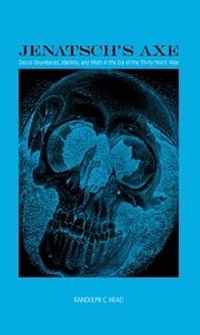
Jenatsch's Axe
Social Boundaries, Identity, and Myth in the Era of the Thirty Years' War
Published on 15. June 2008
Book
Hardback
193 pages
978-1-58046-276-1 (ISBN)
Description
During the turbulent events of Europe's Thirty Years' War, both ruthlessness and adaptability were crucial ingredients for success. In this engaging volume, Randolph C. Head traces the career of an extraordinarily adaptable and ruthless figure, George Jenatsch (1596-1639). Born a Protestant pastor's son, Jenatsch's career took him from the clergy to the military to the nobility. A passionate Calvinist in his youth, he converted to Catholicism and prudenceas his power grew. A native speaker of the Romansh language, he crossed the boundaries of language and local loyalty in his service to France, Venice, and his own people. Violence marked every turning point of his life. After fleeing the "Holy Massacre" of Protestants in the Valtellina in 1620, Jenatsch helped assassinate the powerful Pompeius von Planta, in 1621, using an axe. He killed his commanding officer in a duel in 1629, and his own life ended in atavern in 1639 when he was murdered -- with an axe -- by a man dressed as a bear.
After his death, myth took over. Rumors spread that Jenatsch was killed by the same axe that he had wielded on von Planta -- and from there the story only got better, culminating in Conrad Ferdinand Meyer's celebrated 1876 novel, Jurg Jenatsch. This study meticulously traces the social boundaries that characterized seventeenth-century Europe -- region, religion, social state, and kinship -- by analyzing a distinctive life that crossed them all.
Professor Randolph C. Head teaches European History at the University of California, Riverside and is the author of Early Modern Democracy in the Grisons.
After his death, myth took over. Rumors spread that Jenatsch was killed by the same axe that he had wielded on von Planta -- and from there the story only got better, culminating in Conrad Ferdinand Meyer's celebrated 1876 novel, Jurg Jenatsch. This study meticulously traces the social boundaries that characterized seventeenth-century Europe -- region, religion, social state, and kinship -- by analyzing a distinctive life that crossed them all.
Professor Randolph C. Head teaches European History at the University of California, Riverside and is the author of Early Modern Democracy in the Grisons.
Reviews / Votes
The book goes much further than simply popularizing the life of an early modern Swiss terrorist for the Anglo-American world. By thoroughly analyzing the cultural setting and thus telling Jenatsch's story a number of times and from different angles, it challenges long-accepted ideas about historical biography as a logical [and teleological] narrative with a climax at the end. It also underlines the fluidity of early modern confessional, political, and social boundaries. Furthermore, the book is a lively and entertaining read. -- Alexander Schunka * H-NET * Head's writing is lively and engaging. . . Jenatsch's Axe demonstrates that sound historical scholarship can also be fun to read. * RENAISSANCE QUARTERLY * With a deft combination of analytic skill and narrative power, Randolph Head brings Jenatsch and his world -- local, regional, and European -- vividly to life. Anyone, regardless of prior knowledge, who appreciates history written in terms of great and small, the universal and the local, will get great pleasure from reading this book. --T. A. Brady, Professor of History, University of California, Berkeley * . * One thing is clear: George Jenatsch once again has a biography for these times. Randolph Head has succeeded with a masterwork: dense and textured, and with enormous narrative energy -- a book, that many a Jenatsch-ologist would have been happy to write. * NEUE ZUERCHER ZEITUNG * A biography that also confronts wider issues. . . fascinating. * AMERICAN HISTORICAL REVIEW * A lively and insightful discussion of the relationship between fact and fiction in historical writing and memory. * EUROPEAN HISTORY QUARTERLY, Vol. 41 No. 2 *More details
Series
Language
English
Place of publication
Rochester
United States
Publishing group
Boydell & Brewer Ltd
Target group
Professional and scholarly
Product notice
Cloth over boards
Illustrations
14 s/w Abbildungen
14 b/w.
Dimensions
Height: 229 mm
Width: 152 mm
Weight
1 gr
ISBN-13
978-1-58046-276-1 (9781580462761)
Copyright in bibliographic data and cover images is held by Nielsen Book Services Limited or by the publishers or by their respective licensors: all rights reserved.
Schweitzer Classification
Other editions
Additional editions
Randolph C. Head
Jenatsch's Axe
Social Boundaries, Identity, and Myth in the Era of the Thirty Years' War
Book
04/2016
University of Rochester Press
€30.80
Shipment within 3-4 weeks
Randolph C. Head
Jenatsch's Axe
Social Boundaries, Identity, and Myth in the Era of the Thirty Years' War
E-Book
06/2008
1st Edition
De Gruyter
€48.99
Available for download
Person
Content
Introduction
A Brief Life of George Jenatsch
"Georgius Jenatius, Engadino-Rhetus": Mapping an Identity among Region, Nation, and Language
From Religious Zealot to Convert
"Something That Every Goatherd Can Do": Pastor, Soldier, and Noble
Hidden Boundaries?: Behind Conventional Views of Jenatsch
Jenatsch after 1639: Storytelling in Biography and Myth
Epilogue: The Past, the Present, and Magic Bells
A Brief Life of George Jenatsch
"Georgius Jenatius, Engadino-Rhetus": Mapping an Identity among Region, Nation, and Language
From Religious Zealot to Convert
"Something That Every Goatherd Can Do": Pastor, Soldier, and Noble
Hidden Boundaries?: Behind Conventional Views of Jenatsch
Jenatsch after 1639: Storytelling in Biography and Myth
Epilogue: The Past, the Present, and Magic Bells