

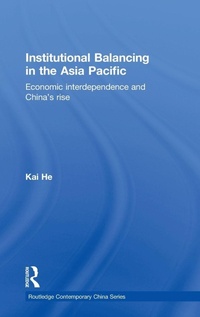
Institutional Balancing in the Asia Pacific
Economic interdependence and China's rise
1st Edition
Published on 4. November 2008
Book
Hardback
224 pages
978-0-415-46952-4 (ISBN)
Description
This book examines the strategic interactions among China, the United States, Japan, and Southeast Asian States in the context of China's rise and globalization after the cold war. Engaging the mainstream theoretical debates in international relations, the author introduces a new theoretical framework-institutional realism-to explain the institutionalization of world politics in the Asia-Pacific after the cold war.
Institutional realism suggests that deepening economic interdependence creates a condition under which states are more likely to conduct a new balancing strategy-institutional balancing, i.e., countering pressures or threats through initiating, utilizing, and dominating multilateral institutions-to pursue security under anarchy. To test the validity of institutional realism, Kai He examines the foreign policies of the U.S., Japan, the ASEAN states, and China toward four major multilateral institutions, Asia-Pacific Economic Cooperation (APEC), the Association of Southeast Asian Nations (ASEAN) Regional Forum (ARF), ASEAN Plus Three (APT), and East Asian Summit (EAS). Challenging the popular pessimistic view regarding China's rise, the book concludes that economic interdependence and structural constraints may well soften the "dragon's teeth." China's rise does not mean a dark future for the region.
Institutional Balancing in the Asia Pacific will be of great interest to policy makers and scholars of Asian security, international relations, Chinese foreign policy, and U.S. foreign policy.
Institutional realism suggests that deepening economic interdependence creates a condition under which states are more likely to conduct a new balancing strategy-institutional balancing, i.e., countering pressures or threats through initiating, utilizing, and dominating multilateral institutions-to pursue security under anarchy. To test the validity of institutional realism, Kai He examines the foreign policies of the U.S., Japan, the ASEAN states, and China toward four major multilateral institutions, Asia-Pacific Economic Cooperation (APEC), the Association of Southeast Asian Nations (ASEAN) Regional Forum (ARF), ASEAN Plus Three (APT), and East Asian Summit (EAS). Challenging the popular pessimistic view regarding China's rise, the book concludes that economic interdependence and structural constraints may well soften the "dragon's teeth." China's rise does not mean a dark future for the region.
Institutional Balancing in the Asia Pacific will be of great interest to policy makers and scholars of Asian security, international relations, Chinese foreign policy, and U.S. foreign policy.
More details
Series
Language
English
Place of publication
London
United Kingdom
Publishing group
Taylor & Francis Ltd
Target group
College/higher education
Illustrations
5 s/w Tabellen, 11 s/w Abbildungen, 11 s/w Zeichnungen
5 Tables, black and white; 11 Line drawings, black and white; 11 Illustrations, black and white
Dimensions
Height: 240 mm
Width: 161 mm
Thickness: 17 mm
Weight
508 gr
ISBN-13
978-0-415-46952-4 (9780415469524)
Copyright in bibliographic data and cover images is held by Nielsen Book Services Limited or by the publishers or by their respective licensors: all rights reserved.
Schweitzer Classification
Other editions
Additional editions
Book
06/2012
1st Edition
Routledge
€68.20
Shipment within 15-20 days
E-Book
11/2008
Routledge
€61.99
Available for download
E-Book
11/2008
Routledge
€61.99
Available for download
Person
Kai He is an Assistant Professor of Political Science at Utah State University.
Content
1. China's Rise and the Institutionalization of Security in the Asia-Pacific 2. China's Institutional Balancing: Peaceful Rise? 3. America's Institutional Balancing: Pragmatic Engagement 4. Japan's Institutional Balancing: Normalizing Foreign Policy 5. ASEAN's Institutional Balancing: Seeking Security among Giants 6. Institutional Balancing and the Rise of China. Methodological Appendix: Comparative Case Studies and Qualitative Methods